Some surprises make you smile.
Others leave you wondering whether they’re trying to tell you something.
When my husband left on what was supposed to be a routine week-long business trip, I expected life at home to become quieter than usual. We’d been married for nearly fifteen years, and although we were both independent, the house always felt different when one of us was away.
The mornings seemed calmer.
Dinner conversations disappeared.
Even our golden retriever wandered through the hallway as though searching for the familiar footsteps that usually greeted him after work.
I planned to keep busy.
I organized closets I had been ignoring for months, caught up on reading, and promised myself I’d finally repaint the guest bedroom.
Instead, my week took a completely unexpected turn.
The morning after my husband left, the doorbell rang promptly at nine o’clock.
Standing on the porch was a florist carrying an enormous bouquet.
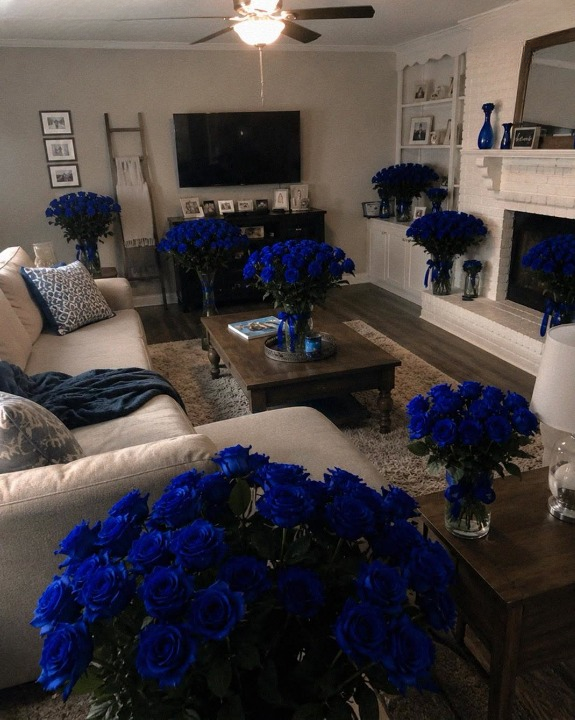
Forty brilliant blue roses.
I had never seen roses that color before.
Their deep blue petals looked almost unreal, arranged perfectly with silver eucalyptus leaves and elegant wrapping paper.
“They’re beautiful,” I said.
The delivery driver smiled.
“Have a wonderful day.”
I searched for a card.
There wasn’t one.
Only my name neatly printed on the delivery label.
Naturally, I assumed my husband had arranged a surprise before leaving.
He enjoyed thoughtful gestures, even if he rarely admitted to planning them.
The flowers brightened the dining room instantly.
Throughout the day I smiled every time I walked past them.
The next morning, precisely at nine o’clock, the doorbell rang again.
Another bouquet.
Exactly the same.
Forty blue roses.
No card.
No explanation.
I laughed quietly to myself.
Perhaps he’d arranged a different bouquet for each day of the trip.
That evening I called him.
“Thank you,” I said.
“For what?”
“The flowers.”
There was a pause.
“What flowers?”
“The blue roses.”
Another pause.
“I honestly don’t know what you’re talking about.”
I smiled.
“Very funny.”
“I’m serious.”
His confusion sounded genuine.
“If I were sending flowers, I’d definitely include a note.”
We both laughed about the mystery before changing the subject.
Still, something about his reaction stayed with me.
On the third morning, another bouquet appeared.
Nine o’clock.
Forty blue roses.
Exactly like the others.
This time curiosity replaced amusement.
Whoever arranged these deliveries had clearly planned them carefully.
I decided to call the florist.
After thanking them for the beautiful arrangements, I politely asked whether they could identify the sender.
The employee apologized.
“I’m afraid customer information is confidential.”
“Could you at least tell me whether all the deliveries were ordered together?”
She checked the computer.
“Yes.”
“They were scheduled several months ago.”
“Several months?”
“That’s correct.”
The call ended with more questions than answers.
That afternoon I looked around my dining room.
Three large bouquets now decorated the table.
The blue flowers looked stunning.
Yet their growing number made the room feel strangely unfamiliar.
On the fourth day, I found myself counting the roses.
Forty.
Exactly forty again.
Why not thirty-nine?
Or forty-five?
Why exactly forty every single day?
Surely the number meant something.
I searched online.
Various cultures associated flowers with different celebrations, anniversaries, and symbolic meanings.
Blue roses themselves often represented uniqueness, mystery, or achieving something considered impossible.
The number forty appeared repeatedly in history, literature, and traditions across many cultures.
Some interpretations described reflection.
Others connected it with periods of transition, remembrance, or important life milestones.
None of the explanations completely fit my situation.
That evening I called my grandmother.
She had always loved gardening and knew far more about flowers than anyone else in our family.
“Blue roses?” she repeated thoughtfully.
“That’s unusual.”
“I know.”
“And there are exactly forty every day.”
She became quiet.
“In some families and traditions,” she explained gently, “specific numbers are chosen for symbolic reasons.”
“It doesn’t always mean the same thing.”
“It depends entirely on who sends them.”
That answer only deepened the mystery.
“Do you know who arranged them?”
“I wish I did.”
She suggested something simple.
“Before worrying, try learning who placed the order.”
It sounded reasonable.
The following morning I called my husband again.
This time his phone went directly to voicemail.
I assumed he was attending meetings.
Several hours later I tried once more.
Still unavailable.
Again, I thought little of it.
Business travel often meant unpredictable schedules.
Later that afternoon I attempted calling the hotel where he had originally planned to stay.
After confirming my identity, the receptionist politely informed me that he had already completed his stay earlier than expected.
I was surprised.
“He checked out?”
“Yes.”
“I thought he was there for the entire week.”
“I’m sorry,” she replied kindly.
“That’s all I’m able to confirm.”
She couldn’t discuss guest privacy further.
Nothing she said suggested anything alarming.
Still, I realized I no longer knew exactly where he was.
Combined with the mysterious flowers, my imagination began filling gaps that facts hadn’t yet answered.
By the fifth morning, the bouquets lined nearly the entire dining room.
Neighbors walking past the front windows probably wondered whether I had opened a flower shop overnight.
Friends joked that I had a secret admirer.
I laughed politely.
Inside, however, I wanted answers.
That afternoon I reviewed every possibility.
Perhaps a family member had arranged the surprise.
Perhaps my husband had forgotten scheduling the deliveries months earlier.
Maybe the florist had accidentally delivered someone else’s order.
Each explanation seemed possible.
None fully explained everything.
Finally I contacted the local non-emergency police line—not because I believed a crime had occurred, but because I wanted advice about repeated anonymous deliveries and whether they recommended documenting the situation.
An officer stopped by later that day.
He listened patiently while I explained everything.
The flowers.
The anonymous order.
The prepaid deliveries.
The unanswered questions.
He walked around the dining room, smiling slightly.
“I have to admit,” he said, “this is one of the more unusual calls I’ve received.”
He carefully photographed the delivery labels.
“Anonymous gifts aren’t necessarily cause for concern,” he explained.
“But keeping records is always a good idea if something unexpected continues.”
He encouraged me to notify the florist if additional unusual communication appeared and reminded me to contact authorities immediately if I ever felt unsafe.
His calm professionalism reassured me.
Later that evening my husband finally called.
“I’m sorry,” he said.
“The conference schedule changed unexpectedly, and I’ve been traveling between meetings.”
I told him everything.
He listened without interrupting.
“Let’s solve this together when I get home.”
Two days later he returned.
Before unpacking his suitcase, he stood staring at the dining room table now completely surrounded by elegant blue bouquets.
“I understand why you were puzzled,” he admitted.
The following morning we visited the florist together.
This time, with identification and additional documentation, the manager reviewed archived order information more carefully.
After several minutes she smiled.
“I think we’ve solved the mystery.”
Months earlier, my husband had actually visited the shop while ordering flowers for our wedding anniversary.
During that conversation he casually mentioned that blue roses had always been my favorite because they reminded me of a fairy tale my grandmother used to read when I was little.
The florist, inspired by the story, had entered sample scheduling information while demonstrating future delivery options for milestone celebrations.
Unfortunately, during a later software migration, the demonstration order had accidentally remained active and processed automatically.
The manager apologized sincerely.
“We’ve never seen this happen before.”
She immediately refunded every charge and accepted full responsibility.
My husband laughed.
“So I accidentally became the world’s most consistent anonymous florist.”
The entire situation transformed from unsettling mystery into memorable family story.
Yet something unexpected remained.
Those flowers had accomplished more than confusing us.
They reminded us how quickly assumptions can replace facts.
How easily unanswered questions grow larger inside our imagination.
And how important open communication becomes whenever something unusual happens.
Before leaving, the florist handed us one final bouquet.
“This one,” she smiled, “is actually from us.”
Attached was a handwritten card.
“May these flowers always remind you that even unexpected moments can bloom into wonderful memories.”
Today, whenever friends visit our home and notice photographs from that unusual week, they always ask the same question.
“Why blue roses?”
I simply smile.
Because sometimes life’s greatest stories begin with something as simple as a doorbell ringing at exactly nine o’clock each morning.
And sometimes what first appears mysterious turns into a reminder that patience, communication, and a willingness to seek the truth are far more powerful than fear or assumptions.
Those forty blue roses no longer remind me of uncertainty.
They remind me that every mystery deserves thoughtful answers—and that even the most unexpected experiences can become cherished stories for years to come.