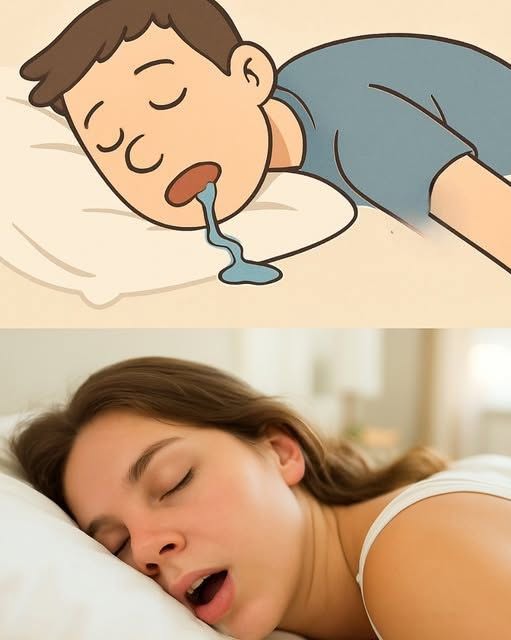
Have you ever woken up in the morning and noticed a small wet spot on your pillow?
If so, you’re certainly not alone.
Drooling during sleep is something that happens to many people, and in most cases, it isn’t a reason to panic. While dramatic social-media headlines sometimes suggest that waking up with drool automatically means something is happening inside your brain, the reality is considerably more complicated.
Saliva is a normal and necessary part of the human body. We produce it throughout the day and night, and our bodies have natural mechanisms for swallowing it. During sleep, however, many of those processes slow down or change.
Depending on your sleeping position, breathing habits, nasal congestion, and other everyday factors, saliva can occasionally escape from the mouth while you’re asleep.
So what causes it?
And when, if ever, should frequent nighttime drooling be discussed with a healthcare professional?
Let’s take a closer look.
Why Do We Produce Saliva?
Saliva has several important jobs.
It helps keep the mouth moist, makes swallowing easier, supports digestion, and contributes to oral health. Saliva also helps protect tissues inside the mouth.
Your body produces saliva continuously, although the amount can vary throughout the day.
During waking hours, you’re usually swallowing saliva automatically without thinking about it.
Sleep is different.
Your swallowing frequency generally decreases while you’re asleep, and the muscles involved in keeping the mouth closed may become more relaxed.
That combination can occasionally result in saliva collecting around the mouth and eventually reaching your pillow.
Your Sleeping Position Can Make a Difference
One of the simplest explanations for nighttime drooling is sleeping position.
People who sleep on their side or stomach may be more likely to notice saliva on their pillow because gravity can make it easier for saliva to move toward the edge of the mouth.
By contrast, sleeping on your back may reduce this effect for some people, although everyone is different.
This is one reason why a person might notice drooling more frequently after changing their sleeping position.
It’s also possible to experience it only occasionally rather than every night.
Nasal Congestion May Play a Role
Another common factor is difficulty breathing comfortably through the nose.
When your nose is congested because of a cold, seasonal allergies, or another temporary problem, you may naturally breathe through your mouth more often.
Keeping the mouth open during sleep can make drooling more noticeable.
This doesn’t necessarily mean anything serious is happening.
A stuffy nose can be enough to temporarily change your normal breathing pattern.
Once the congestion improves, the nighttime drooling may decrease as well.
Allergies Can Affect Your Sleep Habits
Seasonal allergies can cause several symptoms that influence how comfortably you sleep.
A blocked or runny nose, sneezing, throat irritation, and other symptoms may encourage mouth breathing.
If you notice that drooling becomes more common during particular seasons, consider whether you also experience allergy symptoms around the same time.
That pattern can provide a more practical explanation than assuming the drooling itself is a warning sign.
Mouth Breathing Is Another Possible Explanation
Some people naturally breathe through their mouths while sleeping.
This may happen occasionally or regularly.
Mouth breathing can be associated with nasal congestion, sleeping position, certain anatomical factors, or other circumstances affecting comfortable nasal breathing.
Because the mouth remains open more often, saliva may be more likely to escape.
If you frequently wake with a dry mouth in addition to noticing drooling, it may be useful to pay attention to your nighttime breathing habits.
What About Sleep Quality?
Drooling itself isn’t necessarily a sign of poor sleep.
However, if it occurs alongside other persistent nighttime symptoms, the broader pattern may deserve attention.
For example, some people experience loud snoring, frequent awakenings, morning headaches, persistent daytime tiredness, or noticeable pauses in breathing during sleep.
Those symptoms can have several possible causes.
If you regularly experience them, it’s reasonable to discuss them with a healthcare professional.
The important point is that the drooling alone doesn’t establish a diagnosis.
Does Drooling Mean Your Brain Is Not Working Properly?
This is where many online claims become misleading.
The brain plays an important role in controlling swallowing and many other automatic bodily functions.
But that doesn’t mean ordinary drooling during sleep is evidence of a brain disorder.
A person can drool occasionally while sleeping and be completely healthy.
There are neurological conditions that can affect swallowing, muscle control, or saliva management, but those conditions generally involve additional symptoms and require proper medical evaluation.
A wet pillow by itself isn’t enough to identify a neurological problem.
Why Viral Headlines Can Be Confusing
Online content often takes a small piece of legitimate information and turns it into an alarming conclusion.
For example, it’s true that certain medical conditions can affect swallowing.
It’s also true that the nervous system controls many automatic functions.
But it doesn’t follow that everyone who drools in their sleep has a neurological issue.
That’s an important distinction.
When reading health information online, be cautious about headlines that use phrases such as “this is a clear sign,” “your body is warning you,” or “you need to know this immediately.”
Health symptoms rarely have only one possible explanation.
When Occasional Drooling Is Usually Not Concerning
If you occasionally wake up with a little saliva on your pillow, there may be no reason to be alarmed.
It could simply be related to your sleeping position.
Perhaps you were unusually tired.
Maybe you had temporary nasal congestion.
Maybe you slept with your mouth slightly open.
Or perhaps it happened without any obvious explanation at all.
Bodies aren’t perfectly predictable.
An isolated occurrence doesn’t necessarily mean anything is wrong.
When You May Want to Talk to a Professional
Frequent or newly occurring drooling may be worth discussing with a healthcare professional if it is accompanied by other persistent or concerning symptoms.
For example, seek appropriate medical advice if you notice significant difficulty swallowing, repeated choking or coughing while eating or drinking, unexplained changes in speech, persistent weakness, or other unusual neurological symptoms.
Likewise, if nighttime drooling is accompanied by significant snoring, gasping, breathing pauses, or severe daytime sleepiness, mention those symptoms when speaking with a healthcare professional.
The goal isn’t to assume that something serious is happening.
The goal is simply to understand the overall pattern.
Pay Attention to Changes Rather Than One Isolated Night
One useful approach is to consider whether the behavior is new or has been happening for years.
If you’ve always occasionally drooled while sleeping and otherwise feel well, that may be very different from suddenly developing frequent drooling alongside several other changes.
Keeping track of patterns can be helpful.
You might notice that it happens more often when you have allergies.
Perhaps it occurs when you sleep on your side.
Maybe it becomes more noticeable when you’re extremely tired.
These observations can provide useful context.
Simple Habits That May Help
If nighttime drooling bothers you, a few everyday changes may be worth trying.
First, consider your sleeping position.
Some people find that adjusting their position reduces saliva leakage.
You can also pay attention to nasal congestion and address ordinary causes of a blocked nose appropriately.
Keeping your sleeping environment comfortable may also help.
If allergies are affecting your sleep, discuss suitable management options with a healthcare professional or pharmacist.
Good sleep habits are beneficial regardless of whether drooling is an issue.
Don’t Become Alarmed by Every Health Claim Online
Modern social media makes it easy for health information to spread rapidly.
Unfortunately, popularity doesn’t guarantee accuracy.
A post may receive thousands of shares even if its central claim is exaggerated.
That doesn’t mean every online health article is wrong.
It simply means readers should evaluate health claims carefully.
Look for reputable medical sources.
Consider whether the claim acknowledges other possible explanations.
And be cautious when a headline suggests that one common symptom automatically means you have a serious condition.
Your Body Has Many Normal Variations
People differ in countless ways.
Some people sweat more than others.
Some people snore occasionally.
Some wake up frequently during the night.
Some sleep very deeply.
Some naturally breathe through their mouths.
And some occasionally drool.
A difference from someone else’s sleep habits isn’t automatically a sign of illness.
The important thing is whether there are persistent changes or additional symptoms that affect your health and daily life.
Sleep Is a Complex Process
While you’re asleep, your body doesn’t simply “switch off.”
Your brain remains active through different stages of sleep, while breathing, heart rate, muscle activity, and other processes change throughout the night.
Because these systems operate differently during sleep, things that happen automatically while you’re awake may not work in exactly the same way.
Swallowing is one example.
You don’t consciously think about swallowing saliva during the day.
At night, the frequency of swallowing decreases, and your mouth and facial muscles may relax.
That’s part of the reason a little saliva can sometimes end up outside the mouth.
The Bigger Picture Matters
Rather than asking, “What does drooling mean?” it can be more useful to ask, “What else is happening?”
Are you sleeping comfortably?
Are you breathing normally?
Do you wake feeling rested?
Do you have significant difficulty swallowing?
Have you noticed other new symptoms?
These questions provide much more useful information than focusing on one isolated observation.
Final Thoughts
Waking up with some drool on your pillow can certainly be embarrassing or inconvenient, but it is also a relatively common experience.
In many cases, it can be explained by ordinary factors such as sleeping position, relaxed muscles, mouth breathing, nasal congestion, allergies, or simply the normal changes that occur during sleep.
Most importantly, drooling during sleep does not automatically mean that your brain is experiencing a problem.
If the behavior is persistent, suddenly changes, or occurs alongside other concerning symptoms, it’s sensible to speak with a qualified healthcare professional who can consider the complete picture.
Instead of allowing an alarming headline to create unnecessary worry, pay attention to your overall health and how you feel.
Sometimes a wet pillow is simply a wet pillow.
And understanding the difference between a common sleep habit and a genuine health concern can help you approach your health with curiosity rather than fear.