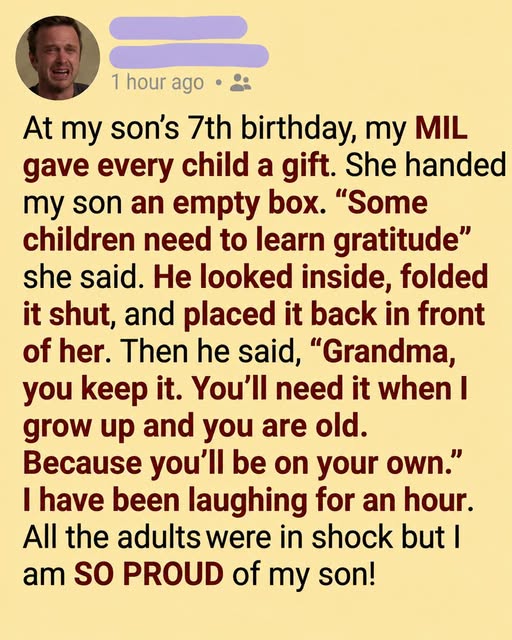
At My Son’s 7th Birthday, My Mother-in-Law Gave Every Child a Gift—Except Him
My son’s seventh birthday was supposed to be one of the happiest days of his young life. I had spent weeks planning every little detail, from the colorful decorations hanging across the backyard to the chocolate cake he had excitedly chosen himself. But by the end of the afternoon, one cruel act had turned what should have been a joyful celebration into a memory none of us would ever forget.
My mother-in-law arrived carrying a large shopping bag filled with beautifully wrapped presents. At first, I thought it was a thoughtful gesture. She had always enjoyed being the center of attention at family gatherings, and I assumed she wanted to make the children feel special.
One by one, she called the children over and handed each of them a gift.
There were toy cars, dolls, art kits, puzzles, and boxes of colorful building blocks. Every child squealed with excitement as they tore through the wrapping paper. Their parents smiled, and the backyard filled with laughter and happy chatter.
Every child received something.
Every child except my son.
When the last present had been distributed, my seven-year-old stood beside the birthday table, watching his cousins and friends compare their gifts. He looked from their excited faces to the empty shopping bag in his grandmother’s hands.
Then my mother-in-law reached into the bag one final time.
She pulled out a small cardboard box.
It was plain, unwrapped, and completely empty.
She walked toward my son and placed it in his hands.
“There you go,” she said with a thin smile. “Something special for the birthday boy.”
At first, my son didn’t understand. He turned the box over, examining its sides, and carefully lifted the lid. He looked inside.
There was nothing.
He checked again, as if perhaps a small toy had slipped beneath a folded piece of cardboard. Then he looked up at his grandmother, his innocent eyes searching her face for an explanation.
She simply shrugged.
“Some children need to learn gratitude,” she announced loudly enough for everyone nearby to hear. “Not everything in life is going to be handed to you. Sometimes, you need to appreciate whatever you receive.”
The laughter around the backyard faded.
Several parents exchanged uncomfortable glances. One of my son’s cousins stopped playing with a new toy. Another child slowly lowered a brightly colored gift box into their lap.
I felt my face grow hot with anger.
How could a grown woman deliberately humiliate a seven-year-old child on his birthday? And how could she do it so casually, as though she had just delivered some valuable lesson?
I stepped forward, ready to take the box from my son’s hands and tell my mother-in-law exactly what I thought of her behavior.
But before I could say a word, my son did something that stopped me completely.
He didn’t cry.
He didn’t shout.
He didn’t throw the box onto the ground or demand a real present.
Instead, he looked inside it one more time, gently folded the lid shut, and walked back toward his grandmother.
Then he placed the empty box on the table directly in front of her.
“Grandma,” he said quietly, “you can keep it.”
My mother-in-law raised an eyebrow.
“Why would I want an empty box?” she asked.
My son tilted his head slightly, considering her question with the seriousness only a child could bring to such a moment.
Then he answered.
“You’ll need it when I grow up.”
For a moment, nobody moved.
My mother-in-law’s smile disappeared.
“What exactly is that supposed to mean?” she demanded.
My son looked at her with an expression that was neither angry nor disrespectful. He simply seemed confused that she hadn’t understood.
“When I’m older,” he explained, “I’ll have a house and a family. I’ll buy presents for people I love. But if someone is mean to my children and makes them feel bad on their birthdays, I won’t give that person anything.”
He paused and glanced at the box.
“So you can keep this one. Then you’ll have something to open when you realize you don’t have a present from us anymore.”
The backyard fell completely silent.
I had heard children say surprisingly wise things before, but nothing had prepared me for the quiet honesty of my own son.
He hadn’t insulted his grandmother. He hadn’t called her names. He hadn’t even raised his voice.
He had simply taken her own gesture and shown her what it looked like from the other side.
My husband, who had been standing near the patio doors, finally stepped forward.
“Mom,” he said, his voice low and firm, “what were you thinking?”
My mother-in-law crossed her arms.
“Oh, don’t be so dramatic. It was a joke. Children are too sensitive these days. I was trying to teach him that he shouldn’t expect everything just because it’s his birthday.”
“His birthday is exactly the day he should feel celebrated,” my husband replied. “And he’s seven years old. What lesson do you think he was supposed to learn from being deliberately embarrassed in front of his friends?”
She rolled her eyes.
“You’re both making me sound like a terrible grandmother. I bought gifts for everyone, didn’t I? He received something too.”
“You gave him an empty box,” I said, unable to hold back any longer. “And then you used the moment to lecture him about gratitude. You didn’t teach him to appreciate what he has. You taught him that someone he trusts is willing to hurt his feelings for entertainment.”
She looked at me as though I had personally offended her.
“You always take everything the wrong way,” she snapped. “This is why children grow up spoiled. Parents like you refuse to let anyone discipline them.”
“Discipline?” I repeated. “He’s not your employee, and this isn’t a classroom. He’s your grandson, celebrating his seventh birthday.”
A few of the other parents quietly nodded.
My mother-in-law noticed.
That seemed to bother her more than anything I had said.
She had expected laughter, perhaps a few amused comments, and certainly no challenge to her authority. She had expected my son to cry or become angry, giving her an opportunity to accuse him of being ungrateful.
Instead, he had remained calm.
And now the adults around her were beginning to see the cruelty behind her little performance.
My son, meanwhile, had returned to his friends.
He picked up a piece of birthday cake and offered half of it to a younger cousin who was still holding a toy car. Within minutes, the children were laughing again, their attention shifting back to the party.
But I couldn’t stop thinking about what had happened.
My son had been hurt. I could see it in the way he occasionally glanced toward the table where the empty box remained. He was trying to behave as though nothing unusual had happened, perhaps because he didn’t want to ruin his own birthday.
That realization hurt me more than his grandmother’s words.
Children often don’t have the language to explain humiliation. They don’t always know how to describe the strange feeling of being singled out by someone they love. Sometimes they simply absorb the moment and wonder whether they somehow deserved it.
I crouched beside my son while the other children played.
“Sweetheart,” I whispered, “you know you didn’t do anything wrong, don’t you?”
He nodded.
“Grandma was probably trying to teach me something,” he said thoughtfully. “But I don’t think being mean is a good way to teach people.”
I swallowed the lump in my throat.
“No,” I told him. “It isn’t.”
He looked at me for a moment before asking the question I had been dreading.
“Mom, does Grandma not like me?”
My heart broke.
I pulled him into my arms and held him close.
“Grandma’s choices are her responsibility,” I explained gently. “They don’t decide how lovable you are. You are kind, thoughtful, and important. You never have to earn love by accepting someone else’s cruelty.”
He rested his head against my shoulder.
“Okay,” he whispered.
Then he returned to his friends, and I watched him run across the grass with the same enthusiasm he had shown that morning when he woke up excited about turning seven.
I promised myself that his grandmother’s behavior would never become the measure of his worth.
The party continued, but something between the adults had changed.
My husband barely spoke to his mother for the remainder of the afternoon. When she attempted to join a conversation near the kitchen, he answered her questions politely but without his usual warmth.
Eventually, she approached us while the children were gathered around the cake.
“I hope you’re satisfied,” she said sharply. “You’ve made me look like a monster in front of everybody.”
My husband stared at her.
“No, Mom. You did that yourself.”
She looked stunned.
“I was only trying to make a point.”
“Then explain the point,” he said. “What exactly did our son need to learn today?”
She opened her mouth, then closed it again.
“Children shouldn’t expect gifts,” she finally muttered.
“He didn’t demand a gift,” my husband replied. “He didn’t complain when the others received theirs. You were the one who decided to single him out. You could have given him a book, a small toy, or nothing at all without turning it into a public humiliation. Instead, you made sure everyone watched.”
My mother-in-law glanced toward the children.
“He’ll forget about it by tomorrow.”
“Maybe,” I said. “But even if he forgets the details, he may remember how you made him feel. And I won’t pretend that was acceptable just to protect your pride.”
She shook her head in disbelief.
“You’re acting as though I’ve done something unforgivable.”
“No,” my husband answered. “We’re asking you to acknowledge that you hurt a child. That shouldn’t be so difficult.”
For the first time that afternoon, she had no immediate response.
She picked up her handbag and announced that she was leaving.
Nobody tried to stop her.
As she walked toward the gate, she passed the gift table. The empty cardboard box was still sitting exactly where my son had placed it.
She glanced at it but didn’t pick it up.
Then she left.
The moment the gate closed, I felt a strange mixture of relief and sadness. I was relieved that the confrontation was over, but sad that a family celebration had reached this point at all.
I wished my son could have spent the entire day thinking about cake, balloons, and presents instead of learning that adults could sometimes behave unfairly.
That evening, after the last guests had gone home and the decorations were beginning to sag, I found my son sitting on the living-room floor, arranging his new toys.
He had received plenty of lovely gifts from his friends and relatives. Yet beside him sat a small handmade birthday card that one of his classmates had drawn.
I sat down next to him.
“Did you have a good birthday?” I asked.
He smiled.
“Yeah. The cake was really good. And I like the dinosaur.”
I smiled back.
“I’m glad.”
He hesitated before adding, “I didn’t like the box, though.”
“I know, sweetheart.”
“I thought Grandma might have forgotten to put the present inside,” he explained. “That’s why I checked twice.”
I put an arm around his shoulders.
“I’m sorry she did that to you.”
He leaned against me.
“It’s okay, Mom. I have lots of toys already. I don’t need another one.”
Then he looked up at me with a seriousness that made me catch my breath.
“But if I have children someday, I’m not going to make them feel small just because I can.”
I kissed the top of his head.
“That’s a wonderful promise to make.”
He returned to arranging his dinosaurs, apparently satisfied with the conversation.
I stayed beside him for a while, thinking about the difference between having possessions and understanding generosity.
My son had been given an empty box, but he hadn’t responded with greed. He hadn’t demanded compensation or insisted that he deserved more than the other children.
He had recognized that the problem wasn’t the missing toy.
The problem was the intention behind the gesture.
A simple, inexpensive present could have delighted him. Even a sincere explanation that his grandmother couldn’t afford a gift would have been understandable. But she hadn’t offered either of those things. She had chosen to make him feel less important than everyone else, then dressed her cruelty up as a lesson in gratitude.
And in doing so, she had revealed something about herself that no expensive gift could conceal.
Over the following days, my husband received several messages from his mother. At first, she complained that we had embarrassed her. Then she accused us of turning our son against her. Finally, she insisted that the entire family had misunderstood her intentions.
What she never did was apologize.
She never called her grandson to ask how he was feeling. She never acknowledged that a seven-year-old child shouldn’t have been made the target of a joke at his own birthday party.
My husband eventually sent her a simple message explaining that she would need to take responsibility for her behavior before we could move forward as a family.
He wasn’t demanding an expensive present or a grand public apology.
He wanted her to understand that love and respect couldn’t be separated from the way she treated the people around her.
For a while, she refused.
We didn’t chase her.
Our home remained open to family members who treated our children with kindness, but we no longer felt obligated to pretend everything was fine whenever someone crossed a line.
Weeks later, the birthday incident was still discussed among some relatives. A few thought we had been too harsh. Others admitted that they had been uncomfortable watching the scene unfold but hadn’t known how to intervene.
One aunt told me she couldn’t stop thinking about my son’s response.
“He was more gracious than most adults would have been,” she said. “He didn’t try to humiliate her back. He just told her what her actions meant to him.”
I thought about that conversation for a long time.
Children learn from what we do far more than from what we say. We can lecture them about gratitude, kindness, and respect, but those lessons become meaningless when our own behavior contradicts them.
My mother-in-law had wanted to teach my son that he wasn’t entitled to gifts.
Instead, she had shown him that receiving a present was less important than being treated with dignity.
And my son, without planning it or trying to win an argument, had reminded all of us that kindness is not measured by the price of a gift.
It is measured by the care behind it.
On his eighth birthday, I don’t know whether my mother-in-law will be invited. That decision will depend on whether she can recognize the harm she caused and make a genuine effort to repair the relationship.
What I do know is that my son will never be taught to accept humiliation simply because it comes from an older relative.
Respect for elders does not mean excusing every action they take. Gratitude does not mean remaining silent when someone treats you unfairly. And family ties should never be used as permission to hurt a child.
I still remember the sight of that plain cardboard box sitting on the birthday table, surrounded by colorful wrapping paper and half-opened presents.
It was such a small object, yet it exposed a much bigger truth.
My mother-in-law had believed that an empty box would make my son feel insignificant.
Instead, it gave him a chance to show us the kind of person he was becoming.
He had answered cruelty without cruelty. He had stood up for himself without shouting. And he had understood, even at seven years old, that a gift means very little when it is given without love.
His grandmother had handed him an empty box.
But the lesson she intended to teach was not the lesson he learned.
And the words he spoke that afternoon will stay with me for years:
“Grandma, you keep it. You’ll need it when I grow up.”
Because sometimes, the most powerful response to an act of unkindness isn’t anger or revenge.
Sometimes, it is simply showing someone the future their own choices are creating.