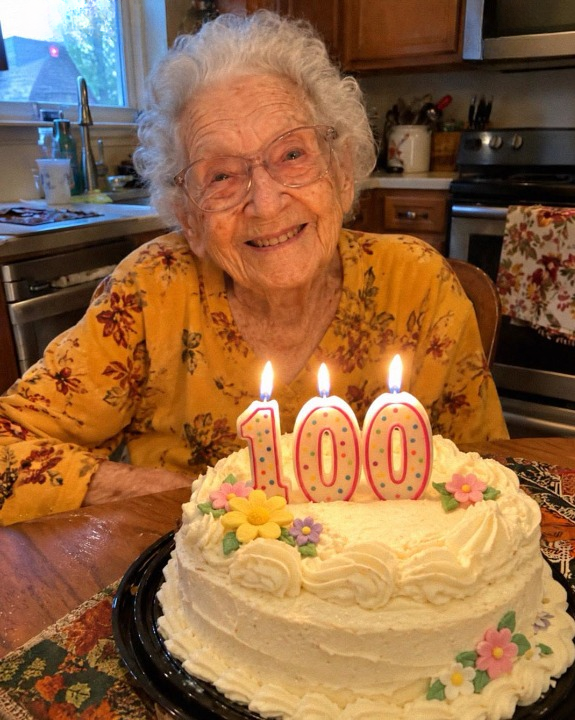
My grandmother, Evelyn, was turning 100 years old when I witnessed something I will never forget.
She had spent a century loving her family, making sacrifices, and putting everyone else’s needs before her own. Yet on the evening when her greatest wish was finally coming true—having all her children and grandchildren gathered under one roof—her six children began arguing about who would inherit her house after she was gone.
I watched my grandmother sit quietly at the head of the table while the people she had devoted her life to discussed her future as though she were no longer part of it.
Her eyes filled with tears.
That was the moment I decided I could not remain silent any longer.
I walked into the next room, returned carrying a large wooden box, and placed it in the center of the table.
The room fell silent.
When my uncles and aunts saw what was inside, their expressions changed completely.
One of them whispered, “How could you do this to us?”
But before I explain what happened that night, you need to understand who my grandmother was and why that house meant so much to her.
The Woman Who Gave Everything to Her Family
My grandmother, Evelyn, was the strongest person I had ever known.
She married my grandfather when they were young, and together they built a modest house that eventually became the heart of their family. They worked hard to create a comfortable home, believing that their children deserved a safe place where they would always belong.
Then tragedy changed everything.
My grandfather died while their six children were still young. Overnight, Grandma became both parents to a large family, with responsibilities that would have overwhelmed many people.
But she refused to give up.
She worked two jobs whenever she could find the hours. Sometimes she took additional work to cover school expenses, groceries, heating bills, and the unexpected costs that seemed to appear every month.
She rarely bought anything for herself.
When one child needed new shoes, she found the money. When another needed books for school, she made sure they had them. If someone became sick, she stayed awake through the night, checking their temperature and offering whatever comfort she could.
The house was never luxurious, but it was filled with warmth.
There were birthday cakes made from inexpensive ingredients, family dinners around a crowded table, and evenings when Grandma told stories until the children finally fell asleep.
She made a difficult life feel safe.
As the years passed, all six children grew up and eventually left home. They found jobs, married, started families, and built lives of their own.
Grandma celebrated every achievement.
She attended weddings whenever possible, welcomed new grandchildren, and helped her children through difficult moments. Even after they became adults, she continued to be the person they called when they needed advice or reassurance.
She never seemed to stop being their mother.
And she never asked for much in return.
The Grandmother Who Was Always There
I was one of the grandchildren who grew up spending time at Grandma’s house.
When my parents worked long hours, she often looked after me. She helped me with schoolwork, made my favorite meals, and listened patiently whenever I needed to talk.
I remember sitting beside her in the kitchen while she prepared dinner.
She would ask about my day, remembering even the smallest details from our previous conversations.
If I was upset, she noticed.
If I was excited about something, she celebrated with me.
And if I made a mistake, she corrected me gently without making me feel that I was a disappointment.
To me, Grandma’s house was more than a building. It was the place where I always felt welcome.
Unfortunately, as the family grew older, visits became less frequent.
My uncles and aunts moved to different cities. Their children grew up, work became demanding, and holidays filled with competing plans.
At first, everyone promised to visit soon.
Then weeks passed between visits, followed by months.
Grandma never complained openly. When I asked whether she felt lonely, she usually smiled and said that everyone was busy.
But I noticed the way she looked toward the front window whenever a car slowed down outside.
I noticed how carefully she prepared meals whenever one of her children promised to come.
And I noticed how disappointed she became when the visit was postponed.
Whenever I could, I went to see her.
We talked about the past, watched television, shared tea, and sometimes sat together without saying much at all.
She never asked me to do anything extraordinary.
She simply seemed happy that someone had come.
A Hundred Years of Memories
When Grandma’s 100th birthday approached, she became unusually excited.
For weeks, she talked about the celebration she wanted.
“I don’t need anything expensive,” she told me one afternoon. “I just want everyone here. All my children, all my grandchildren. I want to see everyone sitting around the same table again.”
I promised her we would do everything possible to make it happen.
She wanted the celebration in the house where she and Grandpa had raised their family. She wanted familiar dishes, old photographs, and enough chairs for everyone.
Most importantly, she wanted the evening to feel like the family gatherings of years ago.
I arrived several hours early to help prepare the food and arrange the dining room.
Grandma wore a beautiful dress she had kept for special occasions. Her silver hair was carefully arranged, and she looked happier than I had seen her in months.
“Do you think everyone will come?” she asked me while we arranged the plates.
“I think they’ll be here, Grandma.”
She smiled.
“I have so many memories in this house. I want them to remember them, too.”
I looked around the room.
The walls held old family photographs. The furniture showed signs of decades of use, and the wooden floors creaked in familiar places.
Every corner carried a story.
This was the house where her children had taken their first steps, celebrated birthdays, brought home school reports, and gathered around the Christmas tree.
It was also the house she had maintained through years of hard work and sacrifice.
That evening, it felt as though the past and present were coming together.
For a while, everything was exactly as Grandma had hoped.
When the Conversation Took a Painful Turn
One by one, the family members arrived.
There were hugs, greetings, and photographs. The grandchildren caught up with one another, and the dining room filled with conversation.
Grandma sat at the head of the table, smiling as she listened to everyone.
For the first hour, it was a beautiful celebration.
Then, while we were finishing dinner, one of my uncles leaned back in his chair and said something that changed the atmosphere completely.
“Well, shouldn’t we talk about what happens to the house when Mom is gone?”
I thought I had misunderstood him.
I looked toward Grandma.
Her smile faded slightly, but she remained quiet.
Another uncle nodded.
“We should probably make sure everything is settled before there are problems.”
One of my aunts immediately joined the conversation.
“I live closest to Mom. I’m the one who can check on her most easily. It makes sense for the house to go to me.”
My mother put down her fork.
“That isn’t fair. The house should be sold, and the money should be divided equally among the six of us.”
Within seconds, the conversation turned into an argument.
One person talked about who had visited Grandma most often. Another brought up old family disagreements. Someone else mentioned financial responsibilities and claimed that certain siblings had received more help over the years.
The birthday celebration was disappearing before my eyes.
I tried to interrupt.
“Can we please talk about something else? It’s Grandma’s birthday.”
Nobody listened.
They were too busy discussing who deserved the property.
Grandma sat silently at the head of the table, her hands folded in her lap.
She had invited her children to celebrate a century of life. Instead, they were debating what would happen to her belongings after her death.
Then one of my aunts said something that made my stomach tighten.
“Mom could die at any time. We need to make a decision now.”
I looked directly at Grandma.
Tears were gathering in her eyes.
She was alive, sitting among her children, listening to them argue over the house she still called home.
I could no longer pretend that this was an ordinary family disagreement.
The Box I Had Kept for Years
I pushed my chair back and stood up.
“Stop,” I said.
My voice was not particularly loud, but it was firm enough to make two people turn toward me.
“We are celebrating Grandma’s hundredth birthday. Can we please remember that?”
My uncle sighed.
“We’re only trying to be practical.”
“Practical?” I repeated. “She’s sitting right here. She asked for one evening with her family, and all you’ve talked about is who gets her house.”
My mother started to respond, but I raised my hand.
“Please. Just give me a minute.”
I walked out of the dining room and into the small sitting room at the back of the house.
In a cupboard beneath a shelf of old photographs, I had kept a wooden box for several years.
Grandma had given it to me when I was younger and asked me to keep it somewhere safe until the family needed to see its contents.
I had never forgotten that request.
I carried the box back to the dining room.
The conversation gradually stopped as everyone watched me approach.
I placed it carefully in the center of the table.
“What’s that?” one of my uncles asked.
“It’s something Grandma asked me to keep safe,” I answered. “I think it’s time everyone saw it.”
My grandmother looked at the box, and her expression changed.
For the first time since the argument began, she sat up straight.
“Are you sure, sweetheart?” she asked quietly.
I nodded.
“You shouldn’t have to listen to this tonight.”
I opened the lid.
Inside were several old family photographs, a handwritten letter, and a collection of documents Grandma had carefully preserved.
The room became completely silent.
My aunts and uncles leaned forward.
One of them picked up the letter and began reading.
As he reached the middle, his face changed.
He passed it to his sister.
She read a few lines, then looked at Grandma with tears in her eyes.
“What is this?” she whispered.
My uncle put the document back on the table.
Then he looked at me.
“How could you do this to us?”
I took a breath.
“I didn’t write it. Grandma did.”
The Truth Behind the Documents
The letter was written in Grandma’s own handwriting several years earlier.
It explained what the house meant to her and why she had preserved certain records.
She described the years she and Grandpa had spent building their life together, the sacrifices she had made to raise six children, and her hope that the family would always remember that a home was meant to provide shelter, belonging, and love.
She also made one thing very clear.
She did not want her children arguing over her property while she was still alive.
The documents included records of the home’s ownership and notes about arrangements she had discussed with a qualified professional. They were not a substitute for proper legal advice, but they showed that Grandma had already begun thinking carefully about her wishes.
She wanted her decisions respected, and she wanted any future arrangements handled transparently and according to the law.
The letter ended with a sentence I will never forget:
“I spent my life making sure my children always had a place to come home to. I hope you will remember that the most important part of this house was never its value. It was the family who lived inside it.”
Nobody spoke for several moments.
My aunt wiped her eyes.
My mother stared down at the table.
One of my uncles slowly pushed his chair back.
I looked at all six of them.
“Grandma doesn’t owe anyone a decision tonight,” I said. “She invited you here because she wanted to celebrate her life with you. Whatever happens to the house in the future should be discussed respectfully, with her wishes at the center of the conversation.”
Grandma reached for my hand.
“Thank you,” she whispered.
The Apology That Came Too Late for the Evening
The argument did not immediately disappear.
Some family members were embarrassed. Others seemed defensive. One aunt insisted that she had only been thinking about practical matters.
But nobody resumed arguing about who deserved the house.
My eldest uncle finally turned toward Grandma.
“Mom, I’m sorry,” he said. “We shouldn’t have brought this up today.”
Another aunt nodded.
“We were so focused on what might happen in the future that we forgot you were sitting right here.”
Grandma listened quietly.
“I know these things may need to be discussed someday,” she said. “I’m not asking you to ignore practical matters. But I am asking you to remember that I’m still your mother, and I’m still here.”
Her voice trembled slightly.
“I wanted all of you together because I don’t know how many more birthdays I’ll have. I wanted to hear your stories, see your faces, and know that you could still sit around one table without fighting.”
Several people lowered their heads.
My grandmother looked around the room.
“I don’t need you to agree about everything. I only need you to treat one another with kindness.”
For the first time that evening, everyone seemed to understand what she had been trying to tell them.
The house could wait.
The legal questions could be addressed later, carefully and properly.
But the opportunity to celebrate Grandma’s hundred years of life was happening right then.
And none of us could turn back the clock to do it again.
The Birthday We Should Have Remembered
After a while, my cousin brought out the birthday cake.
The candles were arranged carefully across the top, and everyone gathered around Grandma.
We sang together.
Grandma laughed when we struggled to finish the song in time, and she closed her eyes before blowing out the candles.
I watched her face as everyone applauded.
She looked tired, but she was smiling again.
Later, we sat together looking through the photographs from the wooden box. The pictures reminded everyone of childhood holidays, school celebrations, and ordinary afternoons in the house.
One photograph showed all six children standing beside Grandpa in the garden.
They were young, dressed in their best clothes, and smiling at the camera.
Grandma held the photograph for a long time.
“Your grandfather would have liked seeing all of you here,” she said.
The room grew quiet, but this time it was a peaceful silence.
We spent the rest of the evening telling stories about him and remembering the things Grandma had done for us.
For a few hours, we stopped thinking about property, money, and future arrangements.
We simply became a family again.
What I Learned From That Night
Grandma’s hundredth birthday taught me something I wish every family could understand.
Planning for the future is important. Discussing property, inheritance, and responsibilities can prevent misunderstandings. Those conversations should happen openly, respectfully, and with appropriate legal guidance.
But there is a difference between making thoughtful plans and treating a living person as though their life has already ended.
My grandmother had worked for decades to give her children security. She deserved to enjoy the home she had built without feeling that her children were waiting for the day they could divide it.
She deserved to be heard.
She deserved to have her wishes respected.
And, above all, she deserved a birthday celebration where she could feel loved rather than overlooked.
I still remember the moment I placed the wooden box on the table.
I had expected the documents to stop the argument, but I had not expected them to reveal how much everyone had forgotten about the woman sitting among them.
The house was valuable, certainly. It represented years of work and sacrifice.
But its greatest value was not the money someone might eventually receive from it.
It was the childhood memories, the family traditions, and the sense of belonging Grandma had worked so hard to create.
As I helped her get ready for bed that night, she squeezed my hand.
“Thank you for reminding them what matters,” she said.
I kissed her cheek.
“You did that yourself, Grandma. We just needed to listen.”
She smiled.
And as I left her room, I realized that the most important inheritance she could leave us had never been hidden in a box.
It was the example she had set throughout her life: work hard, care for others, remain generous when circumstances are difficult, and never forget that people matter more than possessions.
That was the legacy I wanted to carry forward.
And I hoped that, after everything that happened that evening, the rest of the family would carry it forward, too.