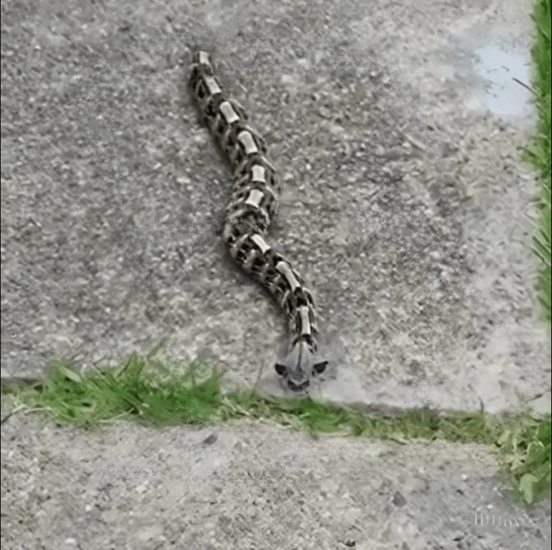
An Unexpected Snake Sighting in the Yard Highlights the Importance of Outdoor Safety
It began as an ordinary morning. I stepped outside, as I often did, expecting to see dew resting on the grass and the familiar quiet of the yard. The air was fresh, the surroundings were peaceful, and nothing seemed unusual. I had planned to spend a few minutes outside before beginning the day’s activities.
Then I noticed something near the edge of the yard.
At first glance, it looked like a fallen branch or a piece of garden debris. The object was partly hidden among the grass and leaves, making it difficult to identify from where I stood. I almost continued walking, but something about its shape caught my attention.
I stopped and looked more carefully.
What I had mistaken for an ordinary object appeared to be a snake.
The discovery immediately changed the way I viewed the familiar space around me. A yard that had seemed completely ordinary only moments earlier now required a little more caution. I did not know what species the snake belonged to, whether it was simply passing through, or whether it had settled beneath the nearby vegetation.
Instead of approaching it for a closer look, I kept my distance.
That decision was important. Snakes are often difficult to identify accurately without specialized knowledge, and some species can pose a serious risk to people or pets. Even a snake that appears calm may react defensively if someone gets too close or attempts to handle it.
The encounter became a reminder that outdoor spaces can occasionally bring people into contact with wildlife they do not recognize. It also demonstrated why remaining calm, observing from a safe distance, and avoiding unnecessary contact are sensible responses to an unexpected animal sighting.
A Familiar Yard Can Hide Unexpected Visitors
Many people think of their yards as predictable places. They may spend years mowing the lawn, tending flower beds, trimming shrubs, and walking along the same paths without encountering anything particularly unusual.
However, gardens and residential outdoor spaces are part of larger natural environments. Even properties surrounded by houses, fences, and paved roads can attract wildlife.
Snakes may enter yards while searching for food, shelter, water, or a suitable place to move between habitats. Depending on the region, they may travel through tall grass, pass beneath shrubs, hide near woodpiles, or follow small animals that provide a source of food.
A snake’s presence does not automatically mean that a property is unsafe. Many species avoid people whenever possible, and their appearance in a yard may be temporary. Nevertheless, identifying the animal correctly is important because different species have different behaviors and levels of medical significance.
The difficulty is that appearance alone can be misleading. Color patterns, body thickness, head shape, and markings vary among species, and similar-looking snakes may have very different characteristics. Lighting conditions, distance, and the animal’s position can make identification even more challenging.
For someone who encounters an unfamiliar snake, the safest approach is not to guess whether it is dangerous. Maintaining distance is more useful than trying to determine its identity at close range.
Why Snake Identification Requires Care
Snakes are found in a wide range of environments, including forests, grasslands, wetlands, deserts, agricultural areas, and suburban neighborhoods. Their appearance often reflects the environments in which they live.
Some species have noticeable patterns, while others have relatively uniform coloring. Certain snakes are slender and difficult to see among plants, while others have thicker bodies that make them more visible. Some move quickly when disturbed, whereas others may remain still or attempt to hide.
These differences can make identification challenging for anyone without relevant experience.
A photograph may provide useful information to a qualified wildlife professional, but even photographs can be misleading when the animal is partially concealed or viewed from an unusual angle. A picture taken from too close a distance may also place the photographer at unnecessary risk.
It is therefore unwise to approach an unfamiliar snake simply to capture a better image.
If documentation is necessary, it should only be attempted from a location that allows the observer to remain safely separated from the animal. In many situations, there is no need to photograph it at all. A general description of where it was seen and whether it has moved away may be sufficient when contacting a local wildlife authority.
People should also avoid relying on common myths about snake identification. For example, the shape of a snake’s head, its color, or its behavior cannot always establish whether it is venomous. Rules that seem reliable for one region may not apply elsewhere.
Local knowledge matters because the species present in one country or region can differ substantially from those found in another.
Understanding the World’s More Dangerous Snakes
Some snake species possess venom that can cause serious medical complications. Their potential effects depend on several factors, including the species involved, the amount of venom delivered, the location of the bite, and how quickly appropriate medical care is provided.
The term “dangerous snake” is often used broadly, but it can mean different things. Scientists may consider venom potency, the amount of venom an animal can deliver, its behavior, and the likelihood of human encounters. Public-health specialists may also consider how frequently bites occur and whether effective medical treatment is available.
These factors do not always produce a single universal ranking.
For instance, certain Australian snakes are known for highly potent venom, while other species are responsible for significant numbers of medically serious bites in areas where people regularly encounter them. The overall risk to a person depends on more than venom potency alone.
Geography is especially important. A species that is native to one part of the world may not occur naturally in another. Someone identifying a snake in a North American garden, for example, should not assume that it belongs to a species commonly associated with Australia, Africa, or Asia.
The animal must be evaluated in the context of the location where it was observed.
This distinction matters when reading stories about unusual wildlife encounters online. Headlines sometimes describe a snake as one of the most dangerous in the world without providing enough information to establish its species or explain the basis for that description.
A more informative account identifies the animal when reliable evidence is available, explains its natural range, and describes the circumstances of the encounter without exaggerating the risk.
In this case, the important lesson is not that every snake found in a yard represents a major threat. Rather, it is that an unfamiliar snake should be treated cautiously until a knowledgeable person can determine what it is.
Why Snakes Sometimes Appear Near Homes
The presence of a snake near a house may have several explanations. Understanding these possibilities can help homeowners make their outdoor spaces more organized without unnecessarily harming wildlife.
One common reason is the availability of food.
Snakes eat different prey depending on their species. Some feed primarily on rodents, others consume frogs or fish, and certain species specialize in lizards, insects, eggs, or other small animals.
A yard that regularly attracts mice or other prey may also attract snakes that hunt those animals. This does not mean that the snake was deliberately seeking contact with people. It may simply have been following a natural food source.
Shelter is another important factor.
Dense vegetation, loose stones, stacked lumber, discarded materials, and gaps beneath outdoor structures can create spaces where wildlife can hide. Depending on the climate, these areas may offer protection from predators, temperature extremes, and disturbance.
Water can also attract animals, especially during dry periods. Birdbaths, ponds, irrigation areas, and other sources of moisture may support a variety of wildlife. Snakes may visit these locations directly or encounter them while searching for prey.
Seasonal conditions influence movement as well. Temperature, rainfall, breeding activity, and changes in food availability can affect when snakes are active and where they travel.
These patterns vary by species and region, so homeowners should consult local wildlife resources rather than assuming that all snakes behave in the same way.
What to Do When You Find a Snake Outdoors
Discovering a snake unexpectedly can be unsettling, particularly when the animal is close to a doorway, walkway, or area used by children and pets. A calm, cautious response is the best starting point.
First, stop moving toward the animal. Do not attempt to touch it, pick it up, corner it, or encourage it to move. Give it room and slowly increase the distance between yourself and the snake.
If other people are nearby, calmly let them know that an animal is present. Keep children away from the area and bring pets indoors if this can be done without approaching the snake.
Do not assume that the animal is harmless because it is small, motionless, or appears uninterested in people. Likewise, avoid assuming that it is aggressive simply because it has raised its head, coiled its body, or moved into a defensive position. The appropriate response remains the same: leave it alone.
If the snake is outdoors and is not preventing access to an essential area, allowing it to leave on its own may be the simplest option. Many snakes move away when they are no longer disturbed.
However, if it is inside a building, near a frequently used entrance, or in a place where people cannot reasonably avoid it, contact a qualified local wildlife professional or animal-control service. The appropriate service will depend on the location and the species that may be present.
Avoid trying to trap or relocate the animal yourself. Handling an unfamiliar snake can increase the chance of a bite and may also injure the animal.
If you cannot safely identify it, treat it as potentially hazardous until professional advice is available.
Why Attempting to Catch a Snake Can Increase Risk
People sometimes believe they can safely handle a snake if they move slowly or use a household object to keep it at a distance. Unfortunately, such attempts can make a situation more dangerous.
A snake may interpret an approaching person or object as a threat. Depending on the species and circumstances, it may attempt to escape, hide, or defend itself. A person who tries to pin down its body or grasp it may place their hands within striking distance.
Using a shovel, stick, broom, or other improvised tool does not eliminate the risk. The animal can move unpredictably, and the tool may fail to provide the separation the person expects.
Attempting to kill a snake is also not a reliable safety measure. People may move closer to the animal in the process, increasing their exposure. Injuring the snake can make its behavior less predictable, while an unsuccessful attempt may leave it in a location where it is harder to observe.
There may also be legal or environmental considerations. Certain snake species are protected by local laws, and unnecessary removal can harm native wildlife populations.
The safer alternative is to maintain distance and contact someone with appropriate training when intervention is necessary.
How to Make a Yard Less Attractive to Unwanted Wildlife
Although it is impossible to guarantee that a snake will never enter a property, ordinary yard maintenance can reduce some of the conditions that attract wildlife close to frequently used areas.
One useful step is to keep grass at a manageable height. Very tall grass can make it harder to see where people are walking and may provide shelter for small animals that snakes hunt.
Shrubs and ornamental plants can be maintained so that walkways, entrances, and commonly used areas remain visible. This does not require removing every plant or creating a completely bare garden. The goal is to improve visibility and reduce concealed spaces immediately beside areas where people spend time.
Firewood, building supplies, and garden materials should be stored in an orderly manner. Where appropriate, keep these materials raised off the ground and away from frequently used entrances. Before moving stored items, look carefully from a safe position rather than reaching blindly into gaps.
Unused equipment, discarded containers, and piles of debris should also be removed when practical. These materials can provide shelter for many small animals, not only snakes.
Homeowners can inspect buildings for gaps that may allow wildlife to enter garages, sheds, basements, or other enclosed spaces. Repairs should be completed using suitable materials, with professional help if an animal may already be inside.
Reducing rodent activity may also help. Food waste should be secured, pet food should not be left outdoors unnecessarily, and birdseed should be stored in closed containers. If rodents are a persistent problem, consider appropriate pest-management methods that are safe for people, pets, and the environment.
These measures are not a guarantee against wildlife encounters. Snakes can move through well-maintained properties, and their presence does not necessarily indicate poor housekeeping. Nevertheless, thoughtful maintenance can make outdoor areas easier to monitor and reduce some potential hiding places.
Protecting Children and Pets
A snake sighting becomes especially important when children or pets regularly use the yard.
Children may be curious about an unfamiliar animal and may not understand why they should keep their distance. Parents and caregivers can explain that wildlife should be observed from far away and never touched, even when it appears quiet or injured.
Simple rules are often more effective than frightening descriptions. Children should know to stop, move away, and tell an adult if they see a snake. They should not try to collect it, move it with a toy, or take a close-up photograph.
Adults should also supervise young children in areas with dense vegetation, woodpiles, garden storage, or other places where visibility is limited.
Dogs and cats may investigate unfamiliar animals out of curiosity. A pet that approaches a snake can provoke a defensive response before its owner has time to intervene.
If a snake is spotted in a yard, bring pets indoors when possible and avoid allowing them to investigate the location. When walking dogs in areas known to support snakes, use a leash and remain aware of the surrounding environment.
If a pet has a possible snakebite, seek urgent veterinary advice. Do not wait for obvious symptoms to appear, because signs and their timing can vary depending on the species and the animal affected.
The same principle applies to people: uncertainty should not be a reason to delay appropriate medical care after a possible bite.
What to Do if Someone Is Bitten
A suspected snakebite should be treated as a medical emergency when a venomous species may be involved or the species is unknown. The safest response is to contact local emergency medical services immediately and follow the instructions provided by qualified professionals.
Move away from the snake without attempting to catch it. If possible, help the affected person remain calm and limit unnecessary movement while waiting for medical assistance. Follow the emergency operator’s directions about positioning and transport.
Do not attempt to suck venom from the wound, cut the bite area, apply ice, or use an improvised tourniquet. These methods can cause additional harm and are not recommended as general first aid for snakebite.
Do not attempt to capture or kill the snake to take it to a hospital. A description from a safe distance, or a photograph taken without approaching the animal, may be useful if readily available, but medical care must take priority.
Avoid giving the injured person food, alcohol, or medication unless a qualified medical professional specifically advises it. The most important steps are obtaining urgent help, minimizing unnecessary activity, and following professional instructions.
Symptoms can vary considerably. Pain, swelling, bruising, nausea, weakness, breathing difficulties, or other signs may occur depending on the circumstances, but the absence of immediate symptoms does not reliably rule out a serious bite.
Anyone who suspects a snakebite should seek prompt medical assessment rather than trying to judge the severity independently.
The Role Snakes Play in the Environment
Although unexpected encounters can be concerning, snakes play important roles in many ecosystems.
Many species help regulate populations of rodents and other small animals. By participating in natural food webs, they contribute to the balance of local wildlife communities.
Snakes are also prey for various birds, mammals, and other animals. Their presence can therefore support broader ecological relationships that are easy to overlook in a residential setting.
Not every snake is venomous, and not every species presents the same level of risk. Some are highly specialized, while others adapt to a range of habitats. Learning about the species that naturally occur in a region can help residents distinguish between common wildlife and animals that require particular caution.
This knowledge can also reduce unnecessary fear. A person who understands that snakes generally do not seek out human contact may be better prepared to respond calmly when one appears.
Respecting wildlife does not mean approaching it or accepting an avoidable risk. It means recognizing that animals have their own behavior and habitat needs while taking reasonable precautions to protect people and pets.
In many cases, leaving a snake undisturbed is the best outcome for both the animal and the homeowner.
Why Online Snake Stories Should Be Read Carefully
Stories about unusual wildlife encounters often attract attention because they combine an everyday setting with an unexpected discovery. A quiet morning in a garden can quickly become a memorable experience when an unfamiliar animal appears.
However, online headlines sometimes emphasize the most dramatic interpretation before the available facts have been established.
A headline may describe a snake as exceptionally dangerous, but the article may provide limited information about its identification, location, or behavior. Without those details, readers may find it difficult to determine how the