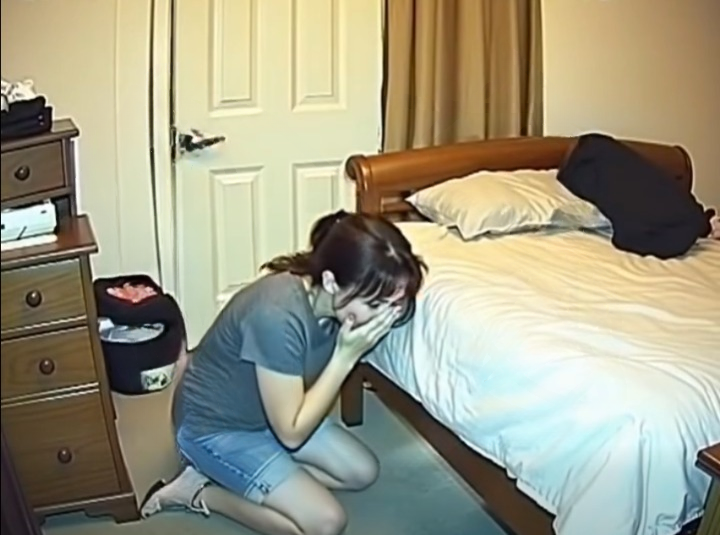
After Losing Our 15-Year-Old Daughter, I Found a Handwritten Note in Her Room That Changed Everything
The days following our daughter’s funeral passed in a blur. I could barely remember what people said to me, what meals I ate, or how I managed to get through each morning. Everything that had once felt familiar had become painfully different.
Our daughter had been only fifteen. She had been full of plans, questions, and little habits that made our home feel alive. Now, the house seemed quieter than I had ever imagined possible.
I remember standing beside her grave, struggling to accept that the moment was real. Friends and relatives gathered around us, offering their condolences and trying to find words that might bring comfort. I appreciated their kindness, but their voices seemed distant. My thoughts kept returning to the same memories: her smile when she came home from school, the sound of her footsteps in the hallway, and the way she used to call for me from her bedroom.
I kept expecting to hear her voice again.
But the house remained silent.
My husband and I were grieving in different ways. I wanted to preserve everything connected to our daughter, while he seemed determined to remove the reminders as quickly as possible.
A few days after the funeral, he began talking about clearing out her room.
“We can’t leave everything like this forever,” he told me one evening. “Seeing her belongings every day is going to make it harder for us to move forward.”
I looked at him, unable to understand how he could even consider putting her things away.
Her clothes were still hanging in the wardrobe. Her books were stacked on the desk. A few hair ties rested beside her mirror, and her favorite blanket lay folded at the foot of the bed.
To me, these were not ordinary possessions.
They were reminders of the daughter we had loved and the life we had shared with her. Each object carried a memory, and I was not ready to let those memories become packed boxes in a storage room.
“I can’t do that yet,” I told him.
He did not argue, but he continued bringing it up over the following weeks.
Eventually, I understood that we were both trying to cope with the same loss, even though our reactions looked completely different. I still did not agree with his approach, but I realized that neither of us knew how to navigate the days ahead.
For almost a month, I avoided entering our daughter’s bedroom.
I passed the closed door every morning and every evening. Sometimes I stopped outside it, resting my hand against the frame. I would think about opening it, but the thought of seeing everything exactly as she had left it felt overwhelming.
Then, one quiet afternoon, I decided to go inside.
I told myself that I did not have to throw anything away. I could simply organize a few things and decide what I wanted to keep.
When I opened the door, I stood there for a long time.
The room looked almost exactly as it had before. Her books were still on the desk, a few drawings were tucked into the corner of a mirror, and her favorite clothes remained in the wardrobe.
The sight brought back so many memories that I had to sit on the edge of her bed.
I picked up a small item from her desk and held it in my hands. I remembered watching her use it while she worked on school assignments and listened to music. Ordinary moments that I had barely noticed at the time now felt precious.
I began sorting through her belongings slowly.
I folded a dress and placed it carefully on the bed. I gathered a few hair ties from the desk and set them beside her favorite book. Every object reminded me of a different part of her personality.
Then, as I lifted one of her school textbooks, a small folded piece of paper slipped from between its pages.
I almost placed it back without looking.
Something about the handwriting caught my attention.
I recognized it immediately.
It was hers.
My hands became unsteady as I unfolded the paper. I had seen her handwriting thousands of times in notebooks, birthday cards, shopping lists, and messages she left around the house.
This note was short.
It read:
“Mom, if you’re reading this, please look under my bed. There’s something I want you to find.”
I read the sentence several times.
I could not remember her mentioning a note or telling me that she had left anything beneath her bed. I tried to think of an occasion when she might have written it, but nothing came to mind.
Why had she written those words?
Had she been planning a surprise? Was it something she had forgotten to show me? Perhaps she had hidden a personal keepsake and wanted me to find it someday.
I had no way of knowing.
For a moment, I considered calling my husband into the room. Instead, I decided to look for myself.
I placed the note on the bed and knelt on the floor.
For several seconds, I hesitated.
Then I leaned forward and looked beneath the bed.
At first, I could make out only a few ordinary objects. There was a storage box, a pair of slippers, and a small container pushed toward the wall.
But behind them, partly concealed by a folded blanket, was something I had never noticed before.
I reached carefully into the space and pulled it toward me.
It was a small, old-fashioned keepsake box.
My daughter had decorated the lid with stickers and colorful paper. The edges were worn, suggesting that she had used it for some time.
I sat back on the floor, holding the box in my lap.
The note had not prepared me for the emotions that came with finding it. I felt curiosity, sadness, and an unexpected sense of closeness, as though I had discovered a small part of her world that she had kept private.
I opened the lid.
Inside were several folded letters, photographs, drawings, and little objects that might have seemed unimportant to anyone else.
To me, each item was a doorway into a memory.
There was a photograph of our family taken years earlier, when my daughter was still small enough to sit on my lap. My husband stood behind us, smiling in a way I had not seen in a long time.
Beneath the photograph was a birthday card she had made for me. The paper was slightly creased, and the writing was uneven in places, but I remembered receiving it.
I had kept the card on the kitchen counter for weeks before placing it in a drawer.
Now I held it as though it were something entirely new.
There were also drawings from her childhood, notes about school projects, and a list of things she wanted to do someday. Some were simple plans, such as learning a new recipe or visiting a place she had seen in a book. Others reflected the dreams she had begun forming as she grew older.
I smiled through my tears.
For the first time in weeks, I was not thinking only about the final days of her life or the sadness surrounding the funeral. I was remembering the person she had been throughout all fifteen years we had shared.
Then I noticed a small envelope at the bottom of the box.
My name was written on the front.
I recognized the familiar letters immediately.
The envelope had been sealed, and I carefully opened it.
Inside was a handwritten letter addressed to me.
“Mom,
If you found this, you are probably cleaning my room. I know you like to keep things, even when you say you are going to throw them away.
I hope you don’t throw away everything that reminds you of me.
I know I sometimes leave my things everywhere, and I know you tell me to organize my room. I promise I really am trying.
I wanted to make this little box because there are things I don’t want to lose. Pictures, cards, and memories that make me smile when I look at them.
I hope that when I’m older, we can look through it together and laugh about some of these things.
I love you, Mom.
Thank you for always listening to me, even when I ask too many questions.
Love,
Your daughter.”
I stopped