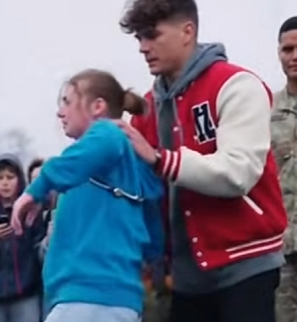
After 20 Days of Flood Rescue, I Took My National Guard Convoy to My Daughter’s School—All I Wanted Was Five Minutes With Her
The mud had been stuck to my boots for nearly three weeks.
It wasn’t ordinary dirt. It was the thick, foul-smelling sludge left behind when floodwaters swept through neighborhoods, carrying soil, sewage, river sediment, and whatever else the rising water could tear loose. It smelled of decay, diesel, and stagnant water. The grime had worked its way beneath my fingernails, settled into the creases of my hands, and left ugly streaks across the Humvee’s dashboard.
Every time I looked down, I was reminded of the disaster we had spent the past twenty days trying to contain.
“Staff Sergeant Miller, we’re approaching the junction,” Corporal Alvarez reported over the radio.
Everyone called him Tex. Even through the static, I could hear the exhaustion in his voice. It was the same exhaustion I felt in my bones.
I rubbed my eyes, trying to clear the grit that seemed permanently lodged beneath my eyelids. Beyond the armored glass, Pennsylvania’s late-October sky hung low and gray. The trees had shed most of their leaves, leaving bare branches stretched toward the clouds like skeletal fingers.
Inside the Humvee, the heater blasted air that smelled of dust and old machinery. It did little to make the cold metal cabin feel comfortable.
We were supposed to return directly to the armory, turn in our equipment, complete our debriefing, and finally get some rest. After weeks of hauling supplies, clearing debris, and helping families escape rising floodwaters, even a few uninterrupted hours of sleep sounded like a luxury.
Then I saw the green exit sign.
LINCOLN HIGH SCHOOL.
My heart tightened.
“Take the exit, Tex,” I said into the radio.
Silence followed.
“Sarge, that puts us about forty minutes behind schedule,” he replied. “The lieutenant expects us back by sixteen hundred. We’re going to hear about it if we’re late.”
“I know.”
I stared at the sign as we approached it.
“Take the exit.”
This time, my voice was quieter. The exhaustion had worn away whatever authority I usually tried to project.
“I just need five minutes,” I added. “That’s all.”
Tex didn’t answer immediately.
Then the radio crackled.
“Copy that, Staff Sergeant. Taking the exit.”
I leaned back against the seat and closed my eyes for a moment.
I hadn’t seen my daughter, Lily, in six months.
Six months.
When I joined the National Guard, the familiar promise of service sounded manageable: one weekend a month, two weeks a year. It was a simple schedule on paper, something a person could build a family life around.
What nobody can fully explain beforehand is how quickly those plans can change.
Emergencies don’t check your calendar. Floods don’t wait until your scheduled training is finished. When an entire region is in danger, the people who need help cannot always wait for you to resolve your responsibilities at home.
During the past twenty days, I had watched frightened families cling to rooftops while water rushed through their streets. I had helped pull people to safety, carried supplies through flooded roads, and worked alongside people who kept going long after their bodies were begging them to stop.
Every rescue mattered.
Every family we helped mattered.
But while I was doing everything I could for strangers, something had happened to my own daughter.
Two months earlier, Lily had been involved in a serious car accident.
I was standing in floodwater when the call came through.
The reception was terrible. My phone kept cutting out, and my former wife’s voice sounded distant and broken beneath the static.
“John, you need to listen,” she said.
I remember dropping the sandbag I was carrying.
“What happened?”
“Lily was in an accident. She’s at the hospital.”
For a moment, the entire world seemed to go quiet.
Then the words began coming in fragments.
A broken leg. Surgery. Pain. Questions I couldn’t get answered because the signal kept disappearing.
“She keeps asking for you, John.”
I wanted to leave immediately.
I wanted to get into my truck, drive straight to the hospital, and sit beside my little girl until she fell asleep. I wanted to hold her hand while the doctors explained what had happened. I wanted to be there when she woke up after surgery and looked around the room for someone familiar.
But our unit had been activated to respond to the flooding. The emergency deployment was still underway, and leave had been suspended.
I couldn’t simply walk away from the assignment.
So I stayed.
I stayed while the water rose. I stayed while families waited for evacuation. I stayed while my phone battery drained and the reception failed again and again.
I sent messages whenever I could. I called during brief breaks, trying to sound calm and reassuring even when I was exhausted and frightened.
Sometimes Lily answered. Sometimes she didn’t feel like talking.
Our video calls were short and awkward. I would ask about her pain, her medication, her physical therapy, and whether she was getting enough rest.
She would tell me she was okay.
I knew that answer didn’t mean everything was fine.
It meant she was trying to be strong.
And I hated that I couldn’t be there to make things easier for her.
I was her father. In my mind, that meant I was supposed to be the person who showed up when things went wrong.
Yet when she needed me most, I was hundreds of miles away.
The guilt followed me everywhere. It sat in my chest beneath my body armor and stayed with me through every long shift. It was heavier than my equipment, heavier than the pack I carried, and far harder to put down.
I understood why we had to stay. I understood the responsibility we had accepted.
But understanding something doesn’t always make it hurt less.
The convoy began slowing as we approached the off-ramp. Three mud-covered Humvees rolled onto the road leading toward Lily’s school.
Their heavy tires hummed against the pavement.
Through the windows, I saw neat lawns, parked minivans, and people walking their dogs beneath the gray sky. The ordinary quiet of the neighborhood felt almost unreal after weeks spent surrounded by emergency vehicles, damaged homes, and rushing water.
People stopped to stare as we passed.
I couldn’t blame them. We looked like we had driven straight out of a disaster zone because, in a way, we had. Our uniforms were stained, our vehicles were filthy, and our equipment was still strapped into place.
Inside those three vehicles were twelve exhausted service members who wanted hot showers, clean clothes, and the comfort of sleeping in their own beds.
But I wanted something else first.
I wanted to see my daughter.
I checked my watch.
2:55 p.m.
The final school bell was about to ring.
My stomach tightened.
What if Lily was angry with me?
What if she had spent the past two months wondering why her father couldn’t come home?
What if she had finally stopped expecting me to walk through the door?
I had rehearsed dozens of things I wanted to say during the long hours of our deployment. Every version sounded inadequate.
I could explain the orders. I could explain the emergency. I could tell her how many people we had helped and how difficult it had been to leave.
But none of those explanations could give her back the days I had missed.
They couldn’t change the fact that I hadn’t been there when she needed comfort.
I looked down at my uniform. It was wrinkled and stained, and my boots looked as though they had been dragged through every flooded street in Pennsylvania.
They probably had.
I brushed some dried mud from my sleeve, straightened my name tape, and took a slow breath.
MILLER.
At least that was still in place.
As Lincoln High School came into view, I directed Tex to pull along the back fence.
“Park here. Keep the engines running.”
He glanced at me in the mirror.
“You want us to come with you, Boss?”
“No.”
I looked toward the school entrance.
“I don’t want to make a production out of this. I’m just going to catch her on the way out, give her a hug, and tell her I’m home.”
Tex studied me for a moment.
His face was streaked with grime, and dark circles sat beneath his eyes. He looked as worn down as the rest of us, but there was something familiar in his expression: the quiet loyalty of someone who had spent too many difficult days beside you to need an explanation.
“You sure?” he asked.
I nodded.
“Five minutes. That’s all I need.”
He gave me a small, tired smile.
“Roger that.”
I reached for the door handle.
The metal was cold beneath my hand.
For the first time in weeks, I felt nervous about something that had nothing to do with floodwater, damaged roads, or the next emergency call.
I was about to see my daughter.
I wanted her to know I was still her dad, even after all the missed calls and unanswered questions. I wanted to show her that I had come back, that I had not forgotten her, and that no matter how far away my duties had taken me, she remained the most important person in my life.
I told myself I would keep it simple.
A hug. An apology. A promise to spend time together.
Then I would climb back into the Humvee, let the convoy return to the armory, and finally go home.
I genuinely believed that was all that would happen.
I had no idea how quickly those five minutes were about to change everything.
And I certainly didn’t know that, before the afternoon was over, I would have to make a decision far more difficult than taking a detour to my daughter’s school.