There are some memories that never lose their sharp edges.
No matter how much time passes, they remain as vivid as the day they happened.
For me, that memory begins with my twin sister, Hannah.
We were sixteen years old.
Although we were twins, our personalities couldn’t have been more different. Hannah loved adventure. She volunteered for every hiking trip, school event, and community fundraiser. She had an incredible way of making strangers feel like lifelong friends.
I was quieter.
I enjoyed books, photography, and spending afternoons repairing old bicycles in our garage.
People often joked that Hannah was the outgoing half of our pair while I preferred observing the world before jumping into it.
Despite our differences, we were inseparable.
Growing up, we shared everything—birthdays, classrooms, inside jokes, and even the occasional argument over whose turn it was to choose a movie on Friday nights.
Our parents often smiled and said they couldn’t imagine one of us without the other.
Neither could I.
Every summer our church organized a weekend retreat at a lakeside lodge surrounded by beautiful hiking trails.
It had become something of a tradition.
Families cooked meals together.
Children played outdoor games.
Adults gathered around evening campfires to share stories and music.
The atmosphere always felt welcoming and peaceful.
This particular year was supposed to be no different.
I had planned to go.
Three days before departure, however, I fell while skateboarding and fractured my arm.
The doctor fitted me with a cast and recommended avoiding strenuous outdoor activities for several weeks.
Mom looked disappointed but practical.
“You should stay home and recover,” she said gently.
“I’ll survive,” I replied, trying to sound more cheerful than I felt.
The morning they left, Hannah laughed as she loaded her backpack into the car.
“You’ll miss all the fun.”
“I’ll hold you to that,” I answered.
She smiled.
“We’ll bring you back something from the gift shop.”
Those were among the last ordinary words we shared.
The first day of the retreat passed without incident.
Mom sent a photo of everyone gathered beside the lake.
Another showed Hannah smiling with marshmallows roasting over the campfire.
Everything looked exactly as it always had.
Then Saturday afternoon arrived.
According to the information later shared with investigators, the retreat participants divided into several smaller hiking groups.
Some chose shorter walking paths.
Others explored longer scenic trails through the nearby state park.
Mom and Hannah initially remained near the lodge because Hannah had mentioned feeling some discomfort after twisting her ankle earlier that morning.
Later they joined one of the easier routes.
At some point during the hike, the group briefly became separated while navigating different sections of the trail.
When everyone regrouped, Hannah was no longer with them.
Camp leaders immediately began searching nearby paths.
When they couldn’t locate her, they contacted emergency services.
Within hours, trained search-and-rescue teams arrived.
Volunteers searched wooded areas.
Helicopters surveyed the surrounding landscape.
Specially trained dogs followed every possible lead investigators could identify.
Entire communities offered support.
The search continued for days.
Then weeks.
Eventually months.
Despite tremendous effort, there were still no clear answers.
The investigation remained open.
Our family returned home carrying questions instead of certainty.
Life after that became difficult to describe.
Hannah’s bedroom stayed almost exactly as she had left it.
Books remained stacked beside her bed.
Posters still decorated her walls.
Her backpack rested near the closet.
Every object seemed frozen in time.
Mom especially struggled.
She often spent quiet evenings sitting in Hannah’s room.
Sometimes she held one of Hannah’s sweaters while looking through old family photographs.
Faith remained important to her.
She carried a well-worn leather Bible almost everywhere she went.
Whenever life felt overwhelming, she turned to it for comfort.
Seeing her quietly reading late into the evening became a familiar sight.
I assumed those moments helped her process grief and uncertainty.
The anniversary of Hannah’s disappearance arrived far sooner than I expected.
Community members organized another awareness event.
Friends released biodegradable lanterns over the lake.
Local officials reassured everyone that the investigation remained active.
Although time had passed, hope hadn’t disappeared.
Then something unexpected happened.
One Tuesday afternoon Mom became ill while at work.
Thankfully it wasn’t life-threatening, but her doctor recommended several days of observation at the hospital to allow her to rest.
When I visited later that evening, she smiled weakly.
“Could you bring something from home tomorrow?”
“Of course.”
“My Bible.”
“I left it on the nightstand.”
The next morning I returned home before visiting the hospital again.
Her bedroom looked exactly as she had left it.
The familiar leather Bible rested beside a reading lamp.
As I picked it up, it slipped unexpectedly from my hands.
It struck the hardwood floor.
The cover opened wider than I expected.
Something felt unusual.
Instead of separating naturally, the pages seemed strangely rigid.
Curious, I looked closer.
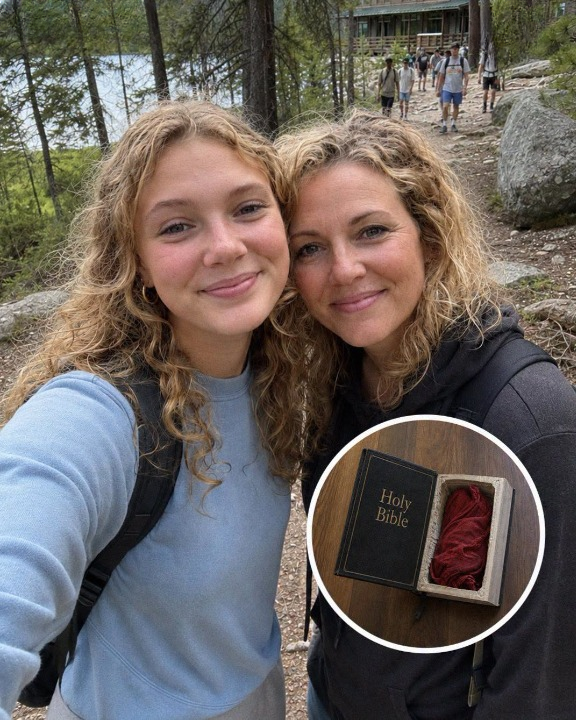
The center section had been carefully carved into a small hidden compartment.
Nestled inside soft fabric rested several items.
There was a folded envelope.
A flash drive.
A small key attached to a handwritten label.
And a notebook no larger than my hand.
For several moments I simply stared.
I wasn’t frightened.
Only confused.
Why had these items been hidden there?
Carefully opening the envelope, I discovered handwritten notes.
They weren’t dramatic confessions or shocking revelations.
Instead, they contained copies of conversations Mom had documented over the previous year—meeting dates with investigators, names of volunteers, reminders about evidence she wanted to share, and questions she hoped authorities might someday answer.
Beneath those notes rested another sealed envelope addressed to me.
Across the front she had written:
“Only open this if something unexpected happens to me.”
My heart began racing.
I hadn’t expected to find anything like this.
The flash drive carried a simple label.
“Investigation Copies.”
Unsure what any of it contained—or whether authorities had already reviewed the material—I realized the responsible thing to do was avoid making assumptions.
If these items related to an active missing-person investigation, professionals should examine them first.
I contacted the local police department’s non-emergency line and explained exactly what I had discovered.
The dispatcher thanked me for calling and asked me not to disturb anything further until an investigator could document the contents properly.
Later that afternoon, two investigators visited our home.
They photographed every item before carefully reviewing the documents.
One officer smiled reassuringly.
“You absolutely did the right thing by contacting us.”
He explained that families sometimes collect information independently while hoping to assist ongoing investigations.
Occasionally those personal records contain details that help organize timelines or verify conversations.
Even if the material duplicated information already collected, preserving proper documentation remained important.
After receiving permission from investigators, I finally opened the envelope addressed to me.
Inside was a letter from Mom.
She explained that over the past year she had become afraid of forgetting small details.
Every conversation with investigators.
Every volunteer who offered help.
Every memory Hannah’s friends shared.
She worried that as months passed, tiny pieces of information might become harder to remember.
So she created her own carefully organized archive.
The hidden compartment wasn’t meant to conceal secrets.
It protected sensitive documents from being misplaced while visitors frequently came and went through the house.
She ended the letter with words I’ll never forget.
“Hope sometimes means continuing careful work even when answers take longer than we wish.”
“If you ever find these notes, promise me you’ll always choose facts over assumptions and kindness over fear.”
A few days later Mom returned home from the hospital.
When I gently told her what had happened, she laughed softly.
“I suppose my hiding place wasn’t as clever as I imagined.”
Then she hugged me.
“I’m glad you called the investigators.”
“They deserve to have every piece of information.”
Over the following months, the materials helped investigators organize several timelines more efficiently and confirm dates connected to volunteer search efforts.
Although they didn’t immediately solve the mystery, they ensured no potentially useful information remained overlooked.
Our family continued supporting community awareness events while remaining hopeful that one day more answers would emerge.
Through everything, I learned something important.
Grief often inspires people to preserve memories in different ways.
Some keep photographs.
Others write journals.
Some save letters, maps, or notes connected to people they love.
None of those actions necessarily hide the truth.
Often, they’re simply attempts to hold onto hope.
Today, Hannah’s room still contains reminders of the joyful person she was.
But alongside those memories now sits a new understanding.
Healing doesn’t mean forgetting.
It means honoring someone by continuing to care, continuing to hope, and continuing to support those working patiently toward answers.
Looking back, discovering that hidden compartment inside Mom’s Bible didn’t reveal the mystery we feared.
Instead, it revealed something equally powerful.
A mother’s determination to never stop searching.
A family’s commitment to preserving every memory.
And a reminder that when unexpected discoveries relate to important matters, the wisest choice is always to seek help through the proper channels rather than jumping to conclusions.
Sometimes the greatest act of hope isn’t finding all the answers immediately.
It’s choosing to keep looking with patience, compassion, and faith that every careful step forward still matters.