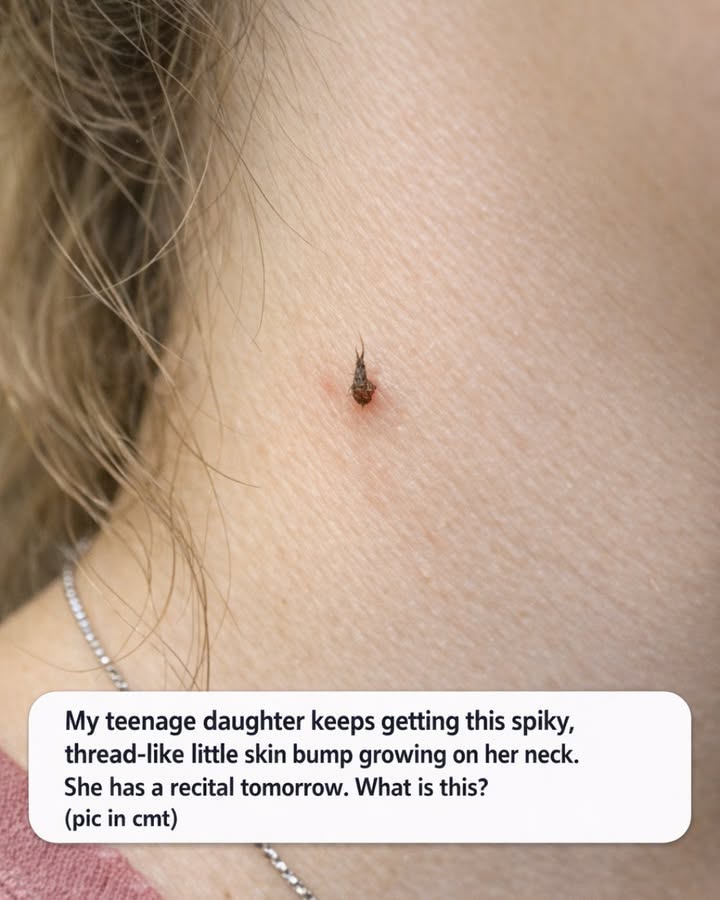
When a parent notices an unusual skin growth on their teenager, it can be difficult not to worry.
That concern can become even stronger when the bump has an unusual appearance—such as being small, narrow, spiky, or thread-like—and seems to keep coming back in the same area.
If your daughter has an important event coming up, you may also be wondering whether there is anything you can safely do about it before the event.
The good news is that many small skin growths are harmless. However, several different conditions can look similar, and a description alone isn’t enough to determine exactly what a particular bump is.
A small, thread-like growth on the neck could potentially represent a wart, a skin tag, or another type of benign skin lesion. Some growths can also recur if only part of the lesion is removed.
Because of these possibilities, it is better to identify the growth before attempting to remove it yourself.
What Can Cause a Small Thread-Like Skin Bump?
There are several possible explanations for a small growth that appears narrow, raised, or finger-like.
One possibility is a type of wart.
Warts are common skin growths caused by certain strains of human papillomavirus, commonly abbreviated as HPV. They can appear on different parts of the body and can vary considerably in appearance.
Some warts are rough and rounded, while others can be more elongated or thread-like.
Another possibility is a skin tag.
Skin tags are generally soft, flesh-colored growths that can hang from the surface of the skin. They commonly appear in areas where skin rubs against skin or clothing.
However, skin tags are more commonly seen in adults, so an unusual growth on a teenager should not automatically be labeled a skin tag without an examination.
There are also other benign skin conditions that can produce small raised growths.
This is why an in-person examination can be useful when a lesion repeatedly appears or changes.
Why Does It Keep Coming Back?
One of the most important details in this situation is that the growth appears to return.
A lesion may seem to “come back” for several reasons.
Sometimes a person removes only the visible portion of a growth while the underlying tissue remains.
In other cases, the original growth may have been irritated or injured, causing temporary changes that make it appear different.
It is also possible that a new lesion develops in the same general area.
If the growth is actually a wart, for example, the virus responsible can remain in the surrounding skin, and new warts can sometimes develop.
That doesn’t mean a recurring bump is necessarily dangerous.
It simply means that repeated growth deserves proper identification rather than repeated home removal.
Should You Remove It Before the Recital?
If your daughter has a recital tomorrow, you may be tempted to cut, pull, burn, freeze, or otherwise remove the bump yourself.
That is generally not a good idea.
Attempting to remove an unidentified skin growth can cause bleeding, irritation, infection, scarring, or discoloration.
It can also make the area look worse immediately before an important event.
If the bump is small and isn’t causing pain, bleeding, or other concerning symptoms, leaving it alone until it can be properly assessed may be the safest short-term approach.
If appearance is the primary concern, simple styling choices may help draw less attention to the area without damaging the skin.
What If It Looks Like a Wart?
Warts can have different appearances depending on where they occur.
A common wart often has a rough surface.
Some warts on the face or neck can appear thinner or more elongated than the classic rounded wart people imagine.
Because several other skin lesions can resemble warts, visual identification isn’t always reliable.
If a healthcare professional confirms that the growth is a wart, there are several treatment options that may be considered depending on its location, size, and appearance.
Treatment may involve approaches designed to destroy or remove the wart, but the appropriate method should be selected with consideration for the sensitive skin of the neck and the possibility of scarring.
What If It Is a Skin Tag?
Skin tags are generally soft, small growths that can hang slightly away from the skin.
They are usually harmless, although they can become irritated if they repeatedly rub against clothing or jewelry.
While skin tags are common, a small growth on a teenager should not automatically be assumed to be one.
A healthcare professional can determine whether the lesion has the typical appearance of a skin tag or whether another explanation should be considered.
If removal is appropriate, it can be performed using a suitable clinical technique.
Why Home Remedies Can Be a Problem
The internet contains countless suggestions for removing small skin growths at home.
Some involve tying material around the growth, applying acids, using household chemicals, cutting the lesion, or attempting to freeze it.
These approaches can be risky, particularly on visible areas such as the neck.
The skin can become burned, infected, scarred, or permanently discolored.
Even if a home treatment appears to work, it may not address the underlying lesion.
There is another important concern: if the growth is not actually a wart or skin tag, treating it as though it were one could delay proper evaluation.
When Should a Doctor Look at It?
A healthcare professional should evaluate a recurring or uncertain skin growth, particularly if its appearance is changing.
It is especially important to arrange an examination if the bump:
-
Grows quickly.
-
Changes color.
-
Changes shape.
-
Becomes painful.
-
Bleeds without an obvious injury.
-
Develops an open sore.
-
Repeatedly crusts over.
-
Becomes increasingly irritated.
-
Appears alongside other unusual skin changes.
-
Does not heal normally after being injured.
These signs do not automatically mean something serious is happening.
They simply make professional assessment more appropriate.
Does It Need Emergency Attention?
Most small, stable skin growths do not require an emergency department simply because they look unusual.
If your daughter is otherwise feeling well and the bump is not causing significant symptoms, arranging an appointment with her pediatrician, primary-care clinician, or dermatologist is generally a reasonable next step.
Urgent evaluation becomes more important if there is uncontrolled bleeding, rapidly developing swelling, severe pain, signs of infection, or another significant acute symptom.
If you’re unsure how quickly it should be evaluated, calling a healthcare service and describing the lesion can help determine the appropriate level of care.
Take a Clear Photograph
If the growth is small and changes over time, taking a photograph can be useful.
Use good lighting and take the picture from a consistent distance.
If possible, include a familiar object or ruler nearby for scale without pressing anything against the lesion.
A photograph isn’t a substitute for an examination, but it can help document how the lesion looked at a particular point in time.
If it disappears before the appointment, showing the healthcare professional a clear photograph may provide useful context.
Don’t Keep Picking at It
Teenagers may understandably be tempted to pick, scratch, or pull at a noticeable bump, particularly if it is visible in the mirror.
Repeated irritation can cause inflammation and make the area look larger or redder.
It can also cause bleeding and increase the chance of infection.
Encourage your daughter to leave the area alone as much as possible until it has been evaluated.
If clothing, necklaces, hair, or other items repeatedly rub against the area, reducing that irritation may help keep the skin comfortable.
What Will a Dermatologist Check?
A dermatologist can examine the growth using magnification and other visual tools.
They will consider its size, color, surface, shape, location, and history.
They may also ask how long it has been present and whether it has changed.
If the diagnosis is uncertain, a clinician may recommend additional evaluation, and in some situations a small biopsy may be considered.
A biopsy involves removing a small sample of tissue for examination.
That does not mean a doctor believes the lesion is dangerous. It can simply be the most reliable way to determine what an unusual growth actually is.
Could It Be Related to HPV?
If the growth turns out to be a wart, HPV can be one possible cause.
HPV is a large family of viruses, and different types can affect different parts of the body.
Common skin warts are not the same thing as every HPV-related condition discussed in the news or on social media.
It’s therefore important not to jump to conclusions based on the word “HPV.”
If a clinician identifies the growth as a wart, they can explain what type it appears to be and whether treatment or observation is appropriate.
Don’t Let an Upcoming Event Create Unnecessary Panic
Having a recital tomorrow can make a small skin issue feel much more urgent than it otherwise would.
But if the growth has been present before and your daughter feels well, there may not be a reason to panic.
The safest approach is usually to avoid experimenting with last-minute removal methods.
A small bump is often less noticeable than an irritated, scratched, burned, or bleeding patch of skin created by an unsuccessful home treatment.
If necessary, simple hairstyle or clothing choices can sometimes make the area less noticeable temporarily.
Then arrange an appropriate medical evaluation after the event.
Final Thoughts
A small, spiky, thread-like bump on a teenager’s neck can have several possible explanations.
A wart is one possibility, while other benign skin growths may have a similar appearance. Because these conditions can look alike, it isn’t possible to determine the cause confidently from a short description.
The fact that the growth keeps appearing is worth mentioning to a healthcare professional.
Until the lesion is identified, avoid cutting, pulling, burning, freezing, or applying strong chemicals to it at home.
If your daughter is otherwise well and the bump isn’t bleeding, severely painful, rapidly changing, or showing other concerning features, it may be reasonable to arrange a routine appointment with her doctor or a dermatologist.
If concerning symptoms develop, seek medical advice sooner.
Most importantly, don’t let the upcoming recital pressure you into a risky last-minute treatment. Protecting the skin and getting an accurate diagnosis is more important than trying to make an uncertain growth disappear overnight.
Once a healthcare professional knows exactly what the bump is, you can make a much more informed decision about whether it needs treatment, removal, or simply observation.