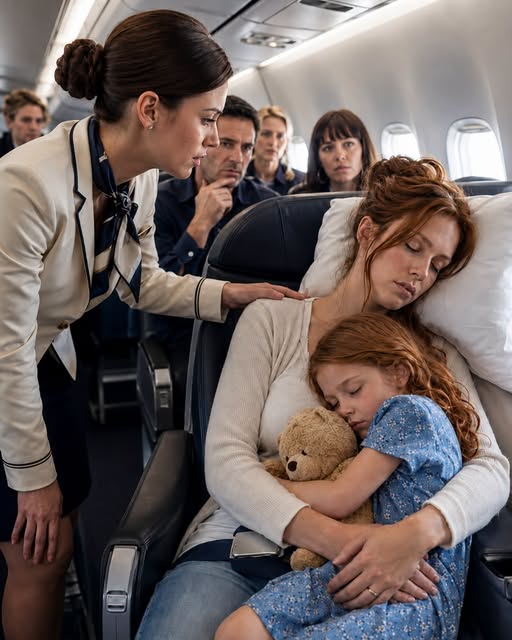
A Single Mother Was Resting in Seat 8A When the Captain Asked for a Fighter Pilot
The overnight flight from New York to Madrid had been in the air for nearly two hours when the captain made an unexpected announcement.
“Ladies and gentlemen, if there is a passenger on board with experience flying military fighter aircraft, please identify yourself to a member of the cabin crew.”
For a moment, the cabin remained quiet.
Nearly three hundred passengers were traveling across the Atlantic. Some were asleep beneath thin blankets, while others watched movies or listened to music through their headphones. A few passengers gazed out at the dark sky beyond their windows.
Most assumed the announcement had been a mistake.
Then the captain repeated it.
“If anyone on board has experience flying military fighter aircraft, please contact a flight attendant as soon as possible. We have a technical situation that requires additional aviation expertise.”
This time, people began looking around.
A man in the aisle seat removed his headphones. A mother pulled her sleeping child closer. An elderly couple exchanged concerned glances.
Nobody knew what was happening inside the cockpit.
And nobody suspected that the person the captain needed was sitting quietly in seat 8A.
Her name was Laura Vance.
She was thirty-eight years old, a single mother, and a former United States Air Force fighter pilot.
At that moment, she was wearing a simple green sweater, dark jeans, and comfortable shoes. A folded blanket covered her legs, and a closed paperback rested against her chest.
She had declined dinner, asked for a glass of water, and spent most of the flight trying to sleep.
To the passengers around her, Laura looked like any other tired traveler returning from a long trip.
Nothing about her appearance suggested that she had once flown F-16 fighter aircraft on demanding military missions.
Nothing revealed the years she had spent learning to remain calm under pressure, make difficult decisions quickly, and trust the training that had prepared her for situations most people would never experience.
Laura had left the Air Force several years earlier.
She had not left because she lacked the ability to fly.
She had left because something happened that changed the direction of her life.
Since then, she had worked hard to build a quieter existence for herself and her young daughter. She wanted ordinary mornings, school pickups, grocery shopping, and evenings when nobody expected her to carry the weight of an entire situation on her shoulders.
She no longer wanted to be introduced as a decorated pilot.
She did not want strangers asking about her military career.
Most of all, she wanted to leave that chapter of her life behind.
That was why she had chosen seat 8A.
A window seat, away from the busiest part of the cabin.
A place where she could read, rest, and remain unnoticed.
But the captain’s announcement had changed everything.
The Voice She Recognized
Laura opened her eyes slowly.
She had heard hundreds of announcements during her years in military aviation. Most had been routine. Others had carried the kind of urgency that experienced pilots recognized immediately.
The captain’s voice was controlled, but there was a noticeable tension beneath it.
Laura knew that tone.
It was the voice of someone trying to communicate clearly while managing a situation that required careful attention.
She sat still, listening.
A few seconds later, a flight attendant hurried down the aisle.
The woman appeared professional, but her movements were quicker than before. She glanced at the passengers as she walked, occasionally stopping to ask a quiet question.
Laura watched her approach.
The flight attendant paused beside row eight.
“Excuse me,” she said to Laura. “Do you happen to know whether anyone nearby has experience flying military aircraft?”
Laura glanced toward the passengers around her.
A young couple sat across the aisle. A family with two small children occupied the row ahead. Farther back, several travelers were beginning to whisper among themselves.
“I’m not sure,” Laura replied.
The flight attendant nodded, preparing to move on.
Then Laura looked toward the front of the aircraft.
“May I ask what kind of experience the captain needs?”
The attendant hesitated briefly.
“He specifically requested someone with military fighter-aircraft experience. The flight crew is handling a technical issue, and the captain would like to speak with someone who has that background.”
Laura felt an old instinct begin to surface.
She recognized the seriousness of the request, but she also knew that her experience had limits.
Flying a fighter jet was not the same as operating a commercial passenger aircraft. The systems, procedures, training, and responsibilities were different.
She could not simply walk into a commercial cockpit and assume she knew how to operate everything.
Still, her aviation background might help the captain interpret a technical situation or discuss procedures.
Laura looked down at the book resting in her hands.
For several years, she had told herself that her military career was over.
She had made a promise that she would not return to a life defined by emergencies, responsibility, and difficult decisions.
But the flight attendant was still standing beside her.
And nearly three hundred people were traveling through the darkness above the Atlantic.
Laura took a slow breath.
“I’m a pilot,” she said.
The flight attendant leaned closer.
“I’m sorry?”
“I’m a former U.S. Air Force fighter pilot. I flew F-16s.”
The attendant’s expression changed.
“You flew fighter aircraft?”
“For several years.”
“Would you be willing to speak with the captain?”
Laura paused.
Then she unfastened her seat belt.
“Yes.”
A Different Kind of Journey
As Laura stood, the passenger beside her turned in surprise.
“You were a fighter pilot?”
Laura gave a small nod.
“I used to be.”
The man looked as though he wanted to ask several questions, but the flight attendant was already guiding Laura toward the front of the aircraft.
The cabin had become unusually quiet.
A few passengers watched her walk past. Others returned their attention to the captain’s announcement, trying to understand why a former fighter pilot was being escorted toward the cockpit.
Laura kept her eyes forward.
She could feel the familiar rhythm of her footsteps against the aircraft floor. The low vibration of the engines seemed louder now.
With every step, memories returned.
Military briefings.
Flight suits.
Preflight checklists.
Long hours studying aircraft systems.
The demanding training that had taught her to process information carefully, even when circumstances changed unexpectedly.
She had spent years building a life that no longer revolved around those memories.
Yet, in a matter of minutes, the past had found its way back into her present.
At the forward galley, the flight attendant stopped beside the cockpit door.
“Please wait here for a moment,” she said.
Laura nodded.
The attendant spoke quietly with another crew member before returning.
“The captain is ready to speak with you.”
The cockpit door opened.
Laura stepped inside.
The first thing she noticed was the concentration on the pilots’ faces.
The captain sat in the left seat, while the first officer worked through a series of instrument indications. A printed checklist rested nearby.
Neither pilot appeared panicked, but both were clearly focused.
The captain turned toward Laura.
“Ms. Vance?”
“Yes, Captain.”
“I’m Captain Daniel Mercer. Thank you for coming forward.”
He gestured toward an available seat.
“Before we begin, I want to be clear that our crew remains in control of the aircraft. We’re following our procedures. I’m hoping your military aviation background may help us discuss a few technical details.”
Laura nodded.
“Understood.”
The captain introduced the first officer, who briefly acknowledged her before returning to the instruments.
Laura settled into the observer seat.
For the first time since the announcement, she could see that the situation was more complicated than the passengers in the cabin understood.
But she also noticed something else.
The captain was looking at her with an expression that went beyond ordinary professional curiosity.
It was as though he had expected her.
Laura studied his face.
“Have we met before?” she asked.
The captain did not answer immediately.
Instead, he looked toward the first officer.
Then he turned back to Laura.
“I believe we may have a connection through your Air Force service.”
Laura felt a quiet tension settle over her.
“What kind of connection?”
Captain Mercer glanced at the closed cockpit door.
“That’s something I need to explain carefully.”
The Technical Situation
The captain began by describing the issue.
The aircraft had experienced an unusual technical indication during the Atlantic crossing. The flight crew had reviewed the relevant information and was following the airline’s established procedures.
The situation did not mean the aircraft was about to lose control, but the crew wanted to understand the indication fully before deciding on the next steps.
Laura listened without interrupting.
She asked a few questions about the timing of the indication, the information available to the pilots, and whether the issue had changed since it first appeared.
The captain answered as clearly as he could.
Laura was careful not to overstate what she knew.
Her experience flying F-16s gave her a strong understanding of aviation discipline, cockpit communication, and the importance of systematic problem-solving. But she understood that the commercial aircraft’s specific systems required the expertise of its own trained crew.
“I don’t want to assume that the procedures I learned in the Air Force apply directly here,” she said. “Your aircraft and your operating procedures are different.”
The captain nodded.
“That’s exactly why we’re keeping the discussion focused. We aren’t asking you to operate the aircraft. We want to understand your background and whether there are any relevant perspectives you can offer.”
Laura appreciated his directness.
For the next several minutes, they discussed the information available to the crew. Laura helped organize a few questions and suggested ways to compare the current indications with the details the pilots had already reviewed.
The first officer continued monitoring the aircraft.
The captain remained in communication with the airline’s operations team.
There were no dramatic gestures, no sudden movements, and no instant solution.
Instead, the cockpit was filled with the steady work of trained professionals trying to understand an unfamiliar situation.
Laura recognized the environment immediately.
Different aircraft.
Different procedures.
The same need for discipline.
Then the captain asked a question that had nothing to do with the technical issue.
“Laura, when did you leave the Air Force?”
She looked at him.
“About seven years ago.”
“And were you stationed overseas?”
“Yes. For part of my career.”
Captain Mercer exchanged a brief glance with the first officer.
Laura noticed.
“Why are you asking?”
The captain folded his hands.
“Because I believe I knew someone who served with you.”
Laura’s expression changed.
“Who?”
The captain took a breath.
“Major Thomas Reed.”
For a moment, Laura could not speak.
The name had not crossed her mind in years.
Thomas Reed had been her flight instructor, mentor, and one of the people who had shaped her approach to aviation.
He had also been connected to the event that led Laura to leave military flying.
She stared at the captain.
“How do you know Tom?”
Captain Mercer leaned back slightly.
“We served together before I joined commercial aviation.”
Laura’s voice became quieter.
“When?”
“Several years ago.”
The cockpit seemed smaller.
Laura had spent years avoiding conversations about that part of her life. She had rarely spoken about Tom, even with people who knew her well.
Now a stranger had brought his name into a situation she had never expected to face.
“Is he all right?” she asked.
Captain Mercer answered carefully.
“Yes. As far as I know, he is.”
Laura looked down at her hands.
The relief was immediate, but it did not erase the questions that followed.
“Then why are we talking about him?”
The captain was silent for a moment.
Then he said, “Because the circumstances that brought you onto this flight may be connected to him.”
The Past Laura Tried to Leave Behind
Seven years earlier, Laura’s life had been very different.
She was a highly experienced F-16 pilot, respected by colleagues for her preparation and calm communication.
She had worked hard to earn her position.
The training had been demanding, the standards exacting, and the responsibilities significant. Laura understood that aviation left little room for careless assumptions.
Tom Reed had been one of the first senior pilots to recognize her potential.
He was known for being direct but fair. He expected preparation, encouraged questions, and reminded younger pilots that confidence should never replace careful judgment.
“You don’t have to know everything,” he used to tell her. “You have to know what you know, recognize what you don’t, and communicate clearly.”
Laura had carried those words with her throughout her career.
Then came the mission that changed everything.
During a training operation, an unexpected chain of events led to a serious aviation incident involving another aircraft.
The investigation that followed was extensive. There were interviews, technical reviews, and difficult conversations about decisions made under pressure.
Laura had followed her training, but the incident left her struggling with the consequences.
The experience affected her deeply.
She questioned her judgment, replayed events in her mind, and found it difficult to separate what she could have controlled from what had been beyond her authority.
Tom supported her through the process.
He reminded her that aviation incidents were investigated through evidence, not assumptions, and that responsibility had to be understood in the context of the information available at the time.
But Laura was exhausted.
Eventually, she decided to leave military aviation.
She did not make the decision because someone forced her out. She made it because she needed a different life.
She wanted to raise her daughter, Emma, without carrying the constant emotional weight of returning to the cockpit.
After leaving the Air Force, Laura moved closer to her family.
She found civilian work, established a routine, and focused on being a present mother.
Emma was only a toddler when Laura made that transition.
Now, at nine years old, Emma was the center of her world.
Laura rarely discussed her former career with her daughter. She answered questions when Emma asked, but she never wanted the child to feel that her mother’s identity depended on medals, aircraft, or military achievements.
She wanted Emma to know her as a mother first.
That was why Laura had been traveling to Madrid.
She had accepted an invitation to attend a small aviation safety conference, where former military and civilian pilots would discuss training, communication, and lessons learned from past incidents.
It was not a return to military service.
It was simply a chance to participate in a professional event connected to a field she still respected.
Emma was staying with Laura’s sister while Laura traveled.
Before leaving home, Laura had promised her daughter that she would call as soon as the plane landed.
Now, sitting inside the cockpit of a commercial aircraft, Laura wondered whether her attempt to keep the past at a distance had finally reached its limit.
A Name on the Flight Manifest
Captain Mercer turned toward the first officer.
“Can you bring up the passenger information we discussed?”
The first officer checked the relevant screen before responding.
“It’s available.”
Laura looked between them.
“What passenger information?”
The captain hesitated.
“Your name appeared on a list connected to the aviation conference.”
Laura frowned.
“That doesn’t explain why you recognized me.”
“No,” he admitted. “It doesn’t.”
He paused before continuing.
“Tom Reed contacted our airline’s safety department a few weeks ago. He mentioned that you might be traveling to Madrid for the conference.”
Laura was surprised.
“Tom knew I was coming?”
“He knew you had been invited. I can’t speak to every detail of his conversation, but he asked whether someone from our aviation team could reach out to you.”
Laura leaned forward.
“Why?”
Captain Mercer looked toward the first officer again.
The first officer nodded, then returned his attention to the instruments.
The captain continued.
“Tom wanted to make sure you received a message from him.”
Laura’s expression tightened.
“A message?”
“Yes.”
“Why didn’t he contact me directly?”
“I don’t know the full answer. I only know he asked that we pass something along if we had the opportunity.”
Laura stared at him.
For years, she had assumed that her professional relationship with Tom had quietly ended when she left the Air Force.
They had exchanged a few messages after her departure, but their communication had gradually faded.
She had never blamed him for that.
People moved on. Careers changed. Life continued.
But now his name had returned in the middle of an unexpected cockpit visit.
“What did he want me to know?” she asked.
Captain Mercer reached toward a document folder resting near the console.
Before he could open it, a soft alert sounded from one of the instruments.
The first officer immediately turned his attention toward the display.
The captain stopped speaking.
For the next several moments, the cockpit returned to its earlier rhythm of careful communication and checklist-based work.
Laura remained quiet.
She understood that whatever message Tom had left could wait.
The flight crew had responsibilities that came first.
The Decision to Continue
The captain and first officer reviewed the latest information.
They contacted the airline’s operations team and continued following the procedures appropriate to the aircraft and the situation.
Laura did not interfere.
She observed, listened, and answered questions when asked.
The situation remained manageable, though the crew continued to treat it seriously.
After a period of careful review, the captain informed Laura that they had a clearer understanding of the technical indication.
“We’re comfortable with the next steps based on the information available,” he said. “We’ll continue monitoring it and remain in contact with our operations team.”
Laura nodded.
“I’m glad you have a clearer picture.”
The captain thanked her for her time.
“You’ve been helpful. I appreciate that you were careful about the limits of your experience.”
“That’s important,” Laura replied. “Every aircraft has its own systems and procedures.”
The captain gave a small nod.
Then he picked up the document folder again.
“Now, if you’re comfortable, I’d like to give you Tom’s message.”
Laura felt her attention sharpen.
“Yes. Please.”
Captain Mercer opened the folder and removed a sealed envelope.
Her name was written across the front.
Laura Vance.
The handwriting was unmistakable.
She had seen it on briefing notes, training documents, and handwritten messages years earlier.
Her hands went still.
“That’s Tom’s writing,” she whispered.
The captain held out the envelope.
“He asked that you receive it personally.”
Laura accepted it.
For several seconds, she simply looked at her name.
She had not expected to see Tom’s handwriting again.
She carefully opened the envelope.
Inside was a single sheet of paper.
The message was brief.
Laura,
If this reaches you, I hope it finds you doing well.
I know the years since you left the Air Force have brought many changes. I also know you made the decision you believed was right for you and Emma.
I have never forgotten the work we did together, or the professionalism you showed during a difficult period.
There are some things about that time that I wish we had discussed more fully. I don’t expect you to revisit the past, and I don’t want you to feel obligated to do so.
If you are willing, I would appreciate the chance to speak with you in Madrid.
No pressure. No expectations.
Just a conversation.
Tom
Laura read the note twice.
It was not a dramatic confession.
It did not reveal a hidden conspiracy or explain every painful memory.
It was simply an invitation from someone who had been part of her life during a difficult chapter.
Yet it stirred feelings she had spent years trying to understand.
She folded the paper carefully.
“Is Tom in Madrid?” she asked.
Captain Mercer nodded.
“He’s attending the same conference.”
Laura looked toward the cockpit door.
For a moment, she thought about Emma waiting at home, the promise she had made to call, and the quiet life she had worked so hard to build.
She also thought about the questions she had never asked.
Perhaps she was finally ready to hear the answers.
The Flight Continues
The captain informed Laura that the crew would continue monitoring the aircraft’s technical systems and following the appropriate procedures.
He also explained that she would need to return to her seat before the cabin crew resumed their normal duties.
Laura thanked both pilots.
As she stepped out of the cockpit, the flight attendant who had escorted her forward was waiting nearby.
“Is everything all right?” the attendant asked.
“The captain and first officer are handling the situation,” Laura replied. “They have a plan and are continuing to monitor everything.”
The attendant smiled with visible relief.
“Thank you for coming forward.”
Laura returned to seat 8A.
Several passengers glanced up as she passed.
The man sitting beside her leaned toward the aisle.
“Did they figure out what was happening?”
“The crew is handling it,” Laura said gently.
She settled into her seat, fastened her seat belt, and placed Tom’s letter inside her book.
The cabin remained quiet, though the tension had eased somewhat.
Outside the window, the Atlantic was still dark.
Laura rested her head against the seat and looked at the reflection of her face in the glass.
She had boarded the plane hoping for a peaceful journey.
Instead, she had been reminded of a career she had left behind, a mentor she had not spoken to in years, and a part of her own history she might finally be ready to revisit.
But she was no longer the young pilot who had struggled to understand what happened during that difficult mission.
She was a mother, a professional, and a woman who had spent years learning how to move forward.
The past could still matter without controlling her future.
And when the aircraft eventually landed in Madrid, Laura knew she had a decision to make.
Would she meet Tom Reed and hear what he had wanted to tell her?
Or would she keep the distance she had carefully maintained for years?
For the first time in a long while, Laura realized she did not have to decide out of fear.
She could decide for herself.
As the cabin lights dimmed again, she took out her phone and checked the time.
Emma would be awake soon.
Laura smiled faintly, thinking about the call she had promised to make.
Whatever happened next, her daughter would remain the most important part of her life.
And for now, that was enough.