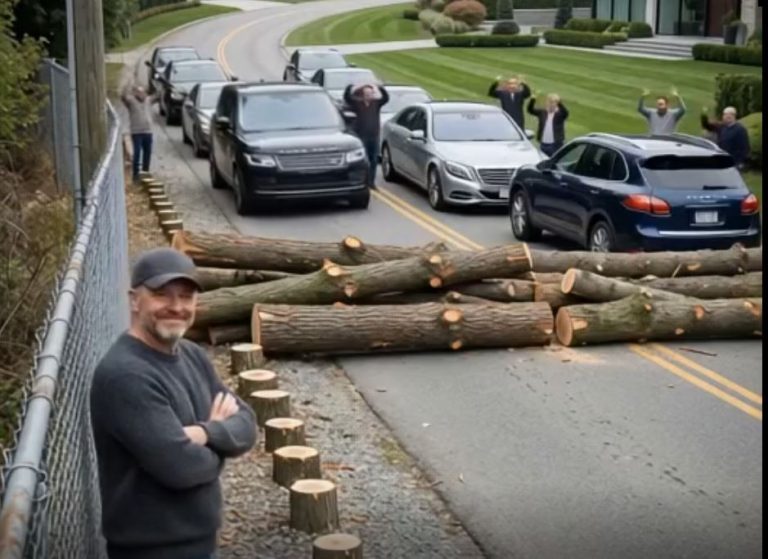
A Property Dispute Over Trees Leads to a Complicated Neighborhood Conflict
The six trees had stood along the eastern edge of Eli’s property for decades. They provided shade during the summer, added privacy to the yard, and had become a familiar part of the landscape.
Three of them had been planted by Eli’s father when Eli was a child. The remaining trees were added years later. Together, they formed a natural boundary between the property and the newer development on the ridge above it.
Then, one ordinary Tuesday afternoon, Eli came home to find that the trees were gone.
What remained were six freshly cut stumps.
The trees had not fallen during a storm. They had not been removed as part of a project Eli had approved. According to what his sister Mara later explained, a professional tree crew had arrived earlier that day and removed them after receiving instructions from the homeowners association of the nearby Cedar Ridge Estates development.
The reason given for the work was that the trees were affecting a view from the neighborhood.
That explanation immediately raised a much larger question: who had actually authorized the removal, and did the people who ordered the work have any legal right to do it?
A Normal Day Takes an Unexpected Turn
Eli’s day had started like any other workday.
He was sitting at his desk during lunch when his sister called.
Mara rarely contacted him during work hours unless something needed immediate attention. When he answered, she sounded unusually tense.
“You need to come home,” she told him.
Eli asked what had happened, but she did not provide many details over the phone. She simply asked him to return as soon as possible.
He left work after informing his manager that there was a family matter to deal with and began the drive home.
The trip usually took a predictable amount of time, but that afternoon it felt longer.
As he approached his property, Eli noticed nothing unusual from the road. The weather was clear, and there were no obvious signs of damage.
It was only after turning onto the road leading to his home that he realized something had changed.
The familiar line of trees along the eastern side of the property was missing.
Six Stumps Instead of Six Trees
The difference was immediately noticeable.
For years, the six sycamores had formed a natural screen between Eli’s property and the ridge above it.
Their branches provided shade and privacy. They also helped define the character of the land.
Now there were only stumps.
The cuts appeared fresh, and the area had been cleaned of most of the branches and larger pieces of wood.
It looked less like the aftermath of a storm and more like a professional tree-removal operation.
Mara was standing near the fence.
She explained that she had been at the property earlier that morning when two trucks arrived.
The vehicles belonged to a tree-management company, and several workers were wearing safety equipment.
Mara initially assumed that Eli had hired them.
When she approached the crew and asked what they were doing, one of the workers told her that they were carrying out a work order.
Mara asked who had requested the work.
According to her account, the worker identified the Cedar Ridge Estates homeowners association.
That was when the situation became confusing.
The Property Was Not Part of Cedar Ridge
Cedar Ridge Estates was a relatively new development located on the ridge above Eli’s property.
The neighborhood had been built several years after Eli’s family had already owned the land.
The development had its own entrance, private roads, shared amenities, and homeowners association.
Eli’s property, however, was not part of the development.
There was no homeowners association agreement governing his land.
The trees had also been planted long before Cedar Ridge Estates existed.
Mara said she had explained this to the workers and asked whether they had verified the property boundary.
She was told that the crew had been given instructions for what was described as a boundary-clearing project.
That explanation did not answer the central question.
If the trees were located entirely on Eli’s property, why had someone outside the property authorized their removal?
The Tree Company
A business card from the tree company had been left at the property.
Eli contacted the company and spoke with a representative named Brad.
He asked why the crew had removed six trees without his permission.
Brad explained that the company had received a work order from Cedar Ridge Estates’ homeowners association.
According to Brad, the request involved clearing vegetation near an area that residents of the development considered part of their view corridor.
Eli explained that the trees were on his property and that he had not authorized their removal.
Brad’s response was cautious.
He explained that the company had acted according to the information provided by the client and suggested that any property dispute should be addressed with the party that had requested the work.
The conversation left Eli with more questions than answers.
The key issue was no longer simply the loss of the trees.
It was the question of property boundaries and authorization.
Why Property Boundaries Matter
Property disputes involving trees can become complicated surprisingly quickly.
A tree may stand near a boundary line, with its trunk on one property while branches extend over another.
In other cases, a tree may appear close to a boundary but actually be located entirely on one side.
Visual estimates are not always reliable.
Property deeds, surveys, recorded plats, easements, and other legal documents may be necessary to determine exactly where a property begins and ends.
This is why homeowners are generally advised to verify boundaries before removing trees or making changes near a neighboring property.
A fence does not always represent the precise legal boundary.
Likewise, a driveway, landscaping feature, or line of trees should not automatically be treated as evidence of the exact property line.
Professional surveys can provide more reliable information when ownership is disputed.
The Importance of Documentation
After discovering the trees had been removed, Eli began documenting what had happened.
He photographed the remaining stumps, the surrounding area, tire marks, and any other visible evidence of the work.
He also kept the business card from the tree company and wrote down what he remembered from his conversation with Brad.
Mara provided her own account of what she had seen that morning.
Documentation can be particularly important in property disputes because memories can change over time.
Photographs can establish the condition of an area at a particular point in time.
Written communications can show what different parties knew or believed.
Invoices and work orders may identify who requested a particular service.
A property survey can help establish where the relevant boundary is located.
These records can make it easier for the parties involved to understand what actually happened.
The Question of Who Authorized the Work
The homeowners association became the next focus of Eli’s attention.
He wanted to understand why the association had requested the tree removal.
There could have been a misunderstanding about the boundary.
The association may have believed that the trees were located on property under its control.
Someone may have provided inaccurate information.
Or there could have been an issue involving an easement or another legal right that Eli was unaware of.
Until the relevant documents were reviewed, it would be difficult to know exactly what had happened.
This is an important distinction in property disputes.
What one party believes about ownership is not necessarily the same as what official records establish.
A disagreement should therefore be investigated through documentation rather than assumptions.
A View Versus Property Rights
The situation also raised an interesting question about views and property ownership.
People often purchase homes partly because of the surrounding landscape.
A property overlooking mountains, forests, water, farmland, or open space can be particularly attractive.
But enjoying a view does not necessarily give a homeowner the right to remove vegetation on someone else’s land.
In many jurisdictions, property owners have rights regarding trees located on their own property, subject to applicable local laws, easements, environmental restrictions, and other considerations.
The details can vary significantly depending on location.
That is why a disagreement involving trees should not be resolved solely through personal assumptions about what seems reasonable.
Checking local law and obtaining appropriate professional advice can help clarify the situation.
The Role of Homeowners Associations
Homeowners associations can manage shared property and enforce community rules, but their authority is generally defined by governing documents and applicable law.
An HOA’s powers do not automatically extend to property outside the community.
However, developments can have easements, access agreements, shared roads, utility rights, drainage arrangements, or other legal interests that cross property boundaries.
Those documents can sometimes create responsibilities or rights that are not obvious from simply looking at a map.
For that reason, anyone involved in a dispute with an HOA should review the relevant property documents before drawing conclusions.
In a situation like Eli’s, the question would not simply be whether the HOA wanted the trees removed.
The more important question would be whether it had a legal basis for requesting the work.
The Road Through the Property
There was another detail that made the situation more complicated.
A road providing access to Cedar Ridge Estates crossed a portion of Eli’s property.
Eli had always understood the arrangement to involve an established access right.
The development’s residents used the road regularly to reach their homes.
When Eli began looking through his property documents, he realized that the road and its legal status could be relevant to the dispute.
However, simply owning land beneath or beside a road does not necessarily mean the owner can close it.
An easement or recorded access agreement may give other parties the right to use the road.
Public roads may also be subject to completely different rules from private roads.
This distinction became extremely important.
Instead of taking immediate action, Eli decided to investigate the documents first.
Why Retaliation Can Make a Dispute Worse
At first, Eli was understandably frustrated.
The trees had personal significance because his father had planted some of them when Eli was young.
Their removal had changed the appearance and privacy of the property.
It was tempting to respond immediately.
However, closing an access road, blocking traffic, placing barriers, or otherwise interfering with a neighbor’s access without confirming the legal situation could create a new dispute.
What appears to be a straightforward response may have legal consequences.
For that reason, property owners dealing with conflicts often benefit from taking a step back and documenting the situation before making decisions.
A measured response can protect the owner’s interests better than an immediate act of retaliation.
Reviewing the Property Records
Eli contacted a professional to help review the property records.
The relevant documents included the deed, recorded survey information, and records relating to the access road.
The goal was to determine exactly what rights existed and where the property boundaries were located.
The review also helped distinguish between three different issues:
Ownership of the land.
Rights to use the road.
Rights involving vegetation near the boundary.
These questions were related but not identical.
Understanding that distinction helped prevent the situation from becoming even more complicated.
What the Trees Represented
For Eli, the trees were more than landscaping.
They represented family history.
His father had planted some of them when Eli was young, and they had grown alongside the family.
Over the years, the trees had become part of the background of birthdays, family gatherings, summer afternoons, and ordinary days at home.
Their removal could not be undone quickly.
Even if new trees were planted, they would take many years to reach the size of the originals.
This is one reason disputes involving mature trees can become emotionally significant.
Trees can provide shade, privacy, wind protection, wildlife habitat, and visual character.
They can also have personal meaning that is difficult to measure financially.
At the same time, resolving a property dispute generally requires separating the emotional value of the trees from the legal questions surrounding their removal.
Finding a Constructive Path Forward
Once the relevant documents were reviewed, Eli had a clearer understanding of the situation.
Rather than taking matters into his own hands, he considered communicating formally with the HOA and the tree company.
The objective was to establish what happened, determine who authorized the work, and discuss how the situation could be addressed.
Depending on the circumstances and applicable law, possible solutions in a property dispute might include reimbursement for unauthorized work, replacement landscaping, restoration efforts, formal boundary clarification, or an agreement regarding future maintenance.
The appropriate solution would depend on the facts and the legal rights involved.
Not every dispute needs to become a prolonged conflict.
Clear documentation and professional communication can sometimes resolve disagreements more effectively than public arguments or retaliatory actions.
The Broader Lesson About Neighbor Disputes
The story of Eli’s trees illustrates how quickly a seemingly small property issue can become complicated.
A homeowner may see a tree as part of a landscape.
A neighboring community may see it as an obstruction.
A contractor may see a work order.
An HOA may believe it has authority to address an area.
But each perspective needs to be compared with the actual property records and applicable rules.
The safest approach is to verify facts before acting.
That includes confirming boundaries, reviewing easements, checking local regulations, and communicating with the parties involved.
When necessary, professional advice can help determine what options are available.
Trees and Neighboring Properties
For homeowners, it is generally useful to understand where property boundaries are located before planting large trees.
Fast-growing species can eventually become substantial and may create disagreements if planted too close to a boundary.
Before planting, homeowners can consider mature tree size, root growth, branches, sunlight requirements, maintenance needs, and local regulations.
Existing trees should also be monitored regularly.
If a tree becomes damaged, diseased, or unstable, professional assessment may be appropriate.
Good communication with neighbors can sometimes prevent disagreements before they begin.
The same principle applies to fences, sheds, driveways, drainage systems, landscaping, and other improvements near property lines.
Why Professional Surveys Can Be Valuable
A professional land survey can be especially useful when ownership is unclear.
Surveyors use legal descriptions and measurement techniques to identify boundaries based on recorded information.
This can be more reliable than relying on an old fence or visual landmarks.
For property owners who plan major landscaping, construction, fencing, or other improvements near a boundary, confirming the location beforehand may prevent future disagreements.
In Eli’s situation, the survey information became an important part of understanding what had happened.
It helped move the conversation away from assumptions and toward documented facts.
A Better Way to Handle Property Conflicts
Property disputes can be stressful, particularly when they involve family history or significant changes to a home.
Still, several practical steps can help keep a disagreement manageable.
First, document the situation.
Second, identify the parties involved.
Third, collect relevant property records.
Fourth, confirm the boundary.
Fifth, review any easements or agreements.
Sixth, communicate in writing when appropriate.
Seventh, seek qualified professional advice if the dispute involves significant property rights or potential legal claims.
Most importantly, avoid assuming that an immediate retaliatory action is automatically lawful.
A response that feels justified emotionally may create additional complications.
A Different Ending Than Expected
The original story might be summarized as a simple act of retaliation: a neighboring community removed trees for a better view, so the property owner closed the road used by the community.
But the real-world issues are more complicated.
A private road may be governed by easements.
An HOA may have defined powers.
Trees may be subject to local regulations.
Property boundaries may not be obvious.
And contractors may rely on information supplied by the person who hires them.
For these reasons, a responsible resolution requires more than simply