For months, I had been preparing my six-year-old daughter, Emma, for her first flight.
Because Emma has autism, I knew the experience could be overwhelming. We practiced what would happen at the airport, talked about the sounds of the plane, and packed her favorite headphones and stuffed airplane.
Most importantly, I had reserved a window seat for her.
Watching the clouds and sky helped Emma stay calm when she became anxious. I wanted her first flight to feel safe and predictable.
I had no idea how quickly those careful plans would be tested.
The night before our trip, I sat on Emma’s bedroom floor while she slept.
Her little suitcase was covered with cloud stickers, and her stuffed airplane, Buzz, was tucked beneath one arm.
This trip was more meaningful than it probably looked from the outside.
Emma’s father, Sean, had passed away two years earlier, and since then, most of our lives had revolved around appointments, routines, and getting through difficult days.
This was supposed to be something different.
Four days at the beach.
Just us.
The following morning, Emma stood at the airport window staring at the aircraft.
“Is that our plane?”
“Yes.”
“And I get to see the clouds?”
I smiled.
“You have seat 7A. Right beside the window.”
She hugged Buzz and smiled.
We boarded shortly afterward.
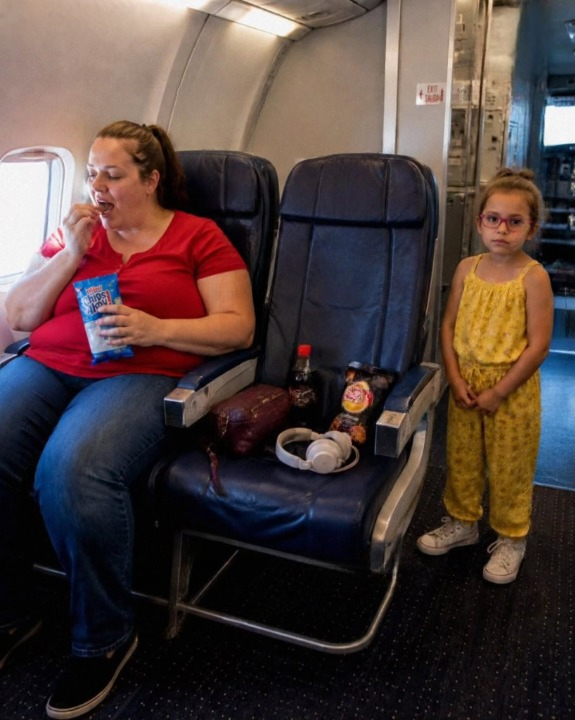
When we reached row 7, however, a woman was already sitting in Emma’s seat.
I checked our boarding passes again.
7A and 7B.
Exactly as booked.
“Excuse me,” I said politely. “I believe you’re sitting in our seats.”
The woman looked at our boarding passes.
Then she looked at Emma.
“I paid for this window seat,” she said.
“So did we.”
Before the conversation could continue, a flight attendant approached.
Her name was Lisa.
I showed her our boarding passes.
She checked the woman’s ticket and then looked at the seating chart.
“There was an aircraft change this morning,” she explained. “Unfortunately, the system reassigned several passengers incorrectly.”
She turned toward the woman.
“Your original seat was 14C. Seat 7A was assigned to you during the change, but this child had already been booked into 7A.”
I explained quietly that Emma was autistic and that the window seat was important for her.
Lisa asked whether the woman would be willing to move to another available seat.
The woman shook her head.
“I paid for a window seat. I’m staying here.”
I felt Emma’s hand tighten around mine.
I knew that look.
She was becoming overwhelmed.
I had two choices: continue arguing or get my daughter somewhere quiet.
I chose Emma.
“It’s okay,” I whispered. “We’ll sit somewhere else.”
Lisa apologized and found two seats farther back.
As we walked down the aisle, I noticed her speaking quietly with another couple near row 19.
I didn’t think much of it.
Once we were seated, I put Emma’s headphones on and gave her the coloring book we’d packed.
For a while, she managed well.
But after takeoff, she began looking around.
“Mommy, sky.”
“I know, sweetheart.”
From our seats, she could barely see outside.
The woman in 7A, meanwhile, appeared to be enjoying the view.
I tried not to look.
I reminded myself that the most important thing was keeping Emma comfortable.
An older passenger sitting nearby noticed what was happening.
She leaned toward us.
“Would she like to look through my window for a moment?”
Emma hesitated.
I nodded.
The woman shifted slightly so Emma could see a small patch of blue sky.
Emma smiled.
“Cloud.”
“Yes,” I whispered. “That’s a cloud.”
It helped, but only briefly.
About an hour and a half into the flight, the captain made an announcement.
“Ladies and gentlemen, this is Captain Brown.”
His voice was calm and friendly.
He explained that the crew wanted to recognize passengers who had shown kindness during the flight.
I looked up.
A flight attendant was walking toward row 7 carrying a small wrapped box.
She stopped beside the woman in the window seat.
“Ma’am, we’d like to give you this.”
The woman looked surprised.
She opened the box.
Inside was a card.
Her expression changed as she read it.
The flight attendant then explained that the crew had been informed about the seating dispute before takeoff.
They had also noticed the child’s difficulty during the flight.
The message wasn’t meant to embarrass anyone.
Instead, it reminded passengers that small acts of consideration can make a huge difference to another traveler.
The woman looked down at the card.
For the first time, she seemed to understand what the situation had meant to Emma.
She quietly asked the flight attendant whether there was still a way to help.
Lisa smiled.
“There is.”
She explained that another couple had volunteered to exchange seats with us.
They had already agreed to give Emma access to their window seat once the crew determined it was safe to move passengers.
I looked toward row 19.
The couple smiled and stood.
“We’d be happy to switch,” the man said.
I thanked them, and we carefully moved Emma to the window.
The moment she saw the clouds, her entire expression changed.
She pressed both hands against the glass.
“Mommy! Look!”
I leaned closer.
“What do you see?”
“Pillows!”
I laughed.
“They do look like pillows.”
She spent the rest of the flight watching the sky.
The earlier anxiety gradually disappeared.
The woman from 7A never approached us, and I didn’t expect her to.
But as we prepared to land, I noticed her speaking quietly with Lisa.
She then glanced toward Emma.
There was no argument.
No dramatic apology.
Just a small nod.
When we landed, Captain Brown met us near the cockpit.
He crouched slightly so he could speak to Emma at eye level.
“Did you enjoy your first flight?”
Emma nodded enthusiastically.
He handed her a small pair of pilot wings.
“You’re officially part of the crew now.”
Emma immediately showed me.
“Mommy, look!”
I smiled.
“I see them.”
Captain Brown then turned to me.
“You did a good job helping her through the difficult moments.”
Those simple words meant more than he probably realized.
For two years, I had wondered whether I was doing enough for my daughter.
That day reminded me that I didn’t have to handle everything alone.
Sometimes support comes from a flight attendant who notices.
Sometimes it comes from a stranger willing to give up a seat.
Sometimes it comes from a pilot who understands that a small gesture can change someone’s entire day.
As we walked through the airport toward the exit, Emma held Buzz in one hand and her little pilot wings in the other.
She looked up at me.
“Can we fly again?”
I smiled.
“Absolutely.”
She pointed toward the windows.
“Next time, I want the clouds again.”
I hugged her.
“Next time, we’ll make sure you get the best view.”
And as we walked toward the sunshine outside, I realized our first flight hadn’t gone according to plan.
But maybe that wasn’t the point.
Emma had learned that unfamiliar places could still contain kind people.
And I had learned something too.
When life doesn’t go exactly as planned, sometimes the best moments come from the people who choose to make room for someone else.