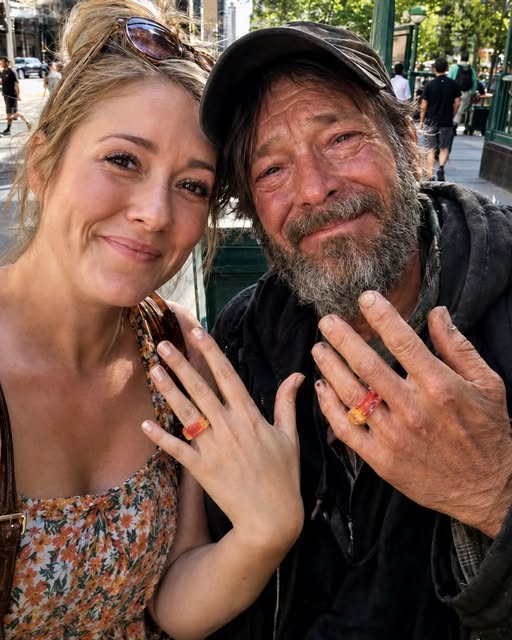
A Homeless Man Asked Me to Marry Him Before He Died—Then His Letter Changed Everything
Every morning, on my way to work, I passed the same man sitting near the entrance of my subway station.
His name was Larry.
I didn’t know much about his life when I first met him. I only knew that he was quiet, polite, and never seemed interested in causing trouble.
He sat on a piece of cardboard beside a brick wall, usually wearing the same dark coat no matter what the weather was like.
Some mornings, commuters ignored him.
Others dropped a few coins into the cup beside his feet.
Larry always thanked them.
He never shouted.
He never followed anyone.
He simply sat there, watching thousands of people hurry past him every day.
I first spoke to him because one morning I noticed that he was shivering.
It was unusually cold, and I had just bought myself a coffee before entering the station.
I looked at him, then at the cup in my hand.
“Do you want this?”
He looked surprised.
“For me?”
I nodded.
He accepted it carefully.
“Thank you.”
“You’re welcome.”
That should have been the end of it.
Instead, the next morning, I bought two coffees.
Larry smiled when he saw me.
“Black?” he asked.
I laughed.
“You remembered.”
“You always get black coffee.”
“Apparently I have a predictable personality.”
“That’s not necessarily a bad thing.”
That was how our little routine began.
Every morning, I would buy two coffees.
Sometimes we talked for five minutes.
Sometimes only thirty seconds.
We talked about the weather, the subway, the construction happening across the street, and occasionally about the strange things people did during rush hour.
Larry had a dry sense of humor.
He could make observations that made me laugh even when I was already late for work.
Over time, I learned a few things about him.
He had once worked with his hands.
He liked old jazz records.
He hated sweet coffee.
He loved dogs.
And he had been estranged from his family for many years.
He never explained exactly why.
I didn’t push.
There are some questions you don’t ask someone simply because you have the right to know.
I was never particularly wealthy, either.
I had an apartment, a job, and enough money to live comfortably, but I wasn’t someone who could solve another person’s problems with a check.
So I never pretended that I could.
I simply brought coffee.
And Larry seemed grateful for that small kindness.
For almost two years, our routine continued.
Then, one Tuesday morning in January, everything changed.
It was bitterly cold.
The wind came through the streets like a knife, and I remember pulling my scarf tighter around my neck as I approached the station.
I expected to see Larry sitting in his usual place.
But he wasn’t holding his coffee cup.
He wasn’t asking for change.
Instead, he was holding a piece of cardboard.
I almost walked past him.
Then I saw what was written on it.
MARRY ME.
I HAVE ONE MONTH LEFT TO LIVE.
I stopped.
For several seconds, I simply stared.
Then I crouched beside him.
“Larry?”
He looked up.
His face seemed thinner than usual.
His skin was pale, and there were dark circles beneath his eyes.
I held out his coffee.
He accepted it with shaking hands.
“What is this?”
He looked down at the cardboard.
“It’s a question.”
“I can see that.”
He gave me a weak smile.
“I was hoping you might say yes.”
I thought he was joking.
“Larry, are you serious?”
He nodded.
“I am.”
I looked around.
People were passing us without paying attention.
“Why would you ask me this?”
His expression changed.
The humor disappeared.
“The doctors told me I probably have about a month.”
I stopped smiling.
“What?”
He looked at his coffee.
“I’ve been sick for a while. Liver failure.”
I didn’t know what to say.
“Are you getting treatment?”
“I’m receiving medical care.”
“But they said there’s nothing more they can do?”
“They said they can’t predict exactly how much time I have.”
He paused.
“I told people one month because that’s the estimate I was given.”
I stared at him.
“And marriage?”
He swallowed.
“That’s the part I couldn’t explain to anyone else.”
I sat beside him.
“Try me.”
Larry looked toward the subway entrance.
“Sarah, I’ve spent years being invisible.”
“You aren’t invisible.”
“To most people, I am.”
I couldn’t argue with that.
He continued.
“If I die without anyone claiming me, I don’t know what will happen. I’ve been told that my belongings could be disposed of, and my remains could eventually be handled through the city system.”
He took a breath.
“I don’t want my life to end without anyone knowing where I belong.”
I felt a lump forming in my throat.
“You want a wife to claim your remains?”
He nodded.
“Someone who can make sure I’m buried properly.”
“Why me?”
He looked directly at me.
“Because you have treated me like a person for two years.”
That sentence stayed with me.
Not because it was romantic.
It wasn’t.
It was heartbreaking.
He wasn’t asking for a grand love story.
He was asking not to disappear.
I went to work that morning, but I couldn’t concentrate.
My computer screen was open in front of me.
Emails arrived.
Meetings happened.
People talked around me.
I heard almost none of it.
I kept thinking about Larry.
At lunchtime, I searched for information about what happens to people who die without family or someone to make arrangements for them.
I learned that the exact process varies depending on local laws and circumstances.
But I also realized something else.
Marriage wasn’t a simple solution.
There were legal responsibilities.
Financial considerations.
Medical issues.
Estate questions.
And countless details I hadn’t even thought about.
So when Larry called me that evening, I told him we couldn’t simply sign papers without understanding what we were doing.
“I agree,” he said.
“You’re not angry?”
“No.”
“I need to know exactly what marriage would mean.”
“You should.”
“And I don’t want either of us pretending this is a romantic relationship.”
“I wouldn’t ask that of you.”
I was quiet.
Then I asked:
“Why didn’t you ask someone else?”
He laughed softly.
“Who?”
I didn’t have an answer.
He didn’t either.
Over the next few days, we spoke with people who could explain the legal process.
I wanted everything to be transparent.
There would be no secret bank accounts.
No hidden debts that I knowingly accepted.
No promises about property.
No expectations of a relationship beyond what we both understood.
Larry agreed.
Eventually, we went to the courthouse.
I remember standing outside the building with him.
He looked nervous.
“So,” I said, “are you sure?”
He smiled.
“I’m terrified.”
“Me too.”
“That’s comforting.”
I laughed.
We entered together.
The paperwork took longer than either of us expected.
When everything was completed, we walked back outside.
It was snowing.
Larry looked at the marriage certificate in his hand.
“I never thought I’d get married.”
“Neither did I.”
He looked at me.
“Thank you.”
I shrugged, trying to keep things light.
“Don’t thank me yet. You still owe me a coffee.”
He laughed.
“Fair enough.”
That was the strangest wedding I could imagine.
No flowers.
No music.
No family.
No celebration.
Just two people standing outside a courthouse in the snow.
But something about that moment stayed with me.
Not romance.
Something quieter.
Human connection.
For the next three weeks, I visited Larry whenever I could.
His health declined quickly.
He eventually moved into a hospice facility where he could receive professional care.
The first time I visited him there, he looked almost relieved.
“You came.”
“Of course.”
He smiled.
“I wasn’t sure.”
“Why?”
“Because this wasn’t supposed to become your problem.”
I sat beside him.
“You’ve been my friend for two years.”
“Friend?”
“Yes.”
He smiled.
“I like that.”
We talked for hours.
He told me more about his life than he ever had before.
He had grown up in a small town.
His father had been difficult.
His mother had died when he was young.
He had married once many years earlier, but the relationship had ended badly.
He had lost contact with several people he once considered friends.
A series of financial problems had eventually led to homelessness.
He had worked various temporary jobs, but keeping stable housing became increasingly difficult.
There was no single moment that explained how he ended up on the street.
It was a long chain of setbacks.
I asked him once whether he regretted anything.
He thought about it.
“I regret not asking for help sooner.”
“Why didn’t you?”
“I thought needing help meant I’d failed.”
I looked at him.
“Maybe needing help just means you’re human.”
He smiled.
“I wish someone had told me that twenty years ago.”
Three weeks after our courthouse wedding, Larry’s condition became much worse.
I visited him one afternoon.
He was asleep when I arrived.
I sat beside his bed and read quietly.
After a while, he opened his eyes.
“Sarah?”
“I’m here.”
He looked at me.
“Did you bring coffee?”
I laughed.
“No. You’re in hospice.”
“Then this place needs better management.”
I smiled.
We talked for a little while.
Before I left, he took my hand.
“I need to ask you something.”
“What?”
“When I’m gone, don’t spend your life feeling sorry for me.”
I didn’t answer.
“I’m serious,” he continued.
“Promise me.”
I nodded.
“I promise.”
“And Sarah?”
“Yes?”
“Thank you for seeing me.”
I squeezed his hand.
“You made that pretty easy.”
He smiled.
I didn’t know it would be the last time we’d speak.
Larry died two days later.
I was notified by the hospice.
I sat in my apartment for a long time after receiving the call.
There was no dramatic collapse.
No screaming.
Just silence.
I looked at the coffee maker in my kitchen.
For almost two years, I had made two cups every morning.
The next morning, I made only one.
It tasted strangely wrong.
A few days after the funeral arrangements were completed, I returned to work.
Life continued in the way life always does.
People went to offices.
Trains arrived.
Coffee shops opened.
Cars moved through intersections.
The world didn’t stop because Larry had died.
But I noticed his absence everywhere.
Every time I passed the subway entrance, I expected to see his coat.
Every time I b