A Flight Attendant Helped Calm a Toddler Mid-Flight, but Her Familiar Smile Left His Mother With Questions
Traveling with a young child can be challenging, especially when delays, crowded cabins, and unfamiliar surroundings make an already long journey feel even longer. For one mother, a difficult flight with her three-year-old son, Elias, began as an exhausting experience. What she expected to be an ordinary trip, however, became a moment she would remember for a very different reason.
It started before the airplane had even left the ground.
The departure had been delayed, passengers were growing impatient, and Elias was having trouble settling down. At three years old, he was still learning how to manage his emotions, and the combination of waiting, noise, and unfamiliar surroundings seemed to be more than he could handle.
His mother had prepared for the journey as carefully as she could. She had packed snacks, children’s books, and a tablet loaded with some of his favorite cartoons. She had hoped that a combination of familiar activities and small treats would make the trip easier.
But none of her preparations seemed to help for long.
Elias became upset again and again, leaving his mother feeling increasingly tired and unsure of what to try next. She knew that young children sometimes struggle with travel, but understanding the reason for a tantrum does not necessarily make it easier to manage one in a crowded airplane cabin.
She tried offering him something to eat, encouraging him to look at his books, and distracting him with the activities she had brought along. Still, he remained unsettled.
Around them, other passengers were preparing for the journey. Some appeared focused on their phones, while others watched the cabin activity or spoke quietly to their travel companions. The mother was conscious of the people sitting nearby and worried that her son’s distress was disturbing them.
She wanted to comfort Elias without making the situation more stressful for either of them.
Then a flight attendant approached.
The woman had a warm expression and a friendly manner that immediately made her seem approachable. Rather than speaking to Elias from above or asking him to stop crying, she crouched down so that she could meet him at eye level.
She offered him a small plastic cup containing pretzels.
Then she gave him a simple invitation.
“Hey, buddy, would you like to help me with a very important job?”
It was a small gesture, but it changed the direction of the moment.
Instead of treating Elias as a problem that needed to be managed, the flight attendant gave him something positive to focus on. She spoke to him as though he were capable of helping, allowing him to feel involved rather than overwhelmed.
For a young child, that kind of approach can sometimes make a meaningful difference. Children often respond well when an unfamiliar situation becomes a game or when an adult gives them a simple task that captures their attention.
The flight attendant seemed to understand this instinctively.
Within a short time, Elias became calmer. His attention shifted away from the things that had upset him, and he began following the attendant as she moved through the cabin.
His mother watched the change with a mixture of relief and curiosity.
Only minutes earlier, she had been struggling to find something that would comfort her son. Now he appeared interested in the woman who had offered him pretzels and invited him to help.
Every so often, the flight attendant looked back toward the mother and gave her a reassuring thumbs-up.
The small gestures helped the mother relax. For the first time since boarding, she could take a breath without immediately wondering what she should do next.
The attendant continued performing her duties while keeping an occasional eye on Elias. Her friendly approach made the experience feel less overwhelming, and the mother appreciated the patience she showed.
As the flight continued, the cabin gradually settled into the familiar rhythm of air travel. Passengers adjusted their seats, watched entertainment screens, read books, or looked out the windows as the landscape passed far below.
Somewhere over Colorado, however, Elias did something that caught the attention of several people nearby.
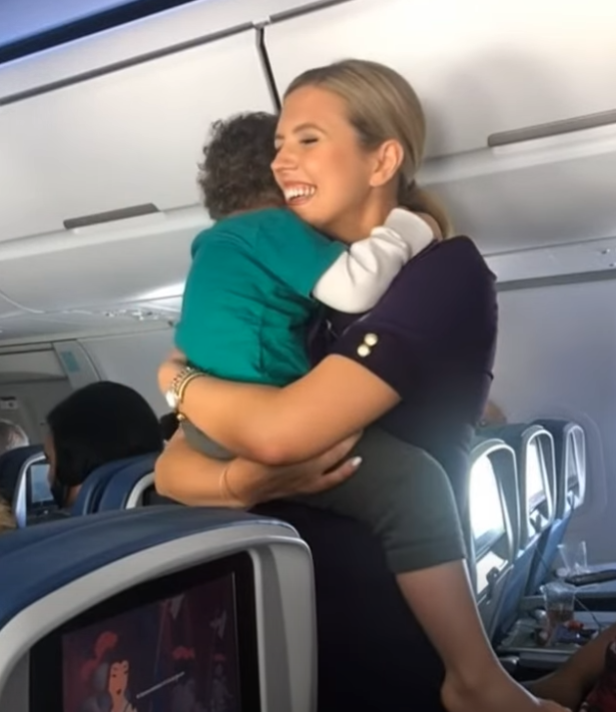
He approached the flight attendant and ran into her arms. Then, in a spontaneous display of affection, he kissed her on the cheek.
The woman appeared genuinely surprised. She laughed warmly and responded with a gentle embrace, clearly touched by the child’s unexpected gesture.
For a moment, the surrounding cabin seemed to share in the happiness of the encounter.
A few passengers smiled. Someone raised a phone to capture the moment, while another person applauded. One traveler reportedly remarked that it was the sweetest thing they had seen all week.
Elias’s mother watched the scene unfold.
At first, she might have expected to feel only gratitude. The flight attendant had helped her son settle down when she was struggling, and the child’s affection appeared to be a natural response to the kindness he had received.
But as the mother looked more closely at the woman, something about her expression began to feel familiar.
It was not simply that the attendant had been friendly. It was her smile.
The mother had seen that smile somewhere before, years earlier. The memory was distant, but the resemblance was strong enough to make her pause.
She tried to place it.
Perhaps it was a photograph she had once seen. Perhaps it belonged to someone connected to a chapter of her life she had not thought about in a long time.
The memory became more specific as she continued watching the attendant. She recalled a photograph displayed on a refrigerator in a place that had not been her own home.
She remembered looking at that picture years earlier, although the circumstances surrounding it were not immediately clear.
Then another detail came back to her.
Elias had occasionally said a name while sleeping.
“Auntie Ray.”
The mother remembered hearing the words before. At the time, she had not necessarily attached any special significance to them. Young children sometimes mention people, places, and names in their sleep, and such moments can be difficult to interpret.
But now, standing in the airplane cabin and looking at the flight attendant, the memory seemed connected to the face before her.
Could the woman be the person Elias had mentioned?
The thought left the mother with more questions than answers.
She looked at the attendant again, trying to determine whether the resemblance was as strong as it seemed. The woman’s expression was relaxed, and she continued interacting with passengers as part of her normal duties.
Nothing about the brief encounter established the full story behind the mother’s recognition. A familiar smile can bring back powerful memories, but resemblance alone cannot explain a person’s relationship to another family.
Still, the timing of the moment made it difficult for the mother to dismiss what she was remembering.
A few minutes earlier, she had been concerned about managing her son’s behavior during a difficult flight. Now she was thinking about an old photograph, a name she had heard in the quiet of the night, and a possible connection she had not expected to encounter while traveling.
She wondered whether she should say something.
Approaching the attendant with questions about her identity or family connections could be awkward, particularly while the woman was working. The mother did not want to make an uncomfortable assumption or place the attendant in a difficult position in front of other passengers.
At the same time, she wanted to understand why the encounter had stirred such a strong memory.
For now, she watched quietly as Elias returned to his seat and continued enjoying the flight. His earlier distress had faded, and he seemed content with the experience.
The contrast was remarkable. What had begun as a stressful journey had become a calmer and more pleasant one, largely because a stranger had taken a few moments to treat a small child with patience.
That kindness mattered regardless of whether the mother’s suspicions proved correct.
Flight attendants have many responsibilities during a journey. They assist passengers, provide information, help maintain cabin safety, and respond to a wide range of needs. A young child who is having a difficult time may require additional patience, but a simple conversation or an age-appropriate distraction can sometimes make the experience easier.
For parents, traveling with children can also involve a great deal of invisible effort. Packing familiar snacks and activities, trying to anticipate a child’s needs, and managing emotions in a public setting can be exhausting. When another adult offers understanding rather than criticism, the relief can be significant.
That was certainly true for Elias’s mother.
The attendant had not needed to do anything extraordinary. She had simply approached the child with warmth, offered him a small treat, and invited him to participate in something that made him feel included.
Yet that ordinary act of consideration had made a noticeable difference.
The unexpected affection Elias showed her was a reminder that children sometimes respond to kindness in spontaneous ways. His kiss was not proof of a particular family relationship, but it was a touching moment between a child and an adult who had helped him feel comfortable.
For the mother, however, the experience carried another layer of meaning.
The smile, the remembered photograph, and the name “Auntie Ray” had brought together fragments of memory that she had not previously connected. She now had a reason to wonder whether the attendant was someone from her past, but the details remained uncertain.
The story ends at the point when that question begins to take shape. It does not establish whether the flight attendant really was Auntie Ray, how she might have known Elias, or what the old photograph meant to the mother.
Those unanswered questions are important. Without the rest of the account, it would be impossible to say whether the resemblance reflected a genuine family connection, a coincidence, or a memory that required further explanation.
What is clear is that the encounter affected the mother in two different ways. On the practical level, the flight attendant helped turn a difficult flight into a more manageable experience. On the personal level, the interaction prompted the mother to revisit a memory she had apparently carried for years.
Sometimes, ordinary moments have an unexpected emotional impact because they remind us of people, places, or experiences we thought we had left behind. A familiar expression, a name, or even a passing conversation can encourage us to reconsider something we once believed we understood.
The best way to resolve such uncertainty is through a respectful conversation rather than assumptions. If the mother decided to approach the attendant, she could explain that the woman’s face seemed familiar and ask whether they might have met before. That would allow both people to clarify the situation without turning a private question into a public spectacle.
Whatever the explanation, the incident offers a simple reminder about the value of patience and human connection.
A parent who is struggling with a restless child may need understanding more than judgment. A small gesture from a stranger can ease a stressful situation, and a kind interaction can remain meaningful long after the immediate problem has passed.
For Elias, the flight attendant was someone who made a difficult journey more enjoyable. For his mother, the same encounter opened the door to a memory and a question she had not expected to revisit.
Whether those two experiences were connected by a deeper family story remains unknown from the available account. But the moment itself shows how a little kindness can change the atmosphere around us—and how an ordinary day can sometimes leave us thinking about the people and memories that shape our lives.