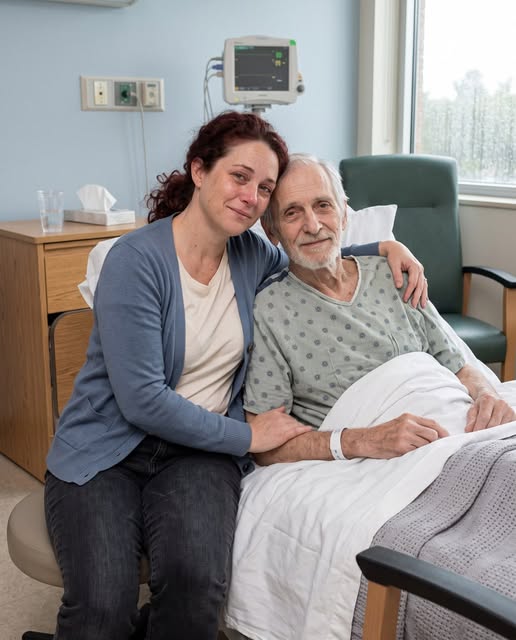
A Dying Man Asked Me to Pretend I Was His Daughter — Then a Nurse Gave Me an Envelope
I never expected to form a friendship with a stranger while visiting my mother in the hospital.
I certainly never expected that stranger to ask me to pretend to be his daughter.
And I could never have imagined that, after his death, a nurse would approach me with an envelope that would completely change the way I understood our unusual friendship.
It all began with something incredibly ordinary.
I was visiting my mother.
She had been in the hospital for several days, and I was spending as much time with her as my schedule allowed.
Her room was across the hall from a man named Thomas.
I noticed him because he always seemed to be alone.
There were no family members sitting beside his bed.
No visitors bringing flowers.
No friends stopping by to check on him.
Most of the time, the only sounds coming from his room were the television and the occasional footsteps of hospital staff walking down the hallway.
Thomas was nearly sixty years old.
He was thin and looked tired, and although he occasionally smiled at nurses, there was a quiet loneliness about him that was difficult to miss.
At first, I didn’t think much of it.
Hospitals are full of people with different circumstances.
Some patients have family nearby.
Others don’t.
I was there to care for my mother, so I didn’t want to interfere in someone else’s life.
Then one afternoon, I happened to walk past Thomas’s room.
I heard something fall.
I looked inside.
A plastic cup had fallen onto the floor beside his bed.
Thomas was trying to reach it, but he was too weak to lean far enough.
I knocked lightly on the open door.
“Do you need some help?”
He looked up.
Then he smiled.
“That would be wonderful.”
I walked in, picked up the cup, and placed it on his bedside table.
“Thank you,” he said.
“You’re welcome.”
I was about to leave when he added:
“You’ve been visiting the woman across the hall, haven’t you?”
I nodded.
“My mom.”
“She’s lucky to have you.”
I smiled.
“Thank you.”
Then I went back to my mother’s room.
I didn’t realize it at the time, but that tiny interaction would be the beginning of a friendship neither of us expected.
A Simple Routine
After that day, Thomas started waving whenever I passed his room.
At first, I simply waved back.
Then I began stopping for a minute.
“How are you feeling today?”
“Better than yesterday.”
“Did you sleep?”
“Not very well.”
“Did you watch anything good on television?”
“Only if you consider old detective shows good.”
We laughed.
Our conversations were simple.
There was nothing dramatic about them.
I wasn’t trying to become part of his life.
He wasn’t trying to become part of mine.
We were simply two people who happened to be in the same hospital.
But gradually, our conversations became longer.
Sometimes I brought my mother a small dessert.
Eventually, I started bringing something for Thomas too.
A piece of fruit.
A cookie.
A small cup of pudding.
Nothing expensive.
Nothing special.
But he always seemed genuinely grateful.
“You don’t have to keep bringing me things,” he told me once.
“I know.”
“Then why do you?”
I shrugged.
“Because I was already stopping at the cafeteria.”
He smiled.
“I think you’re becoming my favorite visitor.”
I laughed.
“You barely know me.”
“That’s probably why.”
Thomas Told Me About His Life
As our conversations continued, Thomas slowly began telling me more about himself.
He had worked for many years.
He loved old movies.
He enjoyed traveling when he was younger.
He once told me that his favorite place he had ever visited was a small coastal town where he had spent a summer many years earlier.
He talked about food too.
He had a weakness for certain desserts.
Whenever I brought him one, he would inspect it carefully before taking the first bite.
“Excellent choice,” he would say.
I began to realize that our conversations were giving him something he desperately needed.
Company.
But I didn’t yet understand just how much.
Thomas had cancer.
His condition was serious, and his health was becoming weaker.
The nurses were kind to him.
The doctors cared for him.
But there was a difference between receiving medical care and having someone sit beside you simply because they wanted your company.
I could see that difference.
So I kept visiting.
The Question I Never Expected
One afternoon, I walked into Thomas’s room with a cup of tea.
He was sitting quietly, looking out the window.
I handed him the cup.
“How are you?”
He smiled.
“Better now.”
I sat down.
We talked for a few minutes.
Then Thomas became unusually quiet.
He looked at me.
There was something different in his expression.
Not sadness exactly.
More like hesitation.
Finally, he reached for my hand.
“Can I ask you something strange?”
I smiled.
“Of course.”
He took a breath.
“Would you pretend to be my daughter?”
I honestly thought I had misunderstood him.
“What?”
He smiled sadly.
“I know how strange it sounds.”
I didn’t know what to say.
Thomas explained that he had a daughter.
But they had been estranged for many years.
They had not spoken in nearly a decade.
He didn’t go into every detail.
He didn’t blame her.
He didn’t speak bitterly.
He simply said that life had become complicated between them.
“I don’t expect you to fix anything,” he told me.
“And I’m not asking you to lie to anyone.”
He paused.
“I just want someone to sit with me sometimes.”
Then he looked toward the empty chair beside his bed.
“You look a lot like her.”
I didn’t know what to say.
He continued.
“When I look at you, sometimes I imagine what it would be like if she had walked through that door.”
His voice became quieter.
“I don’t want to spend all the time I have left staring at an empty chair.”
Those words stayed with me.
Why I Said Yes
I knew his request was unusual.
I also knew that I couldn’t replace his daughter.
Nobody could.
But Thomas wasn’t really asking me to become someone else.
He was asking for companionship.
He wanted to feel, even for a short time, what it was like to have someone who cared sitting beside him.
So I agreed.
“Okay,” I said.
His eyes filled with tears.
“Really?”
“Really.”
He squeezed my hand.
“Thank you.”
From that day forward, our friendship became something slightly different.
Not because I truly became his daughter.
I never pretended to be someone I wasn’t.
But I became someone he could talk to.
Someone who would sit beside him.
Someone who would listen.
Our Conversations Became More Meaningful
I continued visiting my mother as often as possible.
And whenever I was there, I would spend another twenty or thirty minutes with Thomas.
Sometimes longer.
We talked about ordinary things.
What movie he wanted to watch.
What he had eaten.
What kind of weather was outside.
Places he wished he could visit again.
Music he liked.
The first job he ever had.
The car he drove when he was young.
Funny memories from childhood.
Nothing about our conversations had to be profound.
That was part of what made them special.
Thomas didn’t always want to talk about illness.
Sometimes he simply wanted to talk about life.
And I was happy to listen.
He Started Calling Me “Kiddo”
Eventually, Thomas developed a nickname for me.
“Kiddo.”
Whenever I entered the room, he’d smile.
“There she is.”
Sometimes he’d ask:
“Did you bring me anything?”
I’d pretend to be offended.
“Is that the only reason you’re happy to see me?”
He’d laugh.
“No. But the cookies help.”
Those small moments became some of my favorite memories.
I never expected to care so deeply about someone I had met by chance.
But friendship doesn’t always arrive in predictable ways.
Sometimes it begins with something as simple as picking up a fallen cup.
Thomas’s Health Declined
As the weeks passed, Thomas became weaker.
He slept more.
He spoke less.
The nurses spent more time checking on him.
I knew what was happening.
His illness was progressing.
Even though nobody needed to say it directly, I understood that we didn’t have unlimited time.
I started visiting him even when my mother was sleeping.
Sometimes I’d sit beside his bed and read quietly.
Other times we’d watch television.
Sometimes neither of us said much at all.
But I stayed.
Thomas once told me:
“You don’t have to sit here every time.”
I replied:
“I know.”
“Then why do you?”
“Because I want to.”
He smiled.
“That’s what I needed to hear.”
His Daughter
One afternoon, Thomas brought up