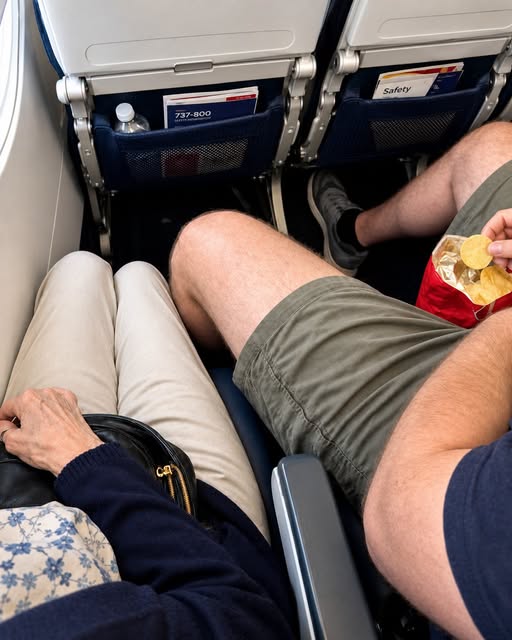
A Man Kept Taking Over My Airplane Seat for Hours — When He Returned From the Restroom, He Couldn’t Believe What I Had Done
I was sixty-one years old, barely five feet two inches tall, and traveling alone to meet my first granddaughter when the man sitting beside me decided that the boundaries of our airplane seats did not apply to him.
I had booked my ticket months earlier. The trip was supposed to be one of the happiest experiences of my life. My daughter had recently given birth, and I was finally going to meet the little girl I had heard so much about during late-night phone calls and video chats.
I had packed a small gift bag, printed my boarding pass, and arrived at the airport early enough to avoid rushing. All I wanted was a comfortable flight, a little rest, and the chance to hold my granddaughter as soon as I arrived.
I had no idea that a stranger’s behavior would become the most memorable part of the journey.
The man assigned to the seat beside me was perhaps fifty years old. He had broad shoulders, an expensive-looking quarter-zip sweater, and polished loafers. Before the plane had even finished boarding, he had already stretched one knee well into my side of the shared space.
At first, I assumed he had not noticed.
Airplane seats are narrow, and people sometimes need a moment to settle in. I moved closer to the window, adjusted my handbag beneath the seat in front of me, and tried to make myself comfortable.
Then he spread his legs even farther.
His knee pressed against mine, and one of his feet extended into the area where I would normally rest my legs.
I turned toward him with a polite smile.
“Excuse me. Would you mind moving your leg a little?”
He glanced down at me, looked at the space between us, and laughed.
“Lady, just look at you. You’re tiny. You don’t need all that room.”
For a moment, I thought he was trying to make a joke. I waited for him to move his leg or at least acknowledge that I had asked a reasonable question.
Instead, he settled farther into his seat.
I decided not to make an issue of it immediately. Perhaps he would adjust once the plane was in the air. Perhaps he was uncomfortable himself and would find a better position after takeoff.
I had spent much of my adult life trying to avoid unnecessary arguments. My late husband used to tease me that I would apologize to a chair if I accidentally bumped into it.
It was an exaggeration, of course, but there was some truth behind the joke. I preferred a peaceful day to a confrontation, and I often gave people the benefit of the doubt.
That habit had served me well in many situations.
On this flight, however, it was about to be tested.
The Invisible Boundary Between Two Seats
Once the plane took off and the seat belt sign was switched off, the man seemed to regard the space between us as an invitation to spread out.
His thigh remained pressed against mine. He occupied the shared armrest, placed his jacket partly across the divider, and continued extending one leg into my limited foot space.
Every time I moved toward the window, he seemed to take the opportunity to stretch farther.
I tried turning slightly toward the window. I adjusted my legs. I placed my hands in my lap and attempted to concentrate on the book I had brought.
None of it helped for long.
My hip began to ache from remaining in an awkward position, and I could feel myself becoming increasingly tense.
I tried asking him again.
“Would you please keep your leg on your side? I’m running out of room.”
He sighed loudly enough for me to hear.
“I’m six-three. Where exactly do you expect me to put my legs?”
I looked at the space available to him.
“Inside the space you paid for,” I replied.
He gave me a smug smile.
“If you’re not using the space, what’s the problem?”
Then he put his headphones back on and returned to his snack.
I sat quietly, trying to decide whether another conversation would accomplish anything.
His comment stayed with me.
If I was not using the space, what was the problem?
The problem was that I had paid for a seat, just as he had. My height did not mean I had agreed to surrender part of it. My preference for avoiding arguments did not mean I was comfortable being pushed aside.
And the fact that I was physically smaller than him did not make my comfort less important.
I knew all of that logically. Yet, sitting beside him, I found myself wondering whether I was making too much of the situation.
That is what can happen when someone repeatedly dismisses a reasonable request. You begin questioning your own expectations instead of questioning the behavior that created the problem.
I reminded myself that I was not asking him to give up his seat or endure an unreasonable inconvenience.
I was asking him to respect the boundary between two passengers.
It seemed like a very modest request.
Even the Tray Table Became a Problem
A little later, I decided to use my tray table.
I had brought a bottle of water and wanted to organize the small items in my handbag before we reached our destination. I also hoped that changing position might ease the discomfort in my hip.
When I tried to lower the tray, I discovered that the man’s elbow was partly covering the area.
“Could you move your arm for a moment?” I asked.
He barely looked up.
“Seriously?”
“I just need to lower the tray.”
He moved his elbow reluctantly, but not before letting out another sigh.
Then he made a comment about how women seemed to turn everything into a problem.
I looked at him, waiting to see whether he would say anything else.
He did not.
He simply returned to his headphones.
I felt embarrassed, although I had done nothing embarrassing. I wondered whether the passengers in front of us had heard the exchange. I wondered whether anyone nearby had noticed how much space he was taking.
Most of all, I felt tired.
I had been looking forward to this trip for weeks. I wanted to arrive at my daughter’s home feeling happy and rested. Instead, I was counting the minutes until I could leave the airplane.
I thought about my husband.
He had been gone for several years, and traveling alone still felt unfamiliar at times. When we had traveled together, he had a way of making small inconveniences feel manageable. He could make a joke about a delayed flight or an uncomfortable hotel room and somehow make the entire situation seem less frustrating.
I missed that companionship more than I expected.
But I also remembered something he used to tell me when I apologized for things that were not my fault.
“You don’t have to make yourself smaller to keep everyone else comfortable.”
At the time, I had usually laughed and changed the subject.
Now, sitting beside a man who seemed determined to occupy as much of the shared space as possible, I understood what my husband had meant.
There was a difference between being considerate and allowing someone to disregard you.
I could remain polite without pretending that his behavior was acceptable.
I could avoid a shouting match without giving up my right to a reasonable amount of space.
And I could decide what to do next without waiting for him to approve.
Four Hours Into the Flight
As the flight continued, the man showed no sign of reconsidering his behavior.
I tried to focus on the journey ahead. I imagined my daughter opening the front door, the sound of the baby’s first little cries, and the moment I would finally see my granddaughter in person.
Those thoughts helped for a while.
Then the man’s knee pressed against mine again, and I was brought back to the uncomfortable reality of the seat.
By the fourth hour, I had grown tired of shifting from one awkward position to another.
The man finally removed his headphones and unfastened his seat belt.
“Bathroom,” he muttered.
He maneuvered past the passenger on his other side and disappeared into the aisle.
For the first time in hours, I had the entire space beside me to myself.
I stretched my aching leg and carefully repositioned my feet.
The difference was immediate. I could sit naturally without pressing myself against the window. I could rest my arm without worrying about where his elbow might appear. I could breathe without feeling that I needed to defend every inch of space.
I looked at the empty seat beside me and remembered his words.
“If you’re not using the space, what’s the problem?”
A small smile appeared on my face.
I had an idea.
It was not a plan to damage his belongings, embarrass him publicly, or start a fight. I did not want to create a safety issue or turn an uncomfortable flight into something worse.
I simply wanted to stop participating in the arrangement he had imposed on me.
For hours, I had been the one moving, adjusting, apologizing, and trying to make everything easier for him.
Now I had a few minutes to make a decision about my own comfort.
I looked around to make sure I would not disturb the passenger on my other side. Then I reached for the small blanket I had folded beside my handbag and arranged my belongings so that I could sit comfortably within my own seat.
I straightened the armrest where possible, moved my bag fully beneath the seat in front of me, and settled into a natural position.
Then I called a flight attendant who was passing through the cabin.
I explained quietly that the passenger beside me had repeatedly extended his legs and arms into my space despite my requests, leaving me uncomfortable for several hours.
I did not ask the attendant to punish him. I asked whether there was a practical way to address the seating issue so that we could both complete the flight comfortably.
The attendant listened, looked at the seating arrangement, and told me she would see what could be done.
She also reminded me that I should let the crew know if the situation became uncomfortable again.
I thanked her.
For the first time that afternoon, I felt that I had taken a reasonable step without needing to argue with the man directly.
I leaned back and waited.
His Return From the Restroom
A few minutes later, the man returned.
He approached our row while looking at something on his phone. Then he glanced toward his seat.
He stopped.
His expression changed immediately.
“What the hell did you do?”
Several nearby passengers looked up.
I remained seated, keeping my voice calm.
“What do you mean?”
He pointed toward the space between us.
“Why is everything different? Where am I supposed to put my legs?”
I looked at him for a moment.
“On your side of the seat, perhaps.”
His face turned red.
“You can’t just decide to change things!”
“I haven’t changed your seat,” I replied. “I’ve simply made room for myself in mine.”
He looked at the armrest, then at the small blanket and my neatly arranged belongings. He seemed to be searching for something that would justify his outrage.
I had not damaged anything. I had not touched his luggage. I had not taken his property or moved anything that belonged to him.
I had simply stopped contorting myself to accommodate his repeated encroachment.
The flight attendant returned before the conversation could go any further.
“Is there a problem here?” she asked.
The man immediately began explaining that I had somehow interfered with his seating arrangement.
The attendant listened without interrupting.
Then she asked him whether he had been extending his legs and arms into the neighboring seat.
He began to protest.
“I’m tall. I need room.”
“I understand that some passengers need to adjust their position,” she said. “But everyone needs to be able to use their assigned seat without being repeatedly crowded by another passenger.”
She explained that she had already spoken with me and wanted both passengers to have a comfortable and safe flight.
The man looked as though he could hardly believe the conversation was not going in his favor.
“But she—”
The attendant raised a hand gently.
“Sir, please take your seat. If you need assistance getting comfortable, I can discuss the available options with you.”
For the first time all afternoon, someone else had acknowledged the practical problem without turning it into a debate about my size.
The man sat down.
He adjusted his legs, pulled his jacket closer to himself, and muttered something under his breath.
I did not respond.
There was no need.
The flight attendant checked that I was comfortable and continued down the aisle.
I turned toward the window and allowed myself a quiet breath of relief.
The situation had not become a dramatic confrontation. No one had been thrown off the airplane, and there had been no triumphant speech.
But something important had changed.
I had stopped treating my own discomfort as something I needed to endure in silence.
The Conversation That Followed
For the next several minutes, the man remained unusually quiet.
He adjusted his position a few times, apparently trying to find a way to sit comfortably without pushing into my space.
I could understand that flying while tall might be uncomfortable. Airplane seats are often restrictive, and passengers with long legs can struggle to find a natural position.
That did not mean his needs were unimportant.
It simply meant that my needs mattered too.
There was no reason that one passenger’s discomfort should automatically become another passenger’s responsibility.
Eventually, he turned toward me.
“You could have just asked the flight attendant earlier,” he said.
I looked at him, surprised.
“I did ask you several times to move your leg.”
He paused.
“Well, I didn’t think it was that big a deal.”
I could have listed every uncomfortable moment of the previous four hours. I could have reminded him of the jokes about my height, the armrest, the tray table, and the repeated sighs whenever I asked for a little space.
Instead, I gave him a short answer.
“It was a big deal to me.”
He looked away.
For a moment, I wondered whether he would apologize. He did not, at least not then.
I decided not to demand one.
An apology would have been welcome, but I no longer needed his agreement to understand that my request had been reasonable.
I had spent too much of the flight hoping that if I asked politely enough, he would eventually recognize the problem.
I now understood that I could communicate clearly and still be met with resistance. When that happened, I could seek appropriate help instead of repeating the same conversation indefinitely.
It was a small lesson, but one I wished I had learned earlier in life.
Why I Had Stayed Quiet for So Long
As the flight continued, I thought about the number of times I had avoided speaking up because I did not want to appear difficult.
At work, I had sometimes accepted extra responsibilities without explaining that my schedule was already full. In shops, I had occasionally walked away from a mistake rather than ask for it to be corrected. At family gatherings, I had let conversations move on even when someone had made an unfair remark.
Most of those situations had been minor.
But they shared a pattern: I had treated other people’s possible discomfort as more important than my own legitimate concerns.
I had convinced myself that being easygoing meant never making anyone uncomfortable.
My husband had understood this about me long before I did.
He had loved my kindness, but he also knew that I sometimes confused kindness with silence. His gentle reminders were never about becoming rude or confrontational. They were about recognizing that a peaceful relationship should not require one person to surrender every preference.
I could be thoughtful and still say no.
I could be patient and still ask someone to change their behavior.
I could care about another person’s needs without pretending my own needs had disappeared.
The airplane incident brought those ideas into sharp focus.
The man beside me was not responsible for every time I had failed to speak up in the past. His behavior was his own, and my response was mine.
But I could choose to handle future situations differently.
I did not need to wait until I was completely frustrated before explaining what was wrong.
I did not need to apologize for a reasonable request.
And I did not need to win an argument to establish a boundary.
Sometimes, the most useful response is simply to state the problem clearly and involve someone who can help resolve it.
A Small Seat, a Big Lesson
As we approached our destination, the cabin crew began preparing for landing.
The man beside me kept to his own space for the remainder of the flight. We exchanged no more than a few words, and the atmosphere gradually settled.
I watched the clouds through the window and thought about my daughter waiting at the airport.
The trip had not gone the way I had imagined. I had expected to spend the flight looking at photographs of my granddaughter and planning what I would do when I arrived.
Instead, I had spent hours learning a lesson about boundaries.
I also realized that I did not need to let the encounter define the entire journey.
The man had made the flight unpleasant, but he had not taken away the reason I was traveling.
My granddaughter was still waiting to meet me.
My daughter would still open her door and hand me that tiny bundle I had dreamed about holding.
And the next time I thought about the trip, I could choose to remember the moment I finally stopped shrinking into the window rather than allowing the man’s behavior to become the only thing I remembered.
When the plane landed, I collected my handbag and waited for the aisle to clear.
The