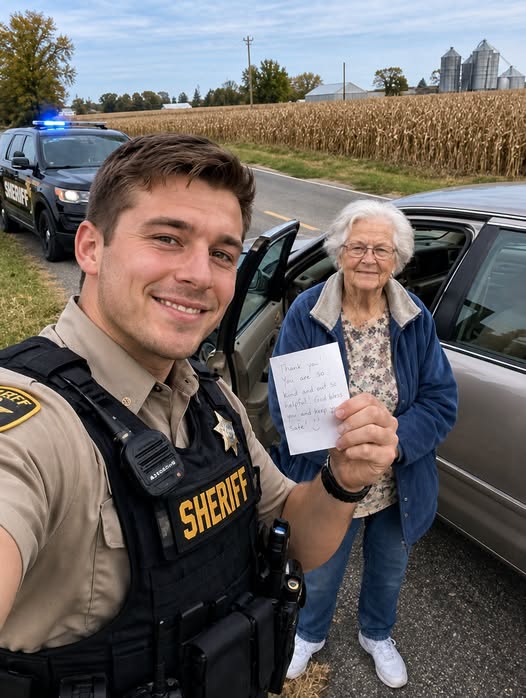
A Deputy Mocked My 71-Year-Old Mother’s Temporary License and Left Her Standing in the Heat — Then One Radio Call Changed Everything
The afternoon was unusually hot, with temperatures reaching 91 degrees. My mother, Shirley Hagen, was driving along County Road 6 with me in the passenger seat. A pan of homemade lemon bars rested on my knees, covered in powdered sugar that had begun to soften in the heat.
Mom was seventy-one years old and had always been a careful driver. She preferred taking her time rather than rushing, and she rarely drove above the speed limit. We were heading to a family gathering, carrying dessert and talking about the things we still needed to do before arriving.
Then I noticed a patrol car behind us.
A moment later, its lights flashed.
Mom immediately signaled and pulled onto the shoulder. She turned off the music, placed both hands on the steering wheel, and waited for the deputy to approach.
There were cornfields on both sides of the road. The plants were tall and dense, and there was almost no shade along that stretch of highway. The sun beat down on the pavement, making the air above the road shimmer.
The deputy approached the driver’s side window wearing sunglasses. He did not begin with a friendly greeting or an explanation. Instead, he asked for Mom’s license and insurance documents.
She opened her handbag and carefully searched through its compartments.
“I have my temporary license,” she explained. “My permanent card hasn’t arrived yet.”
She handed him the document issued by the courthouse while she waited for the replacement card. It was printed on yellow paper and contained the information required for her to drive legally during the waiting period.
The deputy held it between two fingers and raised it toward the sunlight.
He studied it for a moment before making a remark about its appearance.
“What is this? Something you printed at the library?”
He gave a small laugh.
Mom did not respond to the joke. She simply explained that the courthouse had issued the document.
Rather than acknowledging her explanation, the deputy asked her to step out of the car.
She complied.
I watched her open the door and step onto the hot pavement. She was wearing a summer dress, and her handbag remained looped over her arm. The deputy gestured toward the back of the vehicle and told her to stand where he could see her.
I leaned forward in my seat.
“She’s seventy-one years old,” I said.
The deputy turned toward the passenger window.
“Sir, stay in your seat.”
I reached for the door handle, frustrated by the way he was speaking to her.
Before I could open it, Mom looked directly at me.
“Stay there, Jeffrey.”
Her voice was quiet, but I understood that she wanted me to listen.
So I stayed inside.
At the time, I thought she was simply trying to prevent an argument. I did not yet understand that the way she handled that afternoon would eventually make me reconsider several things I had taken for granted about her.
The deputy returned to his patrol car, leaving Mom standing beside the Buick in the open sun.
Ten minutes passed.
Then twenty.
The patrol car remained running, and its air conditioning was clearly working. I could see the deputy sitting comfortably inside while Mom stood beside our vehicle.
I kept checking the side mirror.
She did not lean against the car. She stood upright, occasionally shifting her weight as the heat continued to build around her.
By the time half an hour had passed, I could feel the temperature inside our vehicle rising. The powdered sugar on the lemon bars had begun to dissolve into a sticky coating.
I was becoming increasingly uncomfortable, but my discomfort was nothing compared with what Mom was experiencing outside.
Finally, she approached the deputy’s vehicle.
“Officer, would it be possible for me to sit inside my car while we wait?”
He stepped out and responded that she could sit when he told her she could.
Then he returned to the patrol car.
I stared at him, struggling to understand why a routine traffic stop had become so unnecessarily difficult.
Mom returned to the place where he had directed her to stand.
She did not raise her voice. She did not insult him. She did not make threats or demand special treatment.
She waited.
And as I watched her through the window, another feeling began to surface alongside my frustration.
Shame.
Not because of anything she had done, but because of the way I had thought about her work for so many years.
My mother had spent thirty-four years working night shifts in the basement of the county courthouse. Whenever people asked what she did for a living, I usually answered with a dismissive little sentence.
“She answers phones.”
I had never considered how much that description left out.
I had never thought about the people she spoke with, the responsibilities she carried, the difficult situations she might have encountered, or the knowledge she had gained during decades of service.
Somewhere along the way, I had reduced her career to a simple task because I did not understand its full importance.
Now, watching her stand beside a hot road while a deputy treated her paperwork as a joke, I wondered whether I had made the same mistake about her that he was making.
I had mistaken a quiet person for an unimportant one.
And I was beginning to realize how unfair that assumption had been.
Forty Minutes on the Roadside
After approximately forty minutes, the deputy finally left his vehicle and walked back toward us.
This time, he carried a ticket book.
“I’m going to write this up,” he announced.
He also mentioned that the vehicle might be towed.
Mom looked at him carefully.
“Deputy, could I ask you something before you do that?”
He appeared amused.
“Go ahead.”
She paused briefly.
“Would you mind saying my name over your radio?”
The deputy frowned.
Mom repeated it clearly.
“Shirley Hagen.”
He looked toward the Buick, where I was still sitting in the passenger seat.
“You think that name means something?”
Mom shook her head.
“No. I don’t think I’m important.”
I felt my face grow warm, although the heat outside was already more than enough.
The deputy seemed to interpret her request as an attempt to intimidate him or suggest that she knew someone influential. He gave another small grin, apparently convinced that he understood what she was doing.
Then he lifted the microphone attached to his shoulder.
“Dispatch, I’ve got a woman here with what appears to be a homemade temporary license. She wants me to say her name.”
He turned toward Mom.
“Shirley Hagen.”
He released the button and laughed.
For a moment, nothing happened.
The road remained quiet except for the faint rustling of corn leaves in the breeze. A blackbird sat on a fence wire near the field, and the heat continued to rise from the pavement.
Then the radio crackled.
A woman’s voice came through.
“Fourteen, repeat that name.”
The deputy’s expression changed slightly.
He looked down at the radio, then toward Mom.
He reached for the microphone again, apparently preparing to answer.
But Mom leaned forward just enough to speak before he could respond.
“Please tell her exactly who I am.”
Her words were calm and measured.
For the first time since the stop began, the deputy was no longer smiling.
I sat motionless in the passenger seat, watching the exchange and wondering what my mother knew that I did not.
The radio remained silent for another moment.
Then the dispatcher spoke again.
“Deputy, confirm the spelling of that name, please.”
He looked at Mom.
She spelled it slowly.
“H-A-G-E-N.”
The dispatcher asked him to wait.
The deputy lowered the microphone.
Something about the conversation had changed. He was no longer treating the situation like an amusing encounter with an elderly driver. He appeared to be waiting for information, and Mom seemed perfectly content to let the process unfold.
I wanted to ask her what was happening, but I remembered her earlier instruction.
Stay there, Jeffrey.
So I stayed quiet.
The Dispatcher Recognizes the Name
The radio crackled once more.
“Deputy, please hold your position. A supervisor is being notified.”
The deputy’s posture became more formal.
“What’s this about?” he asked.
Mom did not answer immediately.
Instead, she looked at him and said, “I believe your dispatcher can explain what she needs to explain.”
The deputy glanced down at the yellow paper in his hand.
He examined it again, this time with considerably more care.
The document had not changed. It was still the same temporary license he had mocked minutes earlier. Its printed information was the same, and its appearance had not suddenly become more official.
What had changed was the deputy’s understanding of the person standing in front of him.
I could see that much, even without knowing the full story.
A few minutes later, another voice came over the radio. This time, it was a man who identified himself as a supervising officer.
“Deputy, I need you to provide your location and a brief explanation of the stop.”
The deputy responded with the road name and began describing the situation.
He explained that he had stopped the vehicle, questioned the temporary document, and asked the driver to step outside while he checked the information.
The supervisor asked whether the document contained identifying information and whether the deputy had contacted the issuing office or verified its status.
The deputy paused.
He admitted that he had not yet completed the verification process.
The supervisor instructed him to preserve the document, follow the appropriate procedures, and avoid making assumptions about its validity before the necessary checks were complete.
There was no dramatic