My Father Found Me Walking Home With My Baby and Groceries — Then He Learned Why I Had Lost Access to My Car
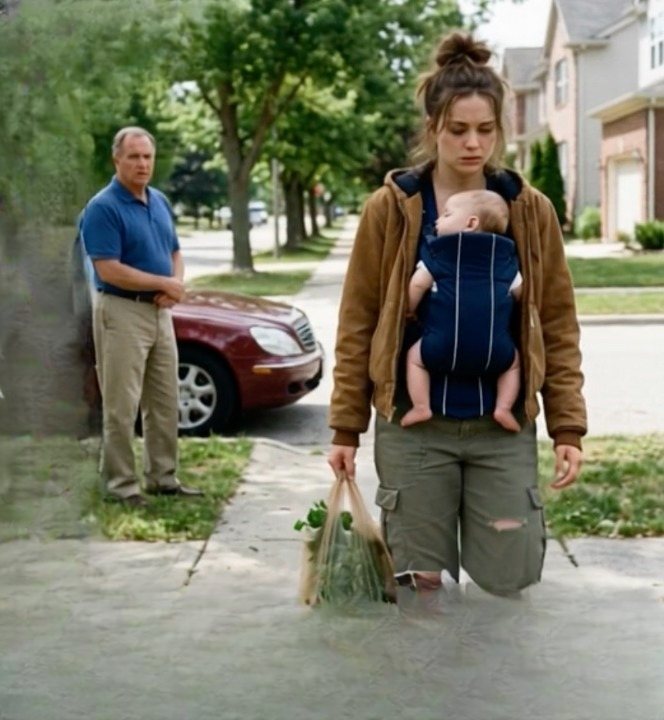
My father spotted me struggling along the street with my eleven-month-old son on one hip and grocery bags hanging from my other hand.
“Where’s your car?” he asked.
I lowered my eyes before answering.
“Luis’s mother took it,” I said quietly. “She says I should be grateful they’re letting us stay with them.”
Dad didn’t argue with me. He didn’t demand an explanation or raise his voice. He simply opened the passenger door and looked at me with an expression I had not seen in a long time.
“Get in,” he said calmly. “We’re going to sort this out tonight.”
At that moment, I had no idea how much the evening would change. I only knew that my ankle hurt, my arms were tired, and I had spent months convincing myself that accepting unfair treatment was the price of having a roof over my head.
My name is Camila, and until that afternoon, I had become so accustomed to feeling powerless that I had almost forgotten what it was like to have someone stand beside me.
The Walk I Never Expected to Take
My left ankle had swollen enough that my sneaker felt painfully tight. Every step sent discomfort up my leg, but I kept walking because I wanted to get home before my son, Mateo, became restless.
He was eleven months old, with soft curls that brushed against my cheek whenever he moved. He rested against my hip, occasionally reaching for my face with his small hands.
In my other hand, I carried groceries in plastic bags. A container of milk bumped against my knee as I walked, and the handles pressed into my fingers.
The afternoon heat in Monterrey made the journey feel longer than it was. I still had about half a mile to go, and I could feel sweat gathering along my forehead.
I tried to focus on reaching the apartment. I did not want to think about my ankle, the groceries, or the conversation I knew I would eventually have with Luis.
Most of all, I did not want to think about how I had ended up in this situation.
A few months earlier, I would never have imagined that I would be walking home injured, carrying a baby and groceries, while the car I helped pay for sat somewhere I could not access.
But life had changed gradually. One difficult decision had led to another, and every compromise had been presented as temporary.
I had told myself that things would improve once Luis found another job. I had promised myself that our living arrangement with his parents would last only a short time.
Yet the longer we stayed, the more often I heard that I should be thankful for the help.
Eventually, gratitude had become the explanation for almost everything I was expected to tolerate.
The Car That Was No Longer Mine to Use
The car was registered in Luis’s name, although I had contributed toward its expenses. We had used it for groceries, appointments, errands, and the ordinary tasks involved in raising a young child.
When Luis lost his job, our financial situation changed quickly. We could no longer comfortably afford our apartment, and his parents offered us a place to stay while we worked out our next steps.
At first, I was relieved.
Having somewhere to live meant that we could focus on reducing expenses and finding a more stable arrangement. I appreciated the offer and wanted to make the situation work.
But the rules of the household gradually became more difficult to navigate.
Luis’s mother, Rosa, had strong opinions about how we should organize our lives. She commented on our spending, questioned some of my decisions, and frequently reminded us that we were living in her home.
I tried to avoid disagreements. I knew that we needed the accommodation, and I did not want arguments to make our situation harder.
Then Rosa decided that I should no longer use the car whenever I wanted.
She explained that, because we were living under her roof, she expected to have a say in how household resources were used. Since the vehicle was registered in Luis’s name, she believed she could decide who should have access to it.
I disagreed, but I did not know how to challenge her without risking another argument.
Luis did not offer a clear solution. He said we needed to keep the peace until our finances improved.
I accepted that answer because I wanted to believe our circumstances were temporary.
That afternoon, however, I had walked to buy groceries despite an injured ankle because I could not use the vehicle.
The situation no longer felt like a minor inconvenience.
It had become a question of independence, respect, and whether I could reliably meet my own needs and Mateo’s.
The Moment My Father Saw Me
A car slowed beside me.
I instinctively moved closer to the edge of the pavement, assuming the driver was looking for an address or trying to pass.
Then I heard someone call my name.
“Camila?”
I turned and recognized my father behind the windshield.
He pulled over immediately, switched on the hazard lights, and stepped out of the car. He was still wearing his work shirt, with the CFE logo visible on the chest. His forearms were darkened by the sun, and he looked as though he had spent the day outdoors.
My father had always been practical. When something broke, he tried to repair it. When a problem appeared, he wanted to understand what had happened before deciding what to do.
He was not a man who needed to speak loudly to make himself heard.
His eyes moved from my face to the groceries, then to Mateo, and finally to my swollen ankle.
“What happened to your foot?” he asked.
“I twisted it,” I replied.
“When?”
“Yesterday.”
He looked down at my sneaker.
“And why are you walking?”
I tried to smile as though the answer were unimportant.
“I needed to get a few things.”
“Where’s your car?”
The question made my stomach tighten.
I had prepared explanations for other people. I had learned how to make our living arrangement sound manageable and how to avoid discussing the disagreements that took place behind closed doors.
But I had not prepared an explanation for my father.
I looked down at the grocery bags.
“Luis’s mother took it,” I said quietly. “She says I should be grateful they’re letting us stay there.”
Dad remained silent for a moment.
Then he asked, “The car you help pay for?”
“It’s registered in Luis’s name,” I answered. “Rosa says that because we live in her house, she gets to decide who uses it.”
His expression changed, although he did not raise his voice.
“You’re living under her roof,” he repeated.
I nodded.
“After Luis lost his job, we couldn’t afford our apartment. His parents offered to let us stay until we got back on our feet.”
“And now you’re walking home with a baby and groceries while your ankle is swollen?”
I did not answer.
There was nothing I could say that would make the situation sound reasonable.
“Get in the Car”
Dad took the grocery bag from my hand and opened the passenger door.
“Get in.”
“Dad, please,” I began. “I don’t want this to become a fight.”
I was thinking about Luis’s reaction. I was thinking about Rosa telling everyone that I was ungrateful. I was thinking about the possibility of making the household even more uncomfortable.
I had spent so much time trying to prevent disagreements that the idea of someone confronting the problem directly frightened me.
Dad looked at me carefully.
“Camila, you’re hurt. You have Mateo with you, and you’re struggling to get home. We need to deal with that first.”
His voice softened.
“You don’t have to convince me that everything is fine when it isn’t.”
My eyes filled with tears.
I had not realized how badly I needed to hear those words until he said them.
For months, I had been trying to prove that I could manage everything. I wanted to be a good partner, a responsible mother, and someone who appreciated the help we had received.
I had confused being grateful with remaining silent.
Dad did not ask me to explain every disagreement or defend every decision. He simply helped me into the car, taking care not to put pressure on my ankle.
Then he secured Mateo in the back seat.
My son looked up at him and smiled, apparently unaware of the tension that had followed us into the afternoon.
Dad smiled back briefly before returning to the driver’s seat.
“First, we’re getting your ankle checked if it needs it,” he said. “Then we’re going to have a conversation with Luis and his mother.”
I stared through the windshield.
“Tonight?”
“Tonight.”
I wanted to protest, but another part of me felt relief.
For the first time in a long while, I did not feel that I had to solve the entire situation by myself.
How We Ended Up Living With Luis’s Parents
As Dad drove, I began explaining how our circumstances had changed.
Luis had lost his job several months earlier. At first, he believed he would find another position quickly, but the search took longer than expected.
Our savings began to shrink. We cut back on expenses and postponed purchases, hoping that the situation would improve before we needed to make a major decision.
Eventually, we could no longer comfortably cover the rent and other costs of our apartment.
Luis’s parents offered us a room and said we could stay until we were financially stable again.
I had been grateful for the offer. I understood that they were taking on additional household responsibilities, and I wanted to contribute wherever possible.
But the arrangement changed the balance of power in ways I had not anticipated.
Rosa began commenting on how I spent money and how I organized Mateo’s routine. Sometimes her suggestions were useful, but other times they came with reminders that I was living in her home and should follow her preferences.
If I disagreed, she often returned to the same point: we would not have a place to stay without her help.
I tried to ignore the comments because I knew our financial circumstances were difficult.
Then the disagreement over the car began.
Rosa argued that the vehicle should be used according to the household’s needs and that I should not assume I could take it whenever I wanted. Since Luis was the registered owner, she believed he should make the final decision.
I felt that the arrangement was unfair, particularly because I had contributed toward the car and needed transportation for errands involving Mateo.
Luis repeatedly told me that it was better not to argue.
He said his mother was trying to help us and that we should avoid upsetting her until we could move out.
I understood the need to keep the peace, but keeping the peace had begun to mean accepting decisions I had little say in.
By the time Dad found me on the street, I had stopped expecting the situation to change on its own.
A Conversation About More Than a Car
When we arrived at my father’s home, he helped me settle on the sofa while Mateo played nearby with a few toys.
He brought me water and asked whether my ankle needed medical attention. I had been trying to ignore the swelling, but the pain was worse than I wanted to admit.
We discussed arranging an examination if the swelling and difficulty walking continued or if the injury seemed severe. I was grateful that he had noticed how much trouble I was having.
After making sure Mateo was comfortable, Dad sat across from me.
“I want you to tell me what has been happening,” he said. “Not just with the car. Everything you think I should know.”
At first, I gave him the shortened version I had been giving everyone else.
We were staying with Luis’s parents. Money was tight. Rosa and I disagreed sometimes. I was trying to be patient.
Dad listened without interrupting.
Then he asked a question that made me stop.
“Are you afraid to disagree with them because you think you might lose your place to stay?”
I looked at my hands.
“Yes,” I admitted.
Saying it aloud made the situation feel different.
I had been telling myself that I was simply avoiding unnecessary arguments. I had not wanted to acknowledge how much the possibility of losing our accommodation influenced my decisions.
Dad did not tell me that I should have acted differently or criticize me for accepting help.
He said that needing temporary support was nothing to be ashamed of.
“People go through difficult periods,” he explained. “Losing a job doesn’t make someone a failure. Needing a place to stay doesn’t mean you lose your right to be treated with respect.”
I began to cry.
The relief was not because every problem had disappeared. We still needed a stable income, a suitable place to live, and a plan for the coming months.
But I finally felt that someone understood the difference between accepting help and being made to feel powerless because I needed it.
Why My Father Decided to Visit
After we had talked for a while, Dad asked whether I wanted him to accompany me to speak with Luis and Rosa.
I hesitated.
Part of me wanted to avoid another uncomfortable conversation. I could already imagine Rosa accusing me of making the family look bad by involving my father.
Another part of me knew that avoiding the subject would leave the situation unresolved.
“I want to talk to Luis,” I said. “But I don’t want everyone shouting at each other.”
Dad nodded