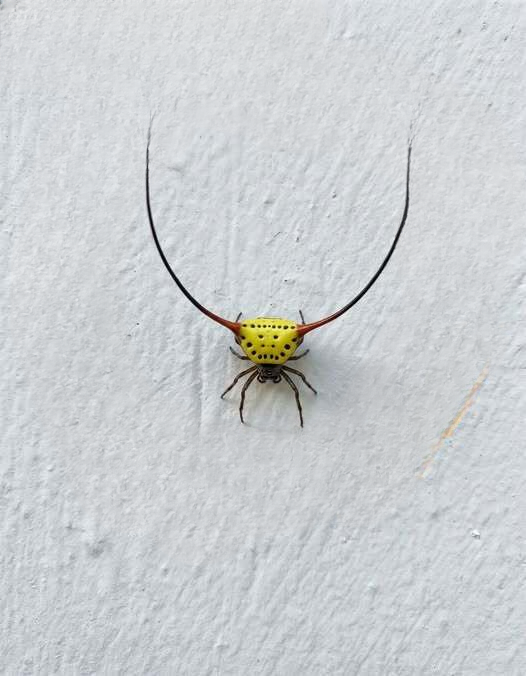
A Surprising Visitor in the Garage: Discovering the Spiny Orb-Weaver Spider
One evening, I walked into my garage, switched on the light, and noticed something unusual on the wall. At first, I could not identify what I was looking at. The small creature had an unfamiliar shape, with a rounded body and several pointed projections extending from its sides. It looked different from the spiders I was accustomed to seeing around the house.
I stopped for a moment and took a closer look from a comfortable distance. The creature appeared almost as though it belonged in a nature documentary rather than on the wall of an ordinary garage. Its unusual shape immediately caught my attention, and I found myself wondering what kind of spider it was and how it had ended up there.
After observing it for a little while, I began to suspect that I had encountered a spiny orb-weaver, a small spider known for its distinctive body shape and interesting appearance. Although spiders are common in gardens, sheds, garages, and other sheltered spaces, this particular species has features that make it especially easy to recognize.
What initially seemed like an unexpected encounter became an opportunity to learn more about one of nature’s fascinating small creatures.
What Is a Spiny Orb-Weaver?
The spiny orb-weaver is a type of spider belonging to the family Araneidae, which includes many species that construct circular, wheel-shaped webs. These webs are commonly called orb webs because of their organized, rounded structure.
One species frequently known by this common name is Gasteracantha cancriformis. It is found in parts of the Americas and is particularly recognizable because of its broad, hard-looking abdomen, which often has several prominent spines around its edges.
Unlike the long-legged spiders that people sometimes notice running across floors or hiding in corners, the spiny orb-weaver has a compact appearance. Its body can look almost shield-shaped, and its pointed projections give it a distinctive outline.
Depending on the individual, its body may display white, yellow, orange, or other contrasting colors, sometimes accompanied by dark markings. The legs are relatively short compared with those of many familiar household spiders.
The combination of a rounded abdomen, noticeable spines, and contrasting colors makes this spider stand out despite its small size.
It is important to remember that the term “spiny orb-weaver” can refer to more than one species in different regions. Identifying a spider accurately may require examining its location, coloration, body proportions, and other distinguishing features.
Why Does This Spider Have Spines?
The most noticeable feature of the spiny orb-weaver is the row of pointed projections along the edges of its abdomen.
These structures can make the spider look intimidating at first glance. However, their appearance is not necessarily an indication that the animal poses a significant danger to people.
In nature, body shapes and external structures often develop through evolutionary processes that help animals survive in their environments. The spines of orb-weaver spiders are generally understood to play a role in defense, potentially making the spider more difficult for certain predators to handle or swallow.
For a small animal, even a modest physical feature can make a difference when avoiding a larger predator.
The spines also contribute to the spider’s unmistakable appearance. They create an outline that looks quite different from the smooth, rounded bodies of many other spider species.
Scientists study such physical characteristics to understand how spiders have adapted to their environments. The diversity of spider shapes demonstrates that there is no single body design suited to every ecological situation.
Some spiders rely on speed, some use camouflage, and others construct elaborate webs. The spiny orb-weaver represents another example of how different species have developed distinctive physical features.
The Purpose of an Orb-Shaped Web
Although the spider’s body attracts immediate attention, its web is another remarkable part of its natural behavior.
Orb-weaver spiders build webs with carefully arranged silk threads. Many of these webs contain radiating lines connected by a spiral pattern, creating a structure that can intercept flying insects.
Constructing a web requires more than simply releasing silk. The spider must establish supporting threads, connect sections, and arrange the capture area in a way that suits its surroundings.
The finished web can appear delicate, but its design is well suited to catching small insects.
When an insect becomes entangled, movements and vibrations travel through the silk. These signals can alert the spider that something has entered the web. The spider can then approach the captured insect and determine how to respond.
Web construction varies among species, and not every orb-weaver creates an identical pattern. Environmental conditions, available attachment points, and the spider’s particular behavior all influence the finished structure.
A garage, garden shed, porch, or sheltered outdoor corner may offer useful places for a spider to attach its web. Roof beams, window frames, light fixtures, and other surfaces can provide the necessary support.
If a spiny orb-weaver appears in such a location, it may simply be using an available space to hunt for food.
Why Might a Spider Appear in a Garage?
Finding a spider in a garage can seem surprising, particularly when the creature looks unfamiliar. However, garages often provide several conditions that make them suitable places for small wildlife.
They may contain sheltered corners, relatively undisturbed surfaces, and openings through which insects can enter. Outdoor lights can also attract flying insects, potentially creating a feeding opportunity for spiders nearby.
Doors that remain open for even a short period can allow insects and other small animals to move indoors. Gaps around windows, vents, and other openings may provide additional access.
A spider might also establish itself near a garage entrance or on an exterior wall before becoming noticeable to someone inside.
The presence of a spider does not automatically mean that a home is dirty or poorly maintained. Many spiders live outdoors and occasionally appear in buildings because the surrounding environment offers suitable shelter or access to food.
In some cases, a spider may have been present for days or weeks before anyone notices it. Its small size and stationary behavior can make it easy to overlook until a light shines directly on it.
This is especially true for spiders that remain near a web or stay motionless for long periods while waiting for prey.
Is the Spiny Orb-Weaver Dangerous?
The unusual appearance of the spiny orb-weaver can make people wonder whether they should be concerned.
For the species commonly identified as Gasteracantha cancriformis, serious bites are not generally considered a major medical concern. Like many spiders, it is not interested in confronting people and will ordinarily attempt to avoid contact.
Nevertheless, it is sensible to avoid handling unfamiliar spiders. Even species that are not considered medically significant can bite if they are squeezed, trapped against the skin, or otherwise threatened.
A spider’s appearance alone cannot reliably establish its identity or determine whether it presents a medical risk. Some unrelated species have similar colors or body shapes, and identification can be difficult without a clear photograph and information about the location where the animal was found.
If a spider is discovered inside a home, there is usually no need to panic. Keeping a reasonable distance while determining what to do next is a sensible approach.
People who are uncertain about the species can consult a local nature organization, university extension service, or qualified pest professional for identification.
If a suspected spider bite causes severe pain, difficulty breathing, widespread swelling, or other concerning symptoms, seek appropriate medical attention rather than relying on a visual identification of the spider.
The important distinction is that an unfamiliar appearance should encourage thoughtful observation, not unnecessary fear.
What Does the Spiny Orb-Weaver Eat?
Spiny orb-weavers are predators that feed primarily on insects and other small arthropods they can capture.
Their diet may include various flying insects, depending on what is available in the surrounding environment. By catching insects in their webs, they participate in the natural processes that influence local insect populations.
The exact insects captured will vary with location, season, habitat, and the size of the spider.
A web placed near vegetation may intercept insects moving between plants. A web near an outdoor light may encounter insects attracted to the illumination. A sheltered area beside a building can provide a useful location if flying insects regularly pass through it.
Spiders do not need to chase every insect they encounter. Their webs function as passive hunting structures, allowing them to wait for potential prey to arrive.
This strategy can be especially useful for small animals because it allows them to conserve energy while taking advantage of movements in their surroundings.
When an insect becomes trapped, the spider uses its sensory abilities to detect the disturbance. It can then move across the silk strands and approach the captured animal.
Although people sometimes regard spiders solely as unwanted visitors, their role in the ecosystem is worth considering. Many spiders feed on insects that people also find inconvenient, including some species that visit gardens and outdoor living spaces.
Their presence is one part of the complex relationship between predators and prey in the natural world.
The Difference Between Male and Female Spiny Orb-Weavers
Another interesting feature of some spiny orb-weaver species is the difference in appearance between males and females.
In the commonly discussed species Gasteracantha cancriformis, females are generally much more conspicuous than males. Females have the broad, spiny abdomen that gives the species its distinctive appearance, while males tend to be smaller and less visually striking.
This difference is an example of sexual dimorphism, a biological term describing physical differences between males and females of the same species.
Sexual dimorphism occurs throughout the animal kingdom. It can involve differences in body size, coloration, ornamentation, or other physical characteristics.
For spiders, these differences can be especially noticeable because males and females may have different body proportions and behaviors.
A person who sees a brightly colored, spiny spider on a wall may therefore be looking at a female, although appearance alone should not be treated as a definitive identification.
The variation between sexes also illustrates why two spiders belonging to the same species can sometimes look surprisingly different.
Where Do Spiny Orb-Weavers Live?
The distribution of a spider depends on the species. Gasteracantha cancriformis, for example, is associated with parts of the Americas, including areas where warm conditions and suitable vegetation support its life cycle.
It is often encountered in gardens, woodland edges, shrubs, orchards, and other places where insects are available and webs can be attached to stable surfaces.
The spider may build a web between branches, stems, or other structures that provide enough room for an effective capture area.
Some webs are established in locations that people regularly pass, making encounters more likely. Others remain hidden among leaves and branches, where the spider can go unnoticed.
Climate, seasonal conditions, and local habitat influence where a particular species can survive. Consequently, an identification that is plausible in one region may be less likely in another.
This is one reason geographic information is useful when identifying unfamiliar wildlife.
If a spiny-looking spider appears in a garage, the location alone is not enough to confirm the species. A photograph showing the body shape, coloration, and surrounding environment can help narrow down the possibilities.
How to Observe an Unfamiliar Spider Safely
When encountering an unfamiliar spider, a few simple precautions can make the experience easier and safer.
First, avoid touching the animal. A spider that feels threatened may attempt to defend itself, and handling can injure the spider even when it does not pose a meaningful danger to people.
Second, give it enough space to remain undisturbed. There is rarely a need to approach closely just to establish that a spider is present.
Third, if identification is important, take a photograph from a safe distance. A clear image of the body and its overall shape can be more useful than a blurry close-up.
It may also help to photograph the web and surrounding area. These details can provide clues about the spider’s behavior and habitat.
If the spider is outside and does not interfere with daily activities, leaving it undisturbed may be the simplest option.
If it is indoors and needs to be moved, consider using a suitable container and a piece of stiff paper without touching the spider directly. Move slowly and avoid placing your hands near the animal. If you are uncomfortable doing this, ask someone experienced with wildlife or contact a pest professional.
People should also consider children and pets when deciding how to manage an unfamiliar animal. Keeping curious hands and paws away from the spider is a sensible precaution until its identity is understood.
These basic measures allow people to deal with unexpected wildlife encounters without turning them into unnecessary emergencies.
Should You Remove a Spider From Your Garage?
Whether to remove a spider depends on its location, identification, and the preferences of the people using the space.
A spider outdoors on a wall or near a garden may not need to be disturbed. If it is not creating a problem, leaving it alone can avoid unnecessary harm to a small animal that is simply occupying its habitat.
An indoor spider may be more inconvenient, especially if it is near a doorway, stored belongings, or an area where people frequently work.
In that situation, gentle relocation may be an option if the spider can be identified with reasonable confidence and the person handling the situation feels comfortable doing so.
However, an unfamiliar spider should not be picked up with bare hands. When its identity is uncertain, a cautious approach is preferable to assuming that it is harmless based only on its size or appearance.
If spiders repeatedly appear in a garage, inspect the space for gaps around doors, windows, and vents. Keeping screens in good condition and reducing unnecessary clutter can make it easier to notice webs and manage indoor spaces.
Outdoor lighting may also influence insect activity around entrances. Where practical, well-positioned lighting and good door seals can help reduce the number of insects entering the building.
These steps are general household measures rather than a guarantee that spiders will never appear. Wildlife naturally moves through the environment, and an occasional encounter is not unusual.
Why Small Creatures Can Capture Our Attention
The experience of discovering an unfamiliar spider highlights how easily an ordinary setting can become interesting when we notice something new.
A garage is usually associated with practical tasks: