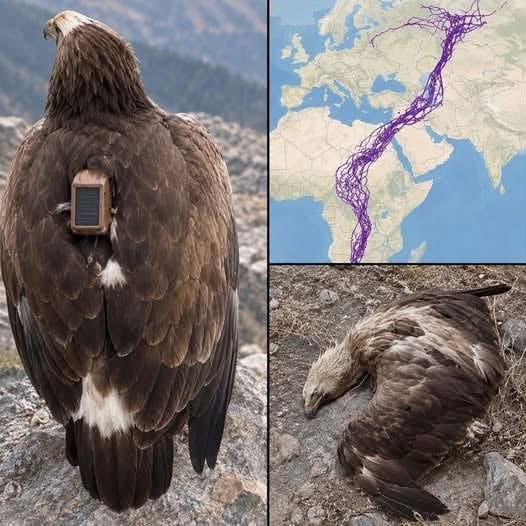
For decades, scientists have used modern technology to understand how wild animals travel across enormous distances. Birds, in particular, continue to fascinate researchers because many species can navigate across mountains, deserts, forests, and oceans with remarkable precision.
Among these impressive travelers, eagles stand out for their strength, sharp eyesight, and ability to cover large territories. Their movements can provide valuable information about wildlife behavior, habitat use, migration patterns, and the environmental changes that affect their survival.
Imagine researchers attaching a lightweight GPS tracking device to an eagle and then following its movements over many years. At first, the purpose might seem straightforward: learn where the bird travels, where it rests, and which areas it uses to find food.
But what happens when the tracking data raises questions that researchers cannot immediately answer?
Long-term wildlife monitoring can reveal patterns that would be almost impossible to observe through occasional field visits. It can show where an animal travels during different seasons, whether it returns to familiar locations, and how its movements change as its environment changes.
The idea of an eagle being tracked for more than twenty years is therefore fascinating. However, without the identity of the bird, the research team, or the original scientific report, it is important not to assume that a particular eagle confused scientists for that entire period. The real value lies in understanding what GPS tracking can reveal about these remarkable birds and why long-term research matters.
Why Scientists Track Eagles in the First Place
Eagles occupy important positions in many ecosystems. As predators and, in some cases, scavengers, they can influence food webs and provide researchers with useful information about the health of the environments they inhabit.
Yet observing an eagle in the wild is not easy.
These birds can travel over large areas, soar at considerable heights, and spend long periods far from human settlements. A researcher might observe an individual at a nesting site but have little information about where it goes after leaving that location.
GPS tracking helps fill this gap.
A tracking device records geographical positions at scheduled intervals. Depending on the equipment, it may also collect information about altitude, movement, or other environmental and behavioral measurements.
Researchers can then use the recorded locations to reconstruct the bird’s movements on a map.
The resulting information can help answer important questions. Does the eagle remain within a familiar territory throughout the year? Does it travel to a different region during a particular season? Does it repeatedly visit the same feeding areas? Are there major changes in its movements following habitat disturbance?
These questions are important because protecting a species requires more than knowing where its members build their nests.
Conservationists also need to understand the wider landscapes that individual birds depend on.
What Makes Long-Term Tracking So Valuable?
A short tracking study can provide a useful snapshot of an animal’s behavior. However, it may not reveal the full range of its movements or the changes that occur throughout its life.
Long-term monitoring offers a broader perspective.
An eagle’s behavior may vary with age, breeding status, food availability, weather conditions, and changes in its environment. Data collected over several seasons can help researchers distinguish regular patterns from unusual events.
For example, an eagle might use one area during the breeding season and move elsewhere when its young have become independent. Another individual might remain in the same general region throughout the year but travel much farther when food becomes scarce.
Without sufficient observations, researchers could mistakenly interpret a temporary change as a permanent behavioral pattern.
Long-term data also allows scientists to compare movements across different years. If an eagle begins using a different route or spending less time in a familiar area, researchers can investigate possible explanations.
The cause might involve changes in prey availability, human activity, weather, or the bird’s own stage of life.
However, GPS data alone does not necessarily explain why an animal behaves in a particular way. Researchers often need additional observations, environmental information, and biological evidence to interpret the results correctly.
That distinction is essential to understanding wildlife research.
How Can an Eagle Navigate Such Large Distances?
One of the most interesting aspects of eagle behavior is navigation.
Birds can travel through complicated landscapes without following roads or other human-made routes. Some species migrate over enormous distances, while others maintain territories that extend across mountains, forests, plains, or coastal regions.
Scientists have studied several mechanisms that may contribute to avian navigation, including visual landmarks, the position of the Sun, learned routes, and sensitivity to aspects of the Earth’s magnetic field.
The importance of each mechanism can vary among species and circumstances.
Eagles also benefit from their ability to soar. By taking advantage of rising air currents, including thermals created when the Sun warms the ground, many large birds can travel efficiently without continuously flapping their wings.
This ability allows them to cover substantial distances while conserving energy.
Their movements may appear mysterious to human observers, but they are influenced by a combination of biological adaptations and environmental conditions.
GPS tracking makes these journeys easier to study. Instead of relying entirely on sightings, scientists can examine the sequence of recorded locations and compare the bird’s movements with information about terrain, weather, and habitat.
Over time, these records can reveal patterns that would otherwise remain hidden.
When Tracking Data Raises Unexpected Questions
A tracking map can sometimes look surprising, particularly when an animal travels farther than expected or repeatedly visits places that researchers had not considered important.
However, unusual-looking movements do not automatically indicate that an animal is behaving in an inexplicable way.
A bird may follow a route shaped by favorable winds, suitable resting areas, prey availability, or the location of breeding habitat. What appears unusual from a human perspective may make sense when viewed in the context of the animal’s environment.
Researchers must also consider the limitations of tracking technology.
GPS devices do not necessarily record a position continuously. Many units collect information at scheduled intervals to conserve battery power, and the frequency of those recordings can affect how a journey appears.
A line connecting two recorded positions does not prove that the bird followed a perfectly straight path between them.
Likewise, missing locations may result from technical limitations, poor signal conditions, device settings, or other factors. Scientists must evaluate the quality of the data before drawing conclusions.
When tracking results seem unexpected, researchers typically examine the records carefully, compare them with other observations, and consider several possible explanations.
This process is not a weakness of scientific research. It is an important part of how reliable explanations are developed.
What GPS Tracking Can Teach Us About Conservation
Understanding where eagles travel is not simply an academic exercise. It can have practical consequences for wildlife protection.
A nesting area may appear secure, but the birds that depend on it might regularly travel through landscapes affected by roads, power lines, wind-energy developments, or other forms of human activity.
Tracking information can help identify important movement corridors and areas where conservation measures may be needed.
It can also help researchers understand whether protected areas provide sufficient habitat throughout the year.
If a bird depends on several distant locations for feeding, nesting, and seasonal movement, protecting only one of those locations may not be enough.
Long-term monitoring can reveal how animals respond to environmental change. Researchers may be able to investigate whether individuals alter their movements as habitats change or whether certain areas remain important across multiple years.
Such findings can contribute to more informed conservation planning.
Nevertheless, tracking one eagle cannot automatically establish how every member of its species behaves. Individual animals differ, and findings must be interpreted within the context of the wider population.
A strong conservation strategy combines multiple sources of evidence, including field observations, population surveys, habitat assessments, and, where appropriate, tracking data.
The Importance of Verifying Extraordinary Wildlife Stories
Stories about animals traveling astonishing distances or displaying unexpected behavior can capture public attention. They can also encourage people to take an interest in science and wildlife conservation.
But extraordinary claims deserve careful verification.
If a particular eagle was tracked for more than twenty years, the most useful next step would be to identify the original research project or scientific publication. The species, tracking period, study location, and conclusions would help establish what actually happened.
It would also be important to distinguish between the length of a research program and the length of time one individual bird was tracked. A long-running study may include several birds, replacement tracking devices, or multiple generations of animals.
These details matter because they can change the meaning of a headline.
Similarly, saying that an eagle’s movements confused scientists is not the same as showing that researchers were unable to explain them. Scientific investigations often begin with uncertainty, but further analysis can reveal ordinary explanations for seemingly unusual observations.
Accurate reporting should explain what the researchers discovered, what evidence supports the conclusion, and which questions remain unanswered.
That approach makes a story more trustworthy and more informative for readers.
A Small Tracking Device, a Much Bigger Picture
GPS technology has transformed the study of wildlife by allowing researchers to investigate movements that once would have been extremely difficult to observe.
For eagles, tracking data can help scientists understand how individuals use their habitats, how their movements change over time, and what challenges they may encounter across large landscapes.
The most important discoveries do not always involve a dramatic or unexplained event. Sometimes, they emerge from years of carefully collected data that reveal how an animal responds to its surroundings.
A single tracking record might show a bird visiting a distant location. A series of records collected across seasons might reveal a regular movement pattern. Data gathered over a much longer period could help researchers investigate changes in habitat use or differences between stages of an animal’s life.
Each observation contributes to a broader understanding of the natural world.
The idea of an eagle being monitored over decades captures our imagination because it combines two remarkable things: an animal capable of traveling across vast landscapes and technology that allows humans to follow parts of its journey.
Yet the scientific value depends on more than the length of the tracking period. It depends on the quality of the data, the questions being investigated, and the care taken when interpreting the evidence.
Until the particular eagle and research project are identified, its supposed twenty-year mystery should be treated as an unverified claim rather than an established scientific finding.
What is certain is that modern wildlife tracking continues to give researchers valuable tools for studying animals that once seemed almost impossible to follow.
And with every carefully documented journey, scientists gain another opportunity to understand the remarkable ways wildlife survives, moves, and adapts in a changing world.
What do you find most fascinating about eagle navigation? Is it their ability to travel long distances, their use of natural air currents, or the way GPS technology allows scientists to study their movements? Share your thoughts in the comments, and consider looking for the original research behind any extraordinary wildlife claim before accepting its details as fact.