For six years, my husband, Ben, and I dreamed of becoming parents.
We tried everything we could think of, endured countless appointments, and learned to live with the disappointment that followed every negative pregnancy test. Each month brought a mixture of hope and fear, and each passing year made us wonder whether the family we wanted would ever become a reality.
So when I finally saw two pink lines on a pregnancy test, I stood in our bathroom staring at it, afraid to believe what I was seeing.
Then I called Ben.
He was at work, but the moment he heard my voice, he knew something was different.
“What is it? Are you all right?”
I could barely speak through my tears.
“Ben, we’re going to have a baby.”
There was silence on the other end.
Then I heard him let out a sound that was half laugh and half sob.
“Are you serious?”
I told him I was.
He came home early that afternoon and held me for a long time. That evening, we sat together on the sofa, talking about names, nursery colors, and all the things we hoped to teach our child.
His mother, Diane, was equally excited.
She began checking on me regularly, bringing meals, offering advice, and helping us prepare the spare room. Sometimes she accompanied me to appointments when Ben couldn’t get away from work.
I felt fortunate to have people who seemed so eager to welcome our baby.
We had waited so long for this moment that I believed nothing could take away our happiness.
I was wrong.
The Day Our Daughter Was Born
My labor began early on a rainy Tuesday morning.
Ben drove me to the hospital, holding my hand whenever I wasn’t gripping the seat or trying to breathe through a contraction.
“You’re doing wonderfully,” he kept telling me. “We’re almost there.”
Hours later, after an exhausting but otherwise uncomplicated delivery, our daughter arrived.
She was tiny, warm, and beautiful.
The nurse placed her in my arms, and I began crying before I could even look at her properly.
We named her Evelyn.
She had a soft little cry, a wrinkled forehead, and fingers so small that my wedding ring looked enormous beside them.
I had imagined this moment for years, but nothing had prepared me for the feeling of holding my own child.
Ben stood beside the bed, smiling as he looked down at her.
“She’s finally here,” I whispered.
For a moment, everything felt perfect.
Then Ben leaned closer to examine Evelyn’s face.
His smile disappeared.
He straightened, stared at her again, and stepped away from the bed.
“No,” he muttered. “This can’t be happening.”
I looked up at him, confused.
“Ben? What’s wrong?”
He shook his head as though he couldn’t accept what he was seeing.
“This isn’t what I expected.”
I tried to laugh nervously, thinking perhaps he was overwhelmed by the reality of becoming a father.
“What do you mean? She’s beautiful.”
But he didn’t smile.
Instead, he looked at me with an expression I had never seen before.
“I can’t do this.”
My stomach tightened.
“Do what?”
He pointed vaguely toward the baby.
“This. I didn’t agree to this.”
I felt as though the room had suddenly become much colder.
Before I could ask another question, Diane approached the bed.
She looked down at Evelyn, pressed her lips together, and sighed.
“Well, this certainly isn’t how we imagined things would turn out.”
I stared at her.
“Diane, what are you talking about?”
She didn’t answer.
Ben turned toward the door.
“When the hospital discharges you, don’t come home. I want a divorce.”
For a few seconds, I genuinely believed I had misunderstood him.
We had spent six years hoping for a child. He had accompanied me to appointments, helped assemble the crib, and talked about the future as though becoming a father were his greatest dream.
Now he was standing in a hospital room, telling me he wanted to end our marriage because of the baby we had waited so long to meet.
“Ben, please,” I whispered. “Tell me what’s happening.”
He wouldn’t look at me.
Diane followed him toward the door.
Neither of them turned back.
I sat there holding Evelyn against my chest, trying to comfort her as she began to cry.
I was recovering from childbirth, exhausted and frightened, and suddenly unsure whether I had a home to return to.
Yet as I looked down at my daughter’s face, one thought became clear.
Whatever had happened between Ben and me, Evelyn was innocent.
She deserved to be loved.
And I would do everything I could to give her that love.
Two Days of Silence
The following days passed in a blur.
The nurses checked on my recovery, helped me learn how to feed Evelyn, and answered the questions I was too embarrassed to ask anyone else.
I tried calling Ben repeatedly.
He didn’t answer.
I sent him a photograph of Evelyn sleeping in her hospital blanket. In the picture, her tiny hand was wrapped around my finger.
I wrote a short message beneath it.
She’s beautiful, Ben. Please tell me what’s wrong. We need to talk.
He never replied.
I kept checking my phone, hoping he would call to apologize or explain that he had been frightened by the responsibility of fatherhood.
But the screen remained silent.
My parents came to visit, and I finally told them what had happened.
My mother held me while I cried.
My father was furious, but he tried to keep his voice calm when he spoke.
“You don’t have to solve everything today,” he told me. “You need time to recover. We’ll help you and Evelyn.”
I was grateful for their support, although I couldn’t stop wondering how the man who had once promised to stand beside me through everything could abandon us so suddenly.
When the hospital finally discharged me, I hoped that returning home might somehow make things clearer.
Instead, it made everything worse.
My parents drove me to the house where Ben and I had lived together.
Before I even reached the front door, I saw several large bags beside the steps.
My clothes were packed inside them.
The diaper bag I had prepared for Evelyn sat on top.
Ben had left everything outside.
I knocked.
No one answered.
I called his phone.
It went straight to voicemail.
I stood there with my newborn daughter in my arms, staring at the bags that contained what remained of the life I thought I had.
Then my father quietly loaded them into the car.
We drove to my parents’ house without saying much.
That evening, after feeding Evelyn and settling her into the small crib my mother had prepared, I sat beside her and cried.
I didn’t know how I would raise a child alone.
I worried about money, childcare, sleepless nights, and all the decisions I had once expected to make with my husband.
But beneath all those fears was something stronger.
I knew I could not allow Evelyn to grow up believing that she was unwanted because of a decision she had never made.
She was my daughter.
She was loved.
And I would remind her of that every single day.
The Unexpected Knock at the Door
The following morning, I was sitting in the living room with Evelyn when the doorbell rang.
My mother went to answer it.
A moment later, I heard her gasp.
Then she called my name.
I stood carefully, still sore from the delivery, and walked toward the entrance.
Ben was standing outside.
Diane stood beside him.
Both looked as though they hadn’t slept.
Ben’s eyes were red, and his face was pale. Diane kept twisting a tissue between her fingers.
The moment he saw me, Ben began to cry.
“Please,” he said. “Can we see Evelyn?”
I tightened my hold on the baby.
“Yesterday, you wouldn’t even come to the door. You packed my things into bags and left us outside. Why are you here now?”
He lowered his head.
“I know. I know what I did was wrong.”
“Then explain it.”
He looked past me toward the living room, where my mother stood watching.
“Please let us come inside. There’s something I should have told you a long time ago.”
I hesitated.
Every part of me wanted an explanation, but another part was afraid that whatever he said would hurt even more.
Finally, I stepped aside.
Ben entered slowly, followed by Diane.
They sat on the sofa, but neither seemed able to find the right words.
Then Ben stood up again.
“I don’t deserve to ask you for anything,” he said. “But I need you to hear the truth.”
“Then tell me.”
He glanced at his mother.
Diane immediately shook her head.
“Ben, perhaps we should wait. She’s just had a baby. This isn’t the time.”
He turned toward her.
“No, Mom. We’ve waited long enough.”
Then he looked at me.
“The reason I reacted the way I did when Evelyn was born wasn’t because of something you did. It was because I recognized something, and I panicked.”
I stared at him.
“What could you possibly have recognized?”
His hands began to tremble.
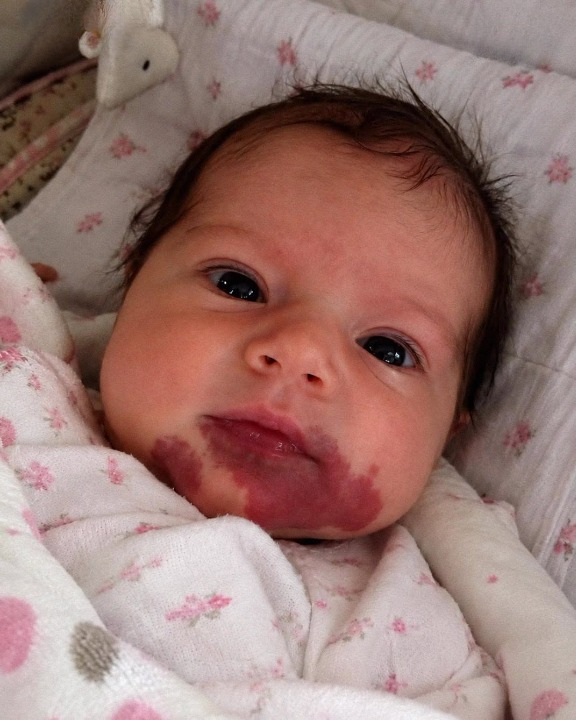
“The mark on her shoulder.”
I instinctively looked down at Evelyn.
She was sleeping peacefully against my chest.
“What mark?”
Ben swallowed hard.
“A small, crescent-shaped birthmark near her left shoulder. I’ve seen it before.”
I waited, barely breathing.
“My younger sister, Laura, had the same mark when she was born.”
I frowned.
I had heard about Laura many times. She had died as an infant, long before Ben and I met. According to the family, she had been born with serious medical complications.
“What does that have to do with Evelyn?”
Ben looked toward his mother.
Diane covered her face with her hands.
And then he said something I had never expected to hear.
“Mom told me that Laura’s medical records contained a family history that she had kept secret for decades. When I saw Evelyn’s birthmark, I remembered a conversation I’d overheard years ago. I became afraid that our daughter might have inherited a serious condition.”
I looked at him in disbelief.
“You threw us out because you were afraid of a birthmark?”
He shook his head.
“No. I thought I was protecting you from something I didn’t understand. But instead of asking the doctors questions or talking to you, I panicked. I let fear control me.”
His voice broke.
“I convinced myself that leaving would somehow make the situation easier. It was cowardly, and I know that now.”
I was angry, but I was also confused.
“Did a doctor tell you Evelyn was ill?”
“No,” he admitted. “No doctor said that. I never even asked. I saw the mark and remembered what my mother had told me about Laura.”
Diane began crying.
“I should have told you both the truth years ago,” she said.
The Family Secret Diane Had Carried for Years
Diane explained that Laura had been born with a rare medical condition that required extensive treatment.
When Laura died, the family was devastated.
In the years that followed, Diane became reluctant to discuss the details. She worried that another child in the family might inherit the same condition, but she never properly explained the medical history to Ben.
Instead, she allowed fear and uncertainty to grow.
Ben had heard fragments of conversations when he was younger. He remembered his mother’s distress and the doctors’ visits, but he had never learned the complete story.
When he saw Evelyn’s birthmark, those old memories returned.
He assumed the worst without asking a single question.
I listened in silence.
The secret was painful, but what hurt most was realizing that Ben had made a life-changing decision based on an assumption.
He hadn’t asked Evelyn’s pediatrician about the birthmark.
He hadn’t spoken to me.
He hadn’t even given our daughter a chance to be examined by a doctor before deciding that he couldn’t accept her.
“You should have told me,” I said quietly. “We waited six years for this child. Whatever challenges she might face, we were supposed to face them together.”
Ben nodded, tears running down his face.
“I know.”
“And if there had been a medical concern, we could have spoken to her doctor. We could have learned what it meant. You didn’t have to abandon us.”
“I know,” he repeated.
Diane reached toward me, then stopped when she saw that I wasn’t ready to accept her comfort.
“We were wrong,” she whispered. “Both of us.”
For a long moment, the only sound in the room was Evelyn’s soft breathing.
Then I asked the question that mattered most.
“Have you spoken to a doctor?”
Ben shook his head.
“No. I wanted to come here first and apologize. I’ll do whatever is necessary to understand the situation properly.”
I looked down at my daughter.
She stirred slightly, then settled against me again.
Whatever the truth about her family history might be, she deserved careful medical attention, not fear-driven assumptions.
“We’ll speak to her pediatrician,” I said. “We’ll ask questions and follow the doctor’s advice. But you need to understand something, Ben. You cannot disappear whenever life becomes frightening.”
He nodded.
“I understand.”
“No,” I replied. “You need to show me that you understand. Words won’t be enough.”
A Difficult Beginning, Not an Instant Forgiveness
Ben asked if he could hold Evelyn.
I looked at him for a long time before carefully placing her in his arms.
He held her awkwardly at first, as though he were afraid she might disappear if he moved too quickly.
Then he looked down at her face and began to cry again.
“I’m sorry, little girl,” he whispered. “You deserved better from me.”
Evelyn opened her eyes briefly.
Ben smiled through his tears.
For a moment, I saw the man I had fallen in love with years earlier. But I also remembered the hospital room, the divorce demand, and the bags waiting outside our home.
I could not pretend those things hadn’t happened.
I told Ben that he would need to take responsibility for his actions. We would discuss our marriage, our daughter’s needs, and the practical arrangements for the coming weeks.
If he wanted to be a father, he would have to demonstrate that commitment consistently.
He agreed.
Diane also apologized, although I made it clear that rebuilding trust would take time.
Over the following weeks, we arranged an appointment with Evelyn’s pediatrician. The doctor reviewed the family history, examined the birthmark, and explained what, if anything, required further investigation.
We learned that a birthmark alone could not establish whether Evelyn had inherited the condition that had affected Ben’s sister. Any additional assessment would depend on the relevant medical history and professional advice.
For the first time, we were dealing with facts instead of assumptions.
Ben attended the appointments and began learning how to care for his daughter. He changed diapers, prepared bottles when needed, and stayed awake during difficult nights.
I noticed his efforts, but I didn’t rush to forgive him.
Trust takes time to rebuild, especially after someone has abandoned you at your most vulnerable moment.
We sought help to discuss what had happened and how we could communicate more honestly in the future.
Our marriage did not return to normal overnight.
There were difficult conversations, painful memories, and moments when I wondered whether we could repair the damage.
But I no longer allowed promises alone to determine my decisions.
I watched what Ben did.
I paid attention to whether he took responsibility, whether he respected my boundaries, and whether he remained present when things became difficult.
Slowly, we began to understand what had gone wrong.
The tragedy in Ben’s family had never been properly discussed. Fear had filled the spaces where honest conversations should have been, and when Evelyn was born, that fear had overwhelmed him.
Understanding the reason for his behavior did not excuse it.
But it gave us a place to begin.
The Lesson Evelyn Taught Us Before She Could Speak
Months later, I sometimes thought about that morning when Ben and Diane stood crying at my parents’ door.
At the time, I believed they had returned because something terrible had happened.
In a way, something terrible had happened.
Not because Evelyn had been born with a particular mark or because she might have inherited a medical condition, but because fear had nearly destroyed a family before anyone had asked the right questions.
Evelyn grew a little more every day.
Her tiny hands became stronger, her expressions more animated, and her personality began to emerge. She had no idea how much uncertainty had surrounded her arrival.
She only knew the people who held her, fed her, and comforted her when she cried.
And that was how it should have been.
Ben eventually understood that being a father meant more than loving the idea of a child. It meant accepting responsibility, asking difficult questions, and staying present even when the future felt uncertain.
I learned something, too.
Love does not mean ignoring hurtful behavior or forgiving someone before you are ready. It means recognizing the difference between understanding a person’s fear and allowing that fear to control your life.
I could care about Ben and still expect him to take responsibility.
I could want our family to heal without pretending that nothing had happened.
And I could give Evelyn a loving home regardless of whether her parents remained together.
The day Ben returned, he asked me to let him see our daughter because he feared losing everything.
But the truth was that Evelyn had never been something he could simply accept or reject according to his fears.
She was a person.
She was our daughter.
And she deserved to be welcomed into the world with patience, care, and unconditional love.
That was the lesson I wanted her to grow up knowing.
Not that families never make mistakes, but that the people who truly care must be willing to face those mistakes honestly and do the work required to make things right.
Because the most important promise a parent can make is not that life will always be easy.
It is that a child will never have to earn the right to be loved.