My name is Jennifer, and I am the mother of a twelve-year-old boy named Caleb. For the past three years, our little family has been learning how to live with a loss that changed everything.
Caleb’s father, David, passed away after a long illness. His condition had gradually worsened over several months, and watching someone we loved become weaker was one of the most difficult experiences we had ever faced.
Even after he was gone, I kept expecting to hear his familiar footsteps in the hallway or his voice calling from the kitchen. Sometimes, I would turn around because I thought I had heard him laughing in another room.
Then reality would return, reminding me that life had changed permanently.
For me, grief meant trying to remain strong for my son while learning how to manage a household without my partner. For Caleb, it seemed to mean something different.
He rarely talked about his feelings, and I often struggled to understand what was happening inside his mind.
At first, I believed he simply needed time.
I did not realize how much he was carrying on his own.
The Changes I Noticed in My Son
Before his father’s illness, Caleb had been an energetic and curious child. He loved spending time outdoors, telling jokes at the dinner table, and showing his father anything new he had learned.
David was his favorite person to share those moments with.
They could spend hours building things together, watching movies, or talking about music. David had taught Caleb how to play a few simple chords on an old acoustic guitar, and the two of them would sometimes sing together on quiet weekend mornings.
Those memories remained precious to me, but they also seemed to become painful reminders for Caleb.
After David died, my son gradually withdrew from the activities he once enjoyed.
He stopped inviting friends over as often. Some evenings, he carried his dinner to his bedroom instead of sitting with me at the table. When I asked about school, he gave short answers and quickly changed the subject.
I tried to encourage him without putting too much pressure on him.
Sometimes, I suggested that we go for a walk or prepare one of his favorite meals together. Other times, I simply sat beside him and let him know that I was available whenever he wanted to talk.
Still, it was difficult not to worry.
His teachers contacted me on more than one occasion because he had become unusually quiet in class. They explained that he was completing his assignments but participating less in discussions and spending more time alone.
I appreciated their concern, although I did not always know what to do with the information.
At home, I would ask Caleb how he was feeling.
“I’m fine, Mom,” he would answer.
Sometimes, he would shrug. Other times, he would simply walk away.
I knew that losing a parent at such a young age could be incredibly difficult. I also knew that children do not always have the words to explain their emotions.
But knowing that did not make it easier to watch my son struggle.
I missed the boy who used to run into the kitchen to tell me every little detail about his day. I missed hearing him laugh without hesitation.
Most of all, I worried that he believed he had to hide his sadness to protect me.
I wanted him to understand that he never had to pretend everything was all right just because I was his mother.
The School Event I Was Dreading
When the school announced its annual Father’s Day assembly, I felt an immediate knot in my stomach.
The event was intended to celebrate fathers and the important roles they played in their children’s lives. Students had been preparing songs, short speeches, and musical performances for several weeks.
For many families, it was a joyful occasion.
For us, it was more complicated.
I knew Caleb would be surrounded by classmates whose fathers might be sitting proudly in the audience. He would see children holding their parents’ hands, smiling at them from the stage, and looking toward familiar faces as they performed.
I worried that the event might remind him of everything he had lost.
For several days, I considered asking the school whether he could miss the assembly without feeling that he was being singled out.
I did not want him to spend the morning feeling uncomfortable or isolated.
But when I mentioned my concerns, Caleb surprised me.
“I’m going,” he said.
I looked at him carefully.
“Are you sure? You don’t have to do anything that makes you uncomfortable.”
He nodded.
“I know, Mom. I want to go.”
I decided to trust him.
Perhaps attending the event would give him an opportunity to remember his father in a way that felt meaningful to him. Perhaps he simply wanted to be with his classmates and experience the day like everyone else.
Whatever his reasons, I promised that I would be there.
On the morning of the assembly, I helped him get ready and reminded him that I was proud of him.
He did not say much, but I noticed that he was carrying something carefully.
It was his old acoustic guitar.
I recognized it immediately.
The instrument had belonged to the many quiet afternoons he had spent learning music with David. Its surface showed signs of use, and a few small marks reminded me of the hours they had spent sitting together, practicing the same chords until Caleb could play them without looking at his fingers.
I assumed he might be taking it to school for a music lesson.
I had no idea he had something much more personal planned.
A Performance I Never Expected
The school gymnasium was filled with families, teachers, and students when I arrived.
Parents greeted one another, children hurried between rows of chairs, and teachers worked to keep the event organized. The atmosphere was warm and cheerful, but I could not help noticing the empty space beside me.
It was the place where David should have been sitting.
I tried to focus on Caleb’s classmates as they performed. Some delivered short speeches about their fathers, while others sang songs or shared memories of family activities.
I applauded for every child.
Still, part of me remained anxious about Caleb’s turn.
When his name was finally announced, I sat up straight.
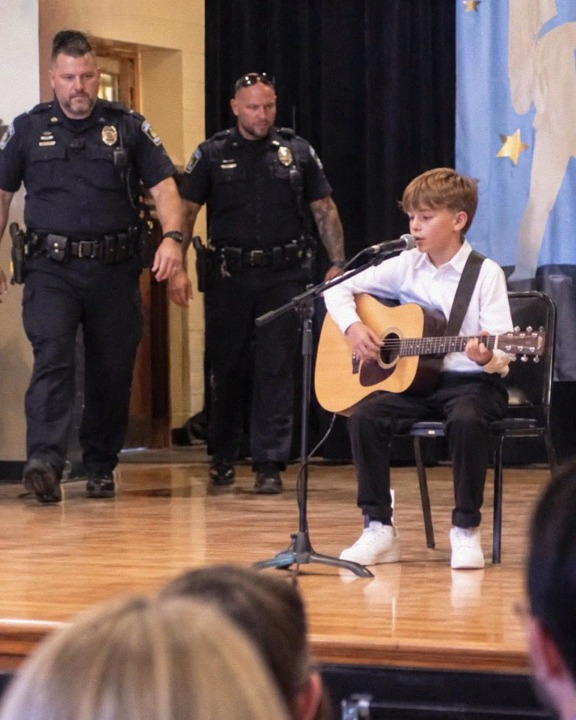
He walked toward the stage carrying the guitar, his shoulders slightly tense. He looked smaller than usual beneath the bright lights, but he kept moving until he reached the microphone.
I had not known he intended to perform.
My heart began beating faster.
He adjusted the guitar strap, looked across the audience, and eventually found me among the rows of parents.
For a moment, our eyes met.
Then he glanced upward, took a quiet breath, and spoke.
“This song is for my dad.”
The room grew still.
I recognized the song almost immediately.
It was one David used to hum while making breakfast on Saturday mornings. Sometimes he would sing it while washing dishes, and other times he would play a few notes on the guitar while Caleb sat beside him.
It had become part of our family routine, an ordinary little melody that I had never imagined would carry so much meaning.
Caleb began to play.
His fingers moved carefully across the strings. At first, his voice was quiet, and I could see how much concentration it took for him to continue.
Then he reached the first verse.
I felt tears gathering in my eyes.
Around me, parents stopped whispering. Several teachers stood quietly along the walls, listening. Some people wiped their eyes, while others watched Caleb with expressions of tenderness and concern.
My son was not performing like someone trying to impress an audience.
He was sharing a memory.
With every line, I remembered another moment from our life with David: the sound of laughter in the kitchen, the guitar resting against the sofa, and the way my husband would smile whenever Caleb finally mastered a difficult chord.
For the first time in a long while, I felt as though my son was allowing the rest of us to see a little of what he had been carrying inside.
By the second verse, I could barely hold back my tears.
Then something unexpected happened.
The double doors at the back of the gym opened.
Two uniformed police officers entered the room.
Their arrival was so unexpected that several people turned around at once. A few parents exchanged puzzled looks, while the teachers near the entrance stepped forward to see whether something had happened.
I froze.
Caleb continued playing for another moment, apparently unaware of the movement behind him.
Then he noticed the sudden change in the room.
His fingers slowed.
He looked toward the back of the gym and stopped singing.
For a moment, nobody moved.
I felt my stomach tighten as I watched the officers speak quietly with a member of the school staff. They were not rushing, and they did not appear to be responding to an emergency, but their presence was clearly connected to something important.
One of the teachers walked toward the stage.
Caleb stood beside his guitar, looking confused.
I rose from my seat, unsure whether I should approach him or wait for someone to explain what was happening.
Then one of the officers stepped forward and asked whether he could speak with Caleb.
The entire gym seemed to hold its breath.
The Reason the Officers Had Come
The teacher gently reassured Caleb that everything was all right and invited him to listen.
The older of the two officers introduced himself and explained that he and his colleague had come because they had heard about the performance Caleb had prepared in memory of his father.
They were not there to interrupt the event or cause him any trouble.
Instead, they had brought something connected to David.
I looked at my son, who was now holding his guitar against his chest.
The officer explained that David had made a meaningful impression on people during his lifetime. Through a connection with the family, they had learned about Caleb’s planned performance and wanted to show their support.
They had also brought a small keepsake that had been preserved among David’s personal belongings.
When the officer presented it, I recognized the handwriting on the accompanying note immediately.
It was David’s.
My hands began to tremble as I stepped closer to the stage.
Caleb looked at me, silently asking whether he should accept the gift. I nodded, unable to find the words.
He carefully opened the package.
Inside was a photograph of David holding the same acoustic guitar Caleb had brought to school. On the back, David had written a short message for his son about being brave, staying kind, and never being afraid to express what mattered to him.
The message was simple, but it felt deeply personal.
Caleb stared at the handwriting for several seconds.
Then his face crumpled, and tears began to fall.
I hurried to the stage and wrapped my arms around him, taking care not to knock the guitar from his hands.
He leaned into me and began to cry.
For three years, I had watched him struggle to express his sadness. I had wondered whether he felt alone, whether he believed he needed to keep his feelings hidden, and whether he thought talking about his father would make the loss more painful.
Now, standing in front of his classmates and teachers, he finally allowed himself to grieve openly.
Nobody rushed him.
The teachers gave us space, and the audience remained respectfully quiet.
The officers offered their condolences and explained that they had wanted to help preserve a meaningful memory of David for his family.
Their visit was not about creating a spectacle. It was a gesture of support for a child who was trying to find his way through a difficult loss.
When Caleb finally looked up, he held the photograph carefully in both hands.
“Can I finish the song?” he asked.
I kissed his forehead.
“Of course you can.”
He returned to the microphone.
His voice was still unsteady, but he began playing again. This time, I did not try to stop my tears. I simply listened, grateful that he had found a way to share something so important.
When the final note faded, the room filled with applause.
Caleb looked embarrassed at first, but then he smiled.
It was a small smile, one I had not seen often enough in recent months, and it meant more to me than any award or recognition could have meant.
What I Learned From That Day
On the drive home, Caleb kept the photograph on his lap.
For a while, neither of us spoke. I did not want to interrupt his thoughts or turn a meaningful experience into a long conversation he was not ready to have.
Eventually, he asked me to tell him more stories about his father.
I was surprised by the request, but I was also relieved.
So I told him about the little things I remembered: how David always sang the wrong lyrics to familiar songs, how he made breakfast on weekends, and how proud he had been when Caleb learned his first complete melody on the guitar.
My son listened closely.
He asked questions I had not heard him ask before, and I realized that remembering his father did not have to mean focusing only on the sadness of losing him.
It could also mean celebrating the life they had shared.
That evening reminded me that grief does not follow a schedule. Some children talk about their feelings openly, while others need more time, patience, and reassurance before they feel comfortable sharing what is happening inside.
As parents, we cannot remove every painful memory or provide an immediate answer to every difficult question. But we can listen, offer support, and remind our children that they do not have to face their feelings alone.
I also learned that support can come from unexpected places. A thoughtful gesture, a familiar photograph, or a few sincere words can help someone feel remembered and understood.
Caleb still misses his father. I know there will be difficult days ahead, including birthdays, holidays, and other occasions that remind us of the person who is no longer with us.
But after that school assembly, I felt hopeful.
My son had taken a brave step toward expressing his grief. He had shared a memory of his father with others, and he had discovered that people could listen without judging him or expecting him to hide his sadness.
As we arrived home, he carefully placed the photograph beside his guitar.
Then he turned to me and said, “Mom, I think Dad would have liked that.”
I smiled through my tears.
“I think he would have been very proud of you.”
And for the first time in a long while, the memory of David brought us not only sadness, but comfort, too.