A Fictional Zoo Encounter Raises Questions About Wildlife Safety and Enclosure Design
A fictional video depicting an unusual encounter between a gorilla and a visitor in a wheelchair has sparked discussion online about zoo safety, animal behavior, and the importance of maintaining appropriate distances between people and wildlife.
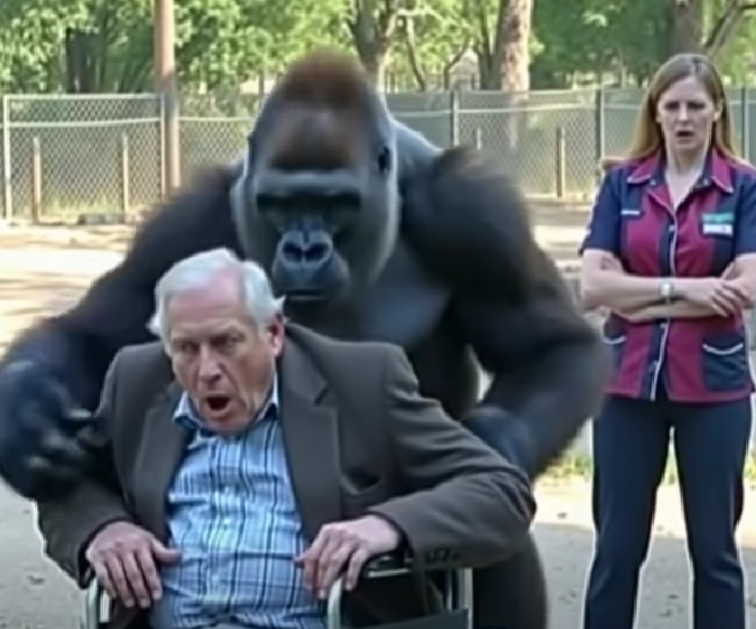
The digitally created scene shows a visitor sitting in a wheelchair near a gorilla enclosure. In the video, a female gorilla reaches toward the wheelchair, appears to grab part of it, and pulls it beyond the visitor area and into the enclosure. People nearby react with concern as zoo staff move quickly toward the scene.
Although the footage may appear realistic at first glance, the story and video are presented as an AI-generated fictional scenario for entertainment purposes. They do not document a confirmed real-world incident, and no real person or animal was involved or harmed.
Even as fictional content, the scenario raises several interesting questions about how modern zoos are designed, how visitors should behave around animal habitats, and why barriers and safety procedures are such an important part of wildlife facilities.
Understanding the Fictional Scenario
In the fictional story, an older man who previously worked at a zoo is visiting the facility as a guest. While positioned near a gorilla habitat, his wheelchair is shown coming close enough to the enclosure for a gorilla to reach it.
The gorilla then appears to take hold of the wheelchair and pull it toward the habitat.
People watching the scene react immediately. In a real zoo, an unexpected movement involving a large animal and a visitor could require an immediate response from trained staff. Zoo personnel are generally responsible for maintaining safe distances between visitors and animals and for responding to situations in which someone enters a restricted area or comes too close to an enclosure.
The fictional video then shows staff intervening and helping the visitor leave the enclosure area. The man is portrayed as being unharmed.
The story does not provide evidence that the gorilla intended to hurt the visitor. Instead, the animal’s behavior is presented as an unusual interaction that develops quickly and ends before a serious outcome occurs.
Because the footage is AI-generated, however, it should not be interpreted as evidence of how a real gorilla would behave in the same circumstances.
Why Zoo Barriers Are Important
Modern zoos use multiple layers of protection to separate visitors from animals. These can include walls, railings, glass panels, moats, elevated viewing platforms, fencing, and other physical barriers.
The specific design depends on the species, habitat, facility layout, and viewing requirements.
Large primates require particularly thoughtful enclosure design because they are intelligent, physically strong animals capable of reaching, moving, or manipulating objects in ways visitors may not expect.
For that reason, zoo staff consider more than simply whether an animal can escape its habitat. They also consider whether a visitor could accidentally place an object, body part, mobility device, stroller, phone, or other item within an animal’s reach.
This is one reason visitors are normally asked to remain behind designated barriers and follow posted instructions.
The goal is not to prevent people from observing animals closely. Instead, the goal is to create a viewing environment in which visitors can observe animals without creating unnecessary risks for either side.
Animal Behavior Can Be Difficult to Predict
One of the main ideas illustrated by the fictional scenario is that animal behavior can be difficult for the public to interpret.
A gorilla reaching toward an object does not automatically mean that the animal is behaving aggressively. Animals may investigate unfamiliar objects, respond to movement, explore their surroundings, or interact with objects for reasons that are not obvious to human observers.
At the same time, an apparently calm animal should never be assumed to be completely predictable.
A large animal can move very quickly and possess considerable physical strength. Even behavior that is not intended to cause harm could result in an accident if a person or object is too close.
This is why visitors should avoid trying to interact directly with animals, even when the animals appear calm or curious.
A familiar-looking animal is still a wild species with its own instincts, communication patterns, social structure, and boundaries.
Why Visitors Should Follow Posted Rules
Zoo rules are generally designed around many years of experience with animal behavior and visitor safety.
Common instructions may include remaining behind barriers, avoiding flash photography when prohibited, not feeding animals, keeping personal belongings secure, and refraining from attempting to attract an animal’s attention.
These rules may seem simple, but they serve an important purpose.
Visitors sometimes become focused on getting a photograph or seeing an animal more closely. In doing so, they may unintentionally move closer to a barrier or place an item within reach.
The safest approach is to allow animals to behave naturally while maintaining the distance specified by the facility.
Mobility Devices and Zoo Accessibility
The fictional scenario also highlights an important issue involving accessibility.
Wheelchairs, mobility scooters, walkers, and other assistive devices allow many people to enjoy zoos and other public attractions. Facilities have a responsibility to make viewing areas accessible while also ensuring that accessibility features work safely with animal enclosures.
A properly designed viewing area should give visitors with mobility limitations an appropriate place to observe animals without requiring them to approach a barrier more closely than other guests.
Accessible pathways and viewing platforms can therefore serve two purposes: improving the visitor experience and helping maintain appropriate separation from animals.
Zoo design increasingly considers the needs of visitors with different mobility levels, making it possible for more people to participate in educational and recreational activities.
The Role of Zoo Staff
If an unexpected situation occurs near an animal enclosure, trained zoo staff are generally better equipped to respond than visitors.
Employees may have specific procedures for handling emergencies, moving visitors away from an area, communicating with animal-care teams, and managing the animals involved.
This is particularly important when large animals are involved.
Members of the public may react emotionally or move toward an incident because they want to help. However, additional people entering a restricted area could make the situation more complicated.
In a real emergency, visitors should follow instructions from zoo employees and security personnel rather than attempting to handle the animal themselves.
Staff members understand the enclosure’s layout, the animal’s behavior, and the facility’s emergency procedures.
Why AI-Generated Videos Can Be Misleading
The fictional nature of the video is especially important because AI-generated footage can look increasingly realistic.
Artificial intelligence tools can create scenes involving people, animals, locations, and events that never actually occurred. When these videos are presented without context, viewers may assume they are genuine recordings.
This can create confusion, particularly when a fictional scene resembles something that could theoretically happen in real life.
A realistic-looking video is not necessarily evidence that an event occurred.
Before sharing unusual footage, viewers should look for information about its source. If a video is presented as news, it can be useful to check whether reputable news organizations, official institutions, or the facility mentioned in the story have independently reported the event.
If no reliable source confirms the incident, viewers should be cautious about treating the video as factual.
This is especially important when the footage involves animals, public safety, medical situations, accidents, or other subjects that can attract strong emotional reactions.
The Importance of Clear Disclaimers
AI-generated entertainment can be creative and engaging, but it benefits from clear labeling.
A simple statement explaining that a scene is fictional or AI-generated helps viewers understand what they are watching.
Without such a disclaimer, people may share the content believing it represents a genuine event.
The fictional video in this story is therefore best understood as a creative scenario rather than documentary footage.
That distinction also allows viewers to discuss the underlying topic—zoo safety and animal behavior—without confusing the fictional scene with an actual incident.
What a Real Zoo Might Do in a Similar Situation
If a real visitor were somehow pulled beyond a protective barrier or otherwise entered an animal enclosure, the response would depend on the facility, species, enclosure design, and circumstances.
Zoo personnel would be expected to follow their established emergency procedures.
Those procedures may include restricting access to the surrounding area, moving other visitors away, contacting animal-care specialists, and coordinating a controlled response.
The exact response would vary considerably between facilities.
A gorilla habitat, for example, is designed differently from an enclosure for large cats, elephants, bears, or reptiles. Each species presents different behavioral and physical considerations.
For this reason, there is no single response that applies to every animal-related incident.
The safest principle for visitors is simple: do not enter restricted areas, do not cross barriers, and follow staff instructions.
Learning From Fictional Scenarios
Even fictional stories can encourage useful conversations when they are clearly presented as fiction.
The gorilla-and-wheelchair scenario can prompt viewers to think about why zoos use barriers, how visitors should behave around wildlife, and how facilities can accommodate people with different mobility needs.
It also demonstrates how quickly an AI-generated video can create the impression of a real event.
Rather than focusing only on the dramatic aspect of the scene, viewers can use it as an opportunity to consider broader questions.
How should animal habitats be designed?
How can accessibility and animal safety work together?
What information should accompany AI-generated footage?
How can viewers determine whether an unusual video is authentic?
These questions are increasingly relevant as digital media becomes more sophisticated.
The Growing Challenge of Identifying Synthetic Media
AI-generated images and videos are becoming easier to produce and increasingly realistic.
A person watching a short clip may have very little context. If the video contains realistic movement, convincing lighting, and believable background details, it can be difficult to immediately recognize that it was created digitally.
This makes source verification more important.
Viewers should pay attention to whether the original uploader identifies the content as AI-generated. They should also consider whether the claimed event appears in credible reporting or official statements.
When a story describes an unusual event at a named zoo, checking the zoo’s official communication channels can be useful.
The absence of independent confirmation does not automatically prove that something is false, but it is a reason to avoid presenting an unverified claim as established fact.
Responsible Sharing of Online Content
Social media encourages people to share interesting videos quickly. However, taking a moment to check the context can prevent misinformation from spreading.
This is particularly useful for content that includes dramatic claims about animals, accidents, celebrities, public figures, or unusual events.
Before sharing a video, viewers can ask a few basic questions:
Who created the video?
Is the original source identified?
Does the creator say that the footage is AI-generated?
Has the event been reported by reliable sources?
Does the location actually exist?
Is the date and context clear?
These questions take very little time and can help distinguish entertainment from genuine reporting.
A Conversation About Respecting Wildlife
Another useful lesson from the fictional scenario is the importance of respecting wildlife.
Gorillas are highly intelligent social animals with complex behaviors. They should not be treated like domestic pets or approached as though they are predictable simply because they are living in a managed environment.
Zoos provide controlled environments where visitors can observe animals while professional teams care for them.
The purpose of maintaining a physical separation is not only to protect visitors. It also protects the animals.
Unexpected visitor behavior can create stress for animals and may interfere with normal routines.
Keeping appropriate distance allows animals to interact with their environment without unnecessary human interference.
What Visitors Can Do
People visiting zoos can contribute to a safe environment by following a few straightforward principles.
Stay behind all designated barriers.
Follow instructions from zoo employees.
Never attempt to touch or feed animals unless a facility specifically provides a supervised activity where this is permitted.
Do not throw objects into habitats.
Keep children within sight and follow family-safety guidance.
Secure phones, cameras, bags, and other belongings.
Avoid trying to attract an animal’s attention for a photograph.
Use accessible viewing areas as intended.
If an unusual situation occurs, alert staff rather than attempting to intervene personally.
These simple steps help protect visitors, employees, and animals.
A Fictional Story With a Real-World Message
The AI-generated gorilla video is not evidence of a real zoo incident. The people, circumstances, and events depicted in the scenario should therefore be understood as fictional.
Nevertheless, the idea behind the story touches on genuine issues that are relevant to modern zoos.
Animal enclosures need carefully designed barriers. Visitors need clear guidance. Accessibility needs to be considered alongside safety. Staff need appropriate emergency procedures. And digital content needs to be clearly labeled when it has been created artificially.
As AI-generated media becomes more common, understanding the difference between entertainment and real-world reporting will become increasingly important.
The fictional encounter may look unusual, but its broader message is straightforward: wildlife should be observed with respect, visitors should maintain appropriate distances, and unusual online footage should be checked before being accepted as fact.
Clear labeling, responsible visitor behavior, thoughtful enclosure design, and careful sharing