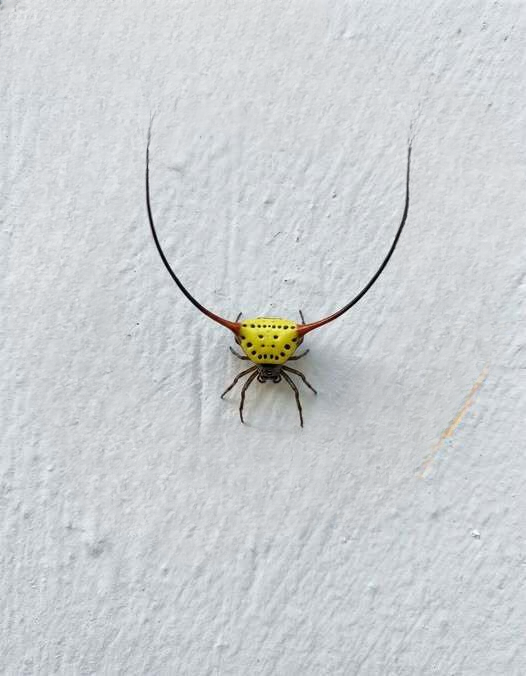
A Surprising Visitor in My Garage: Understanding the Spiny Orb-Weaver
Last night, I stepped into my garage, turned on the light, and immediately noticed something unusual on the wall.
At first, I could not tell what I was looking at.
The creature was small, but its shape was distinctive enough to catch my attention. It had a rounded body with unusual projections along its edges, giving it an appearance that looked completely different from the spiders I was accustomed to seeing around the house.
For a moment, I simply stood there and looked.
The garage had been quiet all day. Tools were hanging on the wall, boxes were stacked along one side, and a small amount of dust covered the floor. Nothing about the room seemed unusual until that moment.
Then I realized I was looking at a spider.
More specifically, the shape suggested a spiny orb-weaver, a group of spiders known for their distinctive body shapes and intricate webs.
Instead of reacting immediately, I decided to observe it.
The closer I looked, the more interesting it became.
What initially seemed strange was actually an example of the remarkable diversity found in the world of spiders.
What Is a Spiny Orb-Weaver?
Spiny orb-weavers are spiders belonging to the family Araneidae, a large group commonly known as orb-weaver spiders.
The term “orb-weaver” refers to the circular or spiral-shaped webs many species construct.
Spiny orb-weavers are particularly recognizable because some species have hardened projections, or spines, around the edges of their abdomen.
These structures can make them look very different from the more familiar spiders people encounter indoors.
Their unusual appearance is one reason they often attract attention when discovered in gardens, garages, porches, sheds, and other areas around homes.
However, appearance alone does not tell us whether a spider is dangerous.
In fact, many spiders with unusual shapes and colors are harmless to people and play useful roles in local ecosystems.
Why Would a Spider Be in a Garage?
Garages can provide several conditions that appeal to spiders.
They are often sheltered from rain and wind.
They may contain corners, beams, shelves, boxes, and other structures that provide places for webs.
Outdoor lighting around garage doors can also attract flying insects.
Where insects gather, spiders may eventually appear because insects provide food.
A garage is therefore not necessarily an unusual location for a spider.
From the spider’s perspective, it may simply be an environment with shelter and access to prey.
The Connection Between Lights and Spiders
Outdoor lights can influence where insects gather.
Many flying insects are attracted to artificial light, particularly at night.
If insects repeatedly gather around a garage door or exterior light, spiders may build webs nearby.
The spider is not necessarily interested in the light itself.
It may simply be taking advantage of the insects that appear there.
This creates a small food chain that is easy to overlook.
A light attracts insects.
Insects provide food for spiders.
Spiders become part of the local ecosystem around the building.
What looks like a random spider on a garage wall can therefore be connected to several environmental factors.
Their Unusual Shape Has a Purpose
The distinctive appearance of some spiny orb-weavers is one of their most interesting features.
Depending on the species, the abdomen may have several projections that extend outward.
These can make the spider appear almost artificial at first glance.
But unusual body structures are common throughout nature.
Animals have evolved an enormous variety of shapes, colors, textures, and defensive features.
A strange appearance does not necessarily mean an animal is dangerous.
It may simply be part of how that species has adapted to its environment.
Identification Requires More Than a General Description
One important point about spiny orb-weavers is that the group contains multiple species.
Their appearance can vary significantly.
Color, body shape, size, number and arrangement of spines, geographic location, and other characteristics can all matter when identifying a particular species.
For that reason, it is better not to claim an exact species identification based only on a vague description.
A photograph can help.
Geographic location can also be important.
If precise identification matters, a local university extension service, natural-history organization, museum, or qualified wildlife specialist may be able to help.
Their Webs Are Often the First Clue
Orb-weaver spiders are famous for their webs.
Many construct large, circular webs with a recognizable geometric pattern.
These webs can be especially noticeable early in the morning when dew collects on the silk.
Sunlight can make the strands appear almost invisible from one angle and highly visible from another.
The web is not simply decoration.
It is a specialized structure used to capture prey.
The spider waits for insects to become caught in the silk and then responds to vibrations traveling through the web.
How Orb Webs Work
A spider web may look delicate, but spider silk has remarkable properties.
The spider creates different types of silk for different purposes.
Some strands provide structural support.
Others form the spiral portion of the web.
The spider carefully places the strands in a pattern that allows it to detect movement.
When an insect contacts the web, the resulting vibrations can alert the spider.
The spider then approaches the trapped prey.
The entire process is an impressive example of natural engineering.
Webs Are Constantly Exposed to the Environment
A spider’s web is not a permanent structure.
Wind can damage it.
Rain can break strands.
Leaves and other debris can interfere with it.
Larger insects may damage sections.
Over time, the spider may repair or rebuild the web.
This is one reason you may notice a web in one location one evening and find that it looks completely different the following day.
The spider is responding to its environment.
Spiny Orb-Weavers and Human Homes
Finding a spider around the home can make people uncomfortable, especially when the spider looks unfamiliar.
However, the presence of a spider does not automatically indicate an infestation or a dangerous situation.
In many cases, an individual spider is simply using an available sheltered location.
Garages, sheds, porches, gardens, and exterior walls can provide suitable habitat.
If a spider is not causing a problem, leaving it alone may be the simplest option.
If it is located in a place where people frequently walk or work, relocation can be considered when it can be done safely.
Why You Should Avoid Handling Wild Spiders
Even when a species is generally considered harmless to people, it is not a good idea to handle a wild spider unnecessarily.
Spiders are animals, not household toys.
They may respond defensively if grabbed or squeezed.
The safest approach is usually to observe without touching.
If you need to move one, using a simple container-and-card method can sometimes allow the spider to be relocated without direct contact.
However, people who are uncomfortable with spiders do not need to handle them personally.
A local pest professional can help when necessary.
A Spider’s Appearance Is Not a Reliable Measure of Risk
People often associate bright colors, unusual body shapes, or prominent spines with danger.
Nature does not always work that way.
Some harmless animals have striking appearances.
Some dangerous animals can look relatively ordinary.
Therefore, appearance should not be the only factor used to determine whether an unfamiliar animal is safe.
The best approach is identification.
Knowing what species you are looking at provides much more useful information than guessing based on appearance.
Spiders Are Important Predators
Spiders play an important role in many ecosystems.
They feed on insects and other small organisms.
By doing so, they become part of natural food webs and can influence insect populations.
A garden with spiders is not necessarily a garden with a problem.
In fact, spiders are often one of many organisms that help maintain ecological balance.
This does not mean every spider should be welcomed indoors.
It simply means that their role in nature is more complex than the fear surrounding them sometimes suggests.
Why People Often Fear Spiders
Arachnophobia, or a strong fear of spiders, is relatively common.
For some people, even a photograph can produce an immediate emotional response.
Part of this may be related to the way humans notice certain types of movement and body shapes.
Cultural influences also play a role.
Movies, stories, social-media videos, and sensational headlines frequently portray spiders as frightening creatures.
This can influence how people interpret a harmless encounter.
Education can help replace some of that uncertainty with knowledge.
Knowing what an animal is often makes it feel less mysterious.
The Garage as a Small Ecosystem
A garage may seem like a purely human space.
But it can function as a miniature habitat.
Small gaps around doors can allow insects inside.
Spiders can build webs in corners.
Small plants may grow near exterior walls.
Moisture can create favorable conditions for certain organisms.
Outdoor lighting can attract insects.
Dust and organic material can accumulate.
In other words, the boundary between the built environment and the natural environment is not as complete as it appears.
Wildlife regularly adapts to human structures.
How to Reduce Unwanted Webs
If you prefer to keep spiders away from frequently used areas, several basic maintenance habits can help.
Keep garages reasonably organized.
Reduce unnecessary clutter.
Sweep corners and ceilings periodically.
Repair damaged screens.
Seal obvious gaps around doors where practical.
Keep exterior lighting clean and consider whether unnecessary lighting can be reduced.
Remove accumulated debris around the outside of the building.
These steps can reduce some of the places where insects and spiders find shelter.
However, complete elimination of spiders from outdoor areas is neither realistic nor necessarily desirable.
Avoid Excessive Use of Pesticides
When people discover a spider, their first thought may be to use an insecticide.
That is not always necessary.
Pesticides can affect more than the target organism.
They can also affect beneficial insects and other wildlife depending on the product and how it is used.
If a spider is simply living outside or in a quiet corner of a garage, removal may not be necessary.
When pest control is genuinely needed, products should be used according to their labels and only for appropriate purposes.
For persistent problems, professional advice can help determine the source.
Look for the Reason Spiders Are Present
If you repeatedly find large numbers of spiders in one area, the useful question may not be:
“How do I kill the spiders?”
Instead, ask:
“Why are so many spiders finding this location attractive?”
There may be a large insect population nearby.
Exterior lights may be attracting moths and other flying insects.
Moisture may be creating favorable conditions.
Vegetation may be providing shelter.
The building may have openings that allow insects to enter.
Addressing the underlying conditions can sometimes be more effective than repeatedly removing individual spiders.
Spiny Orb-Weavers in Gardens
Although the spider I noticed was in a garage, spiny orb-weavers are also associated with outdoor environments.
Gardens can provide excellent locations for webs because plants create support structures and attract insects.
A web stretched between branches may remain unnoticed until sunlight or dew makes it visible.
The spider itself may sit near the center or edge of the web depending on its behavior and species.
Gardeners who observe rather than immediately removing every web may discover a surprisingly diverse community of small organisms living around their plants.
The Beauty of Spider Silk
Spider silk is one of nature’s most fascinating materials.
It is lightweight, flexible, and remarkably strong relative to its mass.
Different spiders produce silk for different purposes.
Some use it to build webs.
Others use silk to create protective structures, anchor themselves, wrap prey, or support reproduction.
The variety of silk-producing behavior across spider species is an example of how evolution can produce specialized solutions to environmental challenges.
A web that looks delicate to us is the result of a sop