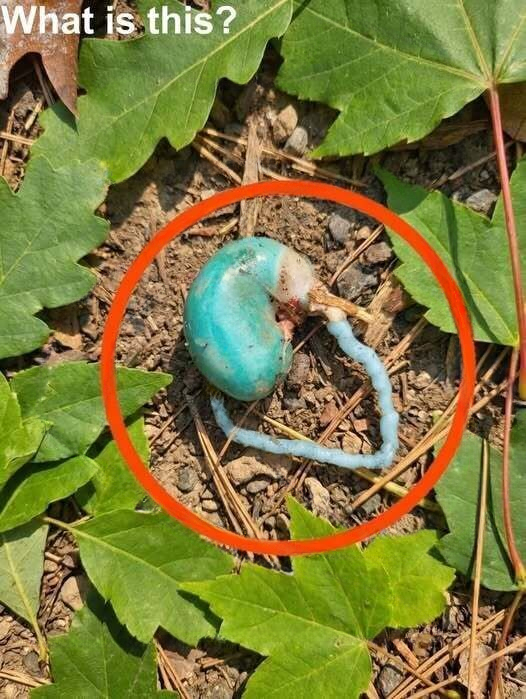
Strange Blue Discovery in the Woods: What Could It Be?
A walk through the woods can sometimes reveal things that are difficult to explain at first glance. A bright-colored plant growing beneath a fallen tree, an unusual patch of fungus, a mineral-covered rock, or even an object left behind by another person can stand out against the natural greens, browns, and grays of the forest.
One of the more unusual sights is a vivid blue substance or object appearing among the trees.
Blue is not necessarily the first color people associate with the forest, so discovering something bright blue on the ground can immediately raise questions. Is it part of a plant? Could it be a type of fungus? Is it a mineral? Could an animal have left it behind? Or is it simply something manufactured that found its way into the woods?
The answer depends heavily on what the object looks like, where it was found, and what is around it.
Nature contains far more colors and forms than we typically notice during an ordinary walk. Some organisms have surprisingly vivid blue pigments or structural colors, while minerals can produce striking shades of blue, green, or blue-gray. At the same time, human-made materials can easily become part of a forest environment.
So if you ever encounter a strange blue discovery in the woods, the best approach is not to immediately assume it is rare, dangerous, or mysterious.
Instead, take a closer look from a safe distance and consider the possibilities.
Why Blue Objects Stand Out in the Forest
Most woodland environments are dominated by relatively muted colors.
Leaves are usually green during the growing season and brown or yellow when they begin to change. Tree bark tends to range from gray and brown to reddish tones. Fallen leaves, branches, soil, and stones generally blend into the same natural palette.
Against that background, blue can appear especially noticeable.
Even a relatively small blue object may catch the eye from several feet away.
Human vision is naturally drawn to color differences, particularly when a bright color contrasts strongly with its surroundings. This is one reason unusual colors can make an otherwise ordinary walk memorable.
However, the fact that something stands out does not tell us what it is.
A blue object can have many possible explanations.
A Blue Discovery Does Not Necessarily Mean Something Rare
When people encounter something unusual outdoors, it is tempting to assume they have discovered something uncommon.
Sometimes that may be true.
But unusual-looking objects are often much more ordinary once they are identified.
A blue substance in the woods might be:
- A naturally occurring mineral
- A mushroom or other fungus
- A plant or plant-related structure
- A piece of colored plastic
- Fabric or clothing material
- Paint or another manufactured substance
- A piece of glass
- A stone reflecting light in an unusual way
- An animal-related object
- Something carried into the woods by a person
This is why identification is more useful than speculation.
The location and physical characteristics of the object can provide important clues.
Could It Be a Fungus?
Fungi are among the most interesting possibilities when unusual colors are discovered in natural environments.
Although many mushrooms are brown, white, beige, gray, or tan, fungi can appear in a surprisingly wide range of colors.
Some species can display blue, blue-green, violet, purple, or grayish shades.
Color alone, however, is not enough to identify a fungus.
A mushroom’s shape, surface texture, size, habitat, growth pattern, and other characteristics are important. Some fungi grow directly from soil, while others appear on dead wood, fallen branches, decaying leaves, or living plants.
The surrounding environment can therefore provide valuable information.
If the blue object appears to be growing from a fallen log, for example, it may have a completely different explanation from a smooth blue object sitting loose on the forest floor.
Never Eat an Unidentified Mushroom
One important rule applies whenever mushrooms or fungi are involved:
Do not eat an unidentified mushroom or fungus.
Some edible species resemble species that should not be consumed, and reliable identification often requires characteristics that are difficult to determine from a casual glance.
Internet photographs can be useful for generating possibilities, but they should not be treated as a substitute for expert identification when consumption is being considered.
The safest approach is simply to observe unusual fungi without consuming them.
Could It Be a Mineral or Rock?
Another possibility is that the blue object is geological rather than biological.
Certain minerals and mineral deposits can produce blue or blue-green colors.
The appearance can vary depending on the mineral itself, impurities, weathering, moisture, and lighting conditions.
A blue-gray stone lying among ordinary brown rocks can therefore look surprisingly unusual.
Some minerals may also show different colors when viewed from different angles.
If you find a blue rock, pay attention to its texture.
Is the surface:
- Smooth?
- Rough?
- Crystalline?
- Glass-like?
- Powdery?
- Metallic?
- Layered?
These characteristics can help distinguish a mineral from other materials.
Weather Can Change How a Rock Looks
Moisture can dramatically alter the appearance of rocks.
A stone that looks dull and gray when dry may become darker and more colorful after rain.
Water can also increase the visual contrast between different minerals within the same rock.
This means that something discovered shortly after rainfall may look considerably different from the same object on a dry day.
Lighting matters as well.
Sunlight filtering through trees can create reflections and shadows that make certain surfaces appear more intensely colored.
Before concluding that an object is unusually bright blue, consider whether the lighting or moisture is affecting its appearance.
Could It Be Glass?
Another relatively common possibility is colored glass.
Broken or discarded glass can sometimes remain in wooded areas for many years. Blue, green, brown, clear, and amber glass are all possible.
A piece of old glass may become weathered, covered in dirt, or partially buried, making its original purpose difficult to determine.
If you encounter a potentially sharp object, do not pick it up with bare hands.
Keep children and pets away from it and, where appropriate, contact local authorities or property managers regarding safe removal.
The presence of glass can also provide evidence that the location has been used by people in the past.
Human-Made Objects Can Become Part of Nature
Forests may look completely natural, but many woodland areas have long histories of human activity.
People hike, camp, hunt, work, build roads, maintain trails, and sometimes leave objects behind.
Over time, manufactured materials can become covered with soil, leaves, moss, and vegetation.
A blue piece of rope might resemble a strange natural structure.
A piece of plastic might look like an unusual plant.
A painted object could become partially hidden beneath leaves.
An old piece of fabric might fade or change color as it weathers.
This is one reason it is important not to assume that every unusual object found outdoors originated in nature.
Could It Be Something Left Behind by Hikers?
Outdoor recreation can introduce many objects into forest environments.
These may include:
- Water bottles
- Clothing
- Food packaging
- Camping equipment
- Rope
- Tarps
- Plastic items
- Paint-marked materials
- Trail equipment
- Fishing-related materials near waterways
Sometimes an object can remain hidden for months or years before becoming visible.
Heavy rain, erosion, fallen trees, or changes in vegetation can expose materials that were previously buried.
What About Blue Paint?
Paint can also create unusual colors in natural environments.
A small piece of painted wood, metal, stone, or another material can appear almost natural after being exposed to weather for a long period.
If you suspect paint, avoid scraping or handling the substance unnecessarily.
Older painted materials may contain substances that should not be disturbed casually.
Instead, photograph the object and consider whether it is located near an old structure, fence, trail marker, building site, or other evidence of previous human activity.
Could an Animal Be Responsible?
Animals can also contribute to unusual discoveries.
Birds and mammals sometimes carry objects, move materials, disturb soil, or leave behind parts of plants and other natural material.
An animal-related discovery may not be immediately recognizable.
For example, a brightly colored object may have been moved from somewhere else rather than originating exactly where you found it.
This is another reason the surrounding area matters.
Look around without disturbing the site.
Are there tracks?
Are there feathers?
Is there disturbed soil?
Are nearby plants damaged?
Is there evidence of a nest or burrow?
These clues can help create a more complete picture.
The Importance of Location
One of the most useful pieces of information when identifying an unknown object is its exact location.
Consider whether it was found:
- On a hiking trail
- Beside a stream
- Near a fallen tree
- Under dense vegetation
- In a clearing
- On exposed soil
- Among rocks
- Near an old structure
- Close to a road
- Around a campsite
Different environments support different explanations.
A blue substance growing from wet wood deserves a different investigation from a blue plastic fragment lying beside a well-used trail.
Water Can Change the Story
If the discovery occurred near a stream, lake, pond, or wetland, water-related explanations become more relevant.
Water can transport small objects over considerable distances.
A piece of plastic, glass, wood, or other material may travel downstream and become lodged among branches or rocks.
Water also supports algae, fungi, aquatic plants, and other organisms that can have unusual colors.
Again, color alone cannot provide a reliable identification.
What About Algae?
Some algae can create unusual colors in water or on wet surfaces.
Although green is the color most commonly associated with algae, other colors can occur depending on the species, environment, pigments, and growth conditions.
If the blue material appears as a film, coating, or thin layer around wet surfaces, an aquatic or microbial explanation may be worth considering.
However, visual identification can be difficult.
Avoid touching or consuming unknown substances found around waterways.
Moss Can Create Optical Illusions
Moss and other small plants can also make ordinary objects look unusual.
A rock covered with moss may appear green, blue-green, gray, or even bluish depending on lighting.
Moisture can intensify these effects.
The same object may look completely different in bright sunlight compared with the shade of a forest canopy.
This is another reason photographs taken under different lighting conditions can sometimes help with identification.
Could It Be a Lichen?
Lichens are partnerships between fungi and photosynthetic organisms and can grow on rocks, bark, soil, and other surfaces.
They come in many forms and colors.
Some may appear pale green, yellow, orange, gray, white, or bluish-gray.
Lichens are often overlooked because they grow slowly and blend into their surroundings.
A small colorful patch on a rock or tree may therefore be a natural organism rather than an unusual manufactured material.
Look at the Texture
When trying to identify an unknown object, texture can be just as informative as color.
Ask yourself whether it appears:
Soft:
Could indicate plant material, fabric, or some biological growth.
Hard:
Could suggest rock, glass, plastic, or metal.
Powdery:
Could indicate soil, mineral material, spores, or another substance.
Gel-like:
Could be associated with moisture-dependent biological material.
Fibrous:
Could suggest plant material, wood fibers, rope, or fabric.
Crystalline:
Could indicate a mineral or salt-like deposit.
Do not touch unknown materials simply to determine their texture.
Visual observation is usually sufficient for an initial assessment.
Use a Camera Before Touching Anything
A smartphone camera can be surprisingly useful for documenting unusual discoveries.
Take several photographs from different distances.
A close-up can show details.
A wider photograph can show the surrounding environment.
A photograph with an ordinary object for scale can help communicate the approximate size.
If the object is too small for the camera to focus on, step back slightly rather than getting extremely clo