My 8-Year-Old Said His Late Brother Was Visiting Every Night — Then I Discovered What Was Really Happening
Losing a child changes a family in ways that are difficult to explain to anyone who has never experienced that kind of grief.
For me, the hardest part wasn’t only learning how to live without my four-year-old son, Mason. It was watching what his death did to his older brother, Nolan.
Nolan was eight years old.
Before everything happened, he was energetic, curious, and constantly talking. He could spend an entire afternoon building something out of blocks, asking questions about animals, or telling me stories that made very little sense but somehow made all of us laugh.
Mason followed him everywhere.
They had the ordinary relationship brothers often have. They played together, argued over toys, laughed at things adults didn’t understand, and occasionally annoyed each other.
But Nolan loved his little brother deeply.
When Mason died, our entire home became different.
The laughter disappeared.
The toys remained where we had left them for a while, almost as if moving anything would make the loss more real. Mason’s little shoes were still near the door. His favorite blanket was folded on the couch.
And Nolan changed almost immediately.
He became quiet.
He stopped asking for things.
He rarely wanted to play.
At night, he sometimes stood in the hallway outside Mason’s room without saying anything.
I tried to give him space while also making sure he knew he could talk to me.
I told him it was okay to miss his brother.
I told him it was okay to cry.
I told him there was nothing wrong with remembering Mason.
But children don’t always express grief the same way adults do.
Sometimes they use stories.
Sometimes they create routines.
Sometimes they talk to the person they’ve lost as though that person is still part of their daily lives.
I understood that in theory.
I wasn’t prepared for what Nolan told me one night.
“Mom, I Saw Mason”
It was around bedtime.
I had just finished cleaning the kitchen when Nolan appeared in the doorway.
He looked tired.
“Mom?”
I turned around.
“Yeah?”
He hesitated.
Then he said something that made me stop what I was doing.
“I saw Mason.”
For a moment, I didn’t know what to say.
I walked toward him and knelt down so we were at the same level.
“What do you mean?”
Nolan looked toward the hallway.
“He comes to my room.”
My heart sank.
“At night?”
He nodded.
“He comes every night.”
I didn’t want to dismiss him.
I also didn’t want to tell him that Mason was literally visiting the house, because I didn’t know what Nolan was experiencing and I didn’t want to make him more frightened or confused.
So I asked gently, “What happens when you see him?”
Nolan shrugged.
“We talk.”
“What do you talk about?”
“Stuff.”
“What kind of stuff?”
He looked at me as though the question were unnecessary.
“School. Games. Things we used to do.”
I sat there quietly.
There was no excitement in his voice.
No attempt to scare me.
He simply seemed certain that his brother was still part of his nights.
I hugged him.
“You miss him very much, don’t you?”
Nolan nodded against my shoulder.
“I don’t want him to be gone.”
Neither did I.
The Changes in Nolan
Over the next several days, something interesting happened.
Nolan started acting more like himself.
He laughed again.
He started eating better.
He began playing with some of his old toys.
At first, I was relieved.
I thought perhaps he was finally beginning to process what had happened.
But there was still something unusual.
Several times, I heard him talking in his bedroom when I knew he was alone.
Sometimes I heard him laugh.
Sometimes he spoke softly enough that I couldn’t understand the words.
When I entered the room, he would often stop.
One evening I asked him who he had been talking to.
“Mason.”
I sat beside him.
“What did you and Mason talk about?”
He smiled.
“He said he likes my new blanket.”
I looked at the blanket.
It was one we had bought after Mason died.
Nolan continued talking as though nothing unusual had happened.
I didn’t correct him.
I didn’t tell him he was imagining things.
Instead, I asked, “Does talking to Mason make you feel better?”
He nodded.
“Yes.”
That answer mattered more to me than anything else.
Still, I began wondering whether Nolan needed more support than I could provide by myself.
I contacted his pediatrician and explained what was happening.
The doctor reminded me that children can experience grief in many forms. Imaginary conversations, talking to deceased loved ones, changes in sleep, and emotional withdrawal can all occur after a major loss.
But the doctor also recommended that I keep paying attention to Nolan’s behavior.
If he became frightened, stopped functioning normally, couldn’t sleep, or appeared increasingly distressed, professional counseling would be appropriate.
I agreed.
I wanted to help my son.
I just wasn’t sure how.
The Night I Became Concerned
A few nights later, I woke up around midnight.
The house was quiet.
I walked toward the kitchen for a glass of water when I heard Nolan’s voice.
It came from his bedroom.
I stopped.
He was talking.
I couldn’t make out every word, but I could hear him clearly enough to know he wasn’t asleep.
I stood outside his door for a moment.
Then I heard him laugh.
That sound should have made me happy.
Instead, I felt uneasy.
Not because I believed something supernatural was happening.
Because my eight-year-old son was grieving deeply, and I didn’t know exactly what was happening inside his mind.
I opened the door.
Nolan was sitting upright in bed.
“Hey, buddy.”
He looked at me.
“Hi, Mom.”
“Who were you talking to?”
He pointed toward the empty space beside him.
“Mason.”
I looked at the bed.
There was nobody there.
Nolan smiled.
“He was just here.”
I sat beside him.
“Do you want me to stay with you?”
He nodded.
So I stayed.
Eventually, he fell asleep.
I watched him for several minutes before turning off the light.
That night, I made a decision.
I needed to understand what was happening.
Not because I wanted to prove Nolan wrong.
Not because I wanted to find evidence of anything frightening.
I simply wanted to know whether there was something I was missing.
The Camera
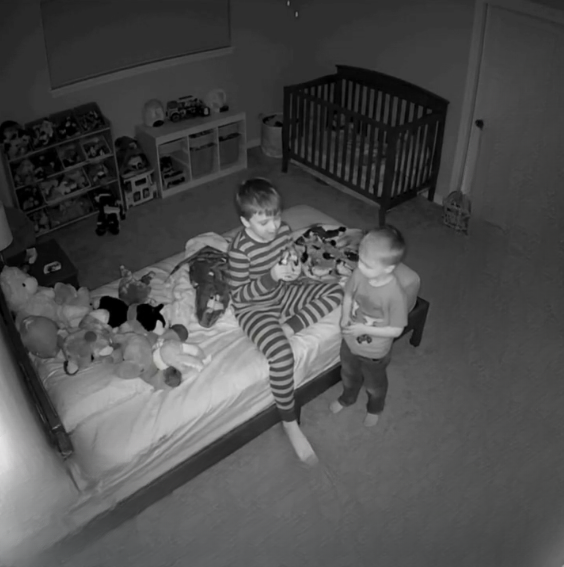
I decided to use a camera in the room, but I did it for safety and observation rather than because I believed in a supernatural explanation.
I wanted to see whether Nolan was waking during the night, sleepwalking, interacting with something in the room, or doing something else that might help explain what he was experiencing.
I also knew that children deserve privacy, so I kept the focus strictly on his sleeping area and did not use it as a way to secretly monitor every part of his life.
That night, I checked the recording shortly after midnight.
For the first several minutes, nothing happened.
Nolan slept peacefully.
Then, at approximately 10:47 p.m., he moved.
He sat up.
He looked toward the empty side of the bed.
And he smiled.
“Hey,” he whispered.
I watched carefully.
He shifted over and pulled the blanket toward the empty space beside him.
Then he said something I couldn’t understand.
A few seconds later, he laughed.
There was no second person in the room.
But Nolan clearly believed he was interacting with someone.
I continued watching.
He eventually lay down again.
The footage wasn’t frightening.
It was heartbreaking.
This wasn’t a horror story.
It was an eight-year-old boy trying to maintain a connection with the brother he had lost.
I almost turned the recording off.
Then something unexpected happened.
Nolan suddenly looked toward the camera.
He stared directly at it.
Then he whispered:
“Mom knows.”
I froze.
For a moment, I wondered whether he had somehow noticed the camera earlier.
Then he smiled.
“He knows Mom is watching.”
I didn’t understand what he meant.
But the next morning, I asked him about it.
He immediately knew what I was talking about.
“You saw me talking to Mason?”
“Yes.”
He looked embarrassed.
“Are you mad?”
“No.”
“Are you scared?”
I paused.
“No. I’m just trying to understand.”
He looked down at his hands.
Then he said something that completely changed how I understood the situation.
“I Know He’s Not Really Here”
I expected Nolan to insist that Mason was physically present.
Instead, he surprised me.
“I know he’s not really here.”
I stared at him.
“What?”
Nolan shrugged.
“Sometimes I pretend he’s here.”
I didn’t know what to say.
He continued.
“Because when I pretend, I can talk to him.”
That was the moment everything became clearer.
The conversations weren’t necessarily something Nolan believed was literally happening.
They were a way for him to cope.
He missed his brother so much that pretending Mason was sitting beside him gave him somewhere to put all those feelings.
Then Nolan looked at me.
“But sometimes it feels real.”
That sentence stayed with me.
Children can understand something intellectually while still experiencing it emotionally in a completely different way.
Nolan knew Mason had died.
But emotionally, he wasn’t ready for the relationship to simply disappear.
The Memory Box
I asked Nolan whether he wanted to make something for Mason.
He agreed.
Together, we found a small wooden box.
We put some of Mason’s things inside.
A photograph.
A tiny toy car.
A drawing Nolan had made for him.
A bracelet Mason had worn.
And a note.
Nolan wrote it himself.
He didn’t want me to read it.
So I didn’t.
He folded it and placed it inside the box.
Then he said, “Now I can talk to him here.”
I asked him what he meant.
He explained that he could write down things he wished he could tell Mason.
That way, he wouldn’t have to keep everything inside.
It was such a simple idea.
But it gave him something I hadn’t realized he needed.
A safe place for his memories.
Grief Doesn’t Follow a Schedule
The following weeks weren’t suddenly easy.
There were good days and bad days.
Sometimes Nolan laughed.
Sometimes he cried.
Sometimes he wanted to talk about Mason for hours.
Other times he became irritated when I mentioned his brother.
I learned that grief doesn’t move in a straight line.
There isn’t a specific day when someone wakes up and suddenly feels normal again.
For children, this can be even more complicated.
They may seem fine one moment and become deeply emotional the next.
They may play happily for an hour and then suddenly ask why the person they love isn’t coming back.
They may understand death in one way at eight years old and understand it differently months later.
So I stopped trying to measure Nolan’s grief.
Instead, I focused on being available.
If he wanted to talk, I listened.
If he wanted quiet, I gave him space.
If he wanted to remember Mason, we remembered him.
The Second Surprise
About two months after the night with the camera, I noticed something else.
Nolan had started leaving one of Mason’s old toy cars beside his bed.
Every morning, it was in a different position.
One morning, I asked him about it.
He smiled.
“I move it when I miss him.”
“Why?”
“Because Mason used to move it around my room.”
I smiled.
“So it’s like you’re remembering him?”
“Yeah.”
Then Nolan looked at me.
“Mom, I don’t need the camera anymore.”
I was surprised.
“Why?”
“Because I know you believe me.”
I realized something important.
He hadn’t needed me to believe that Mason was physically visiting.
He needed me to believe that his grief was real.
He needed someone to take his feelings seriously without making him feel strange.
What I Learned
After losing Mason, I spent a lot of time searching for explanations.
I wanted everything to make sense.
I wanted to understand why Nolan behaved the way he did.
I wanted to know whether I was doing enough.
But eventually I realized that grief doesn’t always need an immediate explanation.
Sometimes it needs patience.
Sometimes it needs professional support.
Sometimes it needs a memory box and a quiet conversation.
And sometimes it simply needs a parent to sit beside a child and say:
“I know you miss him.”
That sentence help