A few days ago, I learned something about my marriage that I wish I had understood much earlier.
It wasn’t something dramatic that happened overnight.
It was something much quieter.
I finally realized that I had been carrying far more responsibility than I ever should have, and the moment I physically couldn’t do everything anymore, my husband was forced to see just how much I had been doing.
It started with an accident.
I had been carrying a basket of laundry upstairs when I lost my balance on the final few steps. I tried to catch myself, but I fell awkwardly and immediately felt a sharp pain in my arm.
At first, I hoped it was just a bad sprain.
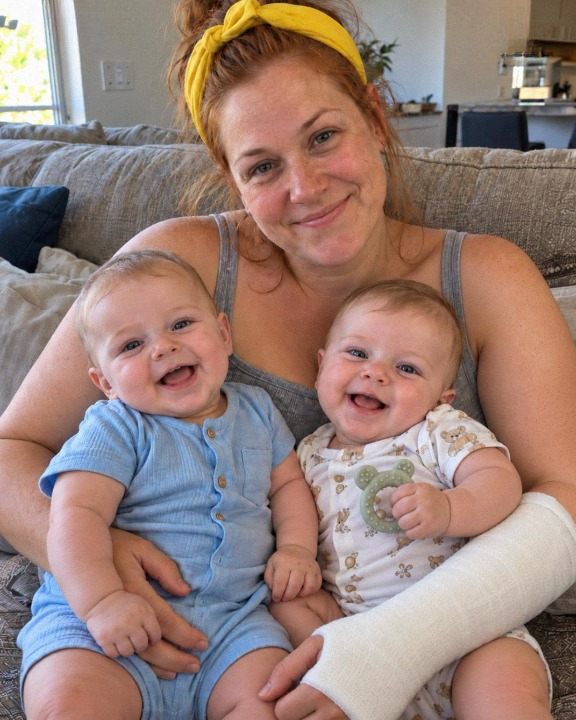
Unfortunately, the doctor confirmed that I had broken my arm.
I left the clinic wearing a cast with very clear instructions: don’t lift anything heavy, avoid unnecessary strain, and give my arm time to heal.
Under ordinary circumstances, that would have been difficult enough.
But my husband, Derek, and I had five-month-old twin boys.
Anyone who has cared for babies knows that five months is not exactly a quiet stage.
There were bottles to prepare, diapers to change, clothes to wash, babies to settle, appointments to remember, and seemingly endless nights when one baby would finally fall asleep just as the other woke up.
With two babies, everything happened twice.
Before my accident, I had somehow managed most of it.
I got up during the night.
I prepared bottles.
I changed diapers.
I organized doctor’s appointments.
I did the laundry.
I cleaned the house.
I cooked dinner.
I kept track of which baby had eaten and when.
I even tried to make sure Derek had clean work clothes ready in the morning.
I had never really thought about the imbalance.
I suppose I had convinced myself that this was simply what mothers did.
But after my injury, I couldn’t physically continue at the same pace.
That was when I asked Derek for help.
One evening, after we had finally settled the babies, I said, “Could you take a day off sometime this week? Or maybe work from home for a few hours? I really need help while my arm heals.”
He looked at me as though I had asked for something unreasonable.
“I have a job,” he said.
“I know,” I replied. “I’m not asking you to quit your job. I’m asking you to help with your children while I’m injured.”
He sighed.
“I can’t just rearrange my entire schedule.”
I stared at him.
“My arm is broken, Derek.”
“I know.”
“Then you understand why I need help.”
He shrugged.
Then came the sentence I would never forget.
“Moms don’t get sick days.”
For a moment, I honestly didn’t know what to say.
I thought maybe he was joking.
He wasn’t.
I explained that I wasn’t asking him to take over the entire household. I simply needed him to participate more while I recovered.
His response was even colder.
“You wanted kids too. You knew what this would be like.”
That sentence stayed with me.
Because he was right about one thing.
I had wanted children.
But so had he.
We had talked about having a family together. We had planned for the twins. We had celebrated when we learned there were two babies on the way.
Neither of us had ever agreed that raising them would become my responsibility alone.
Yet somehow, that’s exactly what had happened.
The next morning, I tried to do everything as usual.
I quickly realized that it wasn’t possible.
I couldn’t comfortably lift both babies.
I struggled with opening containers and preparing bottles.
Even folding laundry became difficult.
By lunchtime, I was exhausted.
I called my mother and asked if she could come over.
Thankfully, she did.
She helped me with the babies and prepared something for us to eat.
Watching my mother step in made me realize something.
I shouldn’t have needed to call her simply because my husband refused to help.
The following evening, I asked Derek to help with bath time.
“I just got home,” he said.
“I know. But I can’t safely manage both babies with one arm.”
He frowned.
“You’ve been home all day.”
That was the moment something inside me changed.
“Yes,” I said. “I’ve been home taking care of two five-month-old babies.”
He shook his head.
“You know what I mean.”
“No,” I replied. “Actually, I don’t think you do.”
He walked away.
I stood there holding one of our sons while the other was crying nearby.
And for the first time, I stopped trying to make everything easier for Derek.
Not because I wanted revenge.
Not because I wanted him to suffer.
I simply stopped pretending that everything was fine.
For years, I had quietly protected him from the reality of how much work went into our home.
If the laundry wasn’t done, I did it.
If dinner wasn’t ready, I made something.
If the babies woke during the night, I got up.
If an appointment needed to be scheduled, I handled it.
If Derek needed something for work, I remembered it.
I had become the invisible system keeping our household running.
And because I rarely complained, he apparently assumed everything happened effortlessly.
So the next evening, I made a decision.
I would do only what I could safely do.
Nothing more.
When Derek came home, he found the kitchen exactly as I had left it.
There wasn’t a freshly prepared dinner waiting.
The laundry wasn’t folded.
The bottles that needed washing were sitting by the sink.
And the babies needed attention.
He looked around.
“What happened?”
I looked at him.
“Nothing happened. I’m injured.”
He frowned.
“But what are we going to eat?”
“I don’t know,” I said. “You can decide.”
He stared at me.
“You didn’t make anything?”
“No.”
For the first time, he seemed genuinely surprised.
“But you always make dinner.”
“I know.”
He looked toward the laundry.
“Why isn’t this done?”
“Because my arm is broken.”
He became frustrated.
“You can’t just stop doing everything.”
I calmly answered, “I’m not stopping everything. I’m doing what I can. But I can’t continue doing the work of two adults while recovering from an injury.”
Then one of the babies began crying.
Derek looked toward the nursery.
I didn’t move immediately.
He looked back at me.
“Can you get him?”
I shook my head.
“That’s your son too.”
He stood there silently.
Then he walked into the nursery.
A few minutes later, he returned carrying our baby.
He looked overwhelmed.
The baby was crying.
The bottle wasn’t ready.
The diaper needed changing.
And suddenly, Derek was confronted with something I had been dealing with every day.
There was no clocking out.
No convenient pause.
No guarantee that the baby would settle simply because you were tired.
That evening wasn’t a punishment.
It was reality.
Derek eventually managed to feed the baby, change him, and settle him.
Then he looked at me.
“I didn’t realize it was this much.”
I almost laughed.
Not because it was funny.
Because I had been trying to tell him.
“It’s this much every day,” I said.
He sat down.
“I’m sorry.”
Those words mattered.
But I also knew an apology wasn’t enough.
I needed a change in behavior.
So we had a long conversation.
I told him I didn’t need him to become a perfect parent overnight.
I needed him to become an involved one.
We talked about dividing nighttime responsibilities.
We discussed household chores.
We made a schedule for feeding and baby care.
We also agreed that when one of us was sick or injured, the other person would step up instead of treating the situation as an inconvenience.
Most importantly, Derek finally acknowledged that staying home with babies isn’t the same as having a day off.
In fact, there is no real “off” switch.
Over the next few weeks, I noticed a difference.
Derek started getting up with the babies.
He learned how to prepare their bottles.
He took over bath time.
He began doing laundry.
He even started noticing things without being reminded.
One morning, I woke up and found him already in the nursery.
He was holding one baby while talking quietly to the other.
When he noticed me standing in the doorway, he smiled.
“Go back to bed,” he said. “I’ve got them.”
It was a simple sentence.
But it meant more than he probably realized.
I didn’t need him to rescue me.
I needed him to understand that we were partners.
The experience also taught me something about myself.
I had spent too long believing that asking for help meant I wasn’t strong enough.
It doesn’t.
Being strong doesn’t mean doing everything alone.
Sometimes strength means recognizing your limits and expecting the people who love you to respect them.
Our twins are still young.
There will be difficult nights ahead.
There will be exhaustion, messy rooms, unexpected problems, and days when neither of us feels particularly patient.
That’s parenthood.
But now, at least, I know I don’t have to carry it all alone.
And Derek learned a lesson that I hope stays with him for the rest of our children’s lives:
Being a parent isn’t something you do only when it’s convenient.
It’s a shared responsibility.
And when one parent is struggling, the other shouldn’t ask, “Why can’t you handle it?”
They should ask, “What can I do to help?”