My Husband’s Family Chose Our Baby’s Name Without Asking Me—So I Made a Quiet Decision of My Own
I was eight months pregnant when my husband told me that our daughter’s name had already been decided.
Not suggested.
Not discussed.
Decided.
His parents had apparently chosen the name, ordered personalized blankets, prepared announcement cards, reserved a venue, and started telling relatives what our baby would be called.
The strangest part wasn’t even the name.
It was how casually my husband presented the whole thing.
As though the only question left was whether I preferred blue or cream decorations.
At that moment, I realized something I should have recognized much earlier.
My husband and his family weren’t waiting for me to participate in the decision.
They were waiting for me to accept a decision they had already made.
And instead of arguing with them at that dinner table, I simply smiled.
“Okay.”
They thought I had surrendered.
They had no idea that I had finally decided to stop arguing and start setting boundaries.
The Sunday Dinner
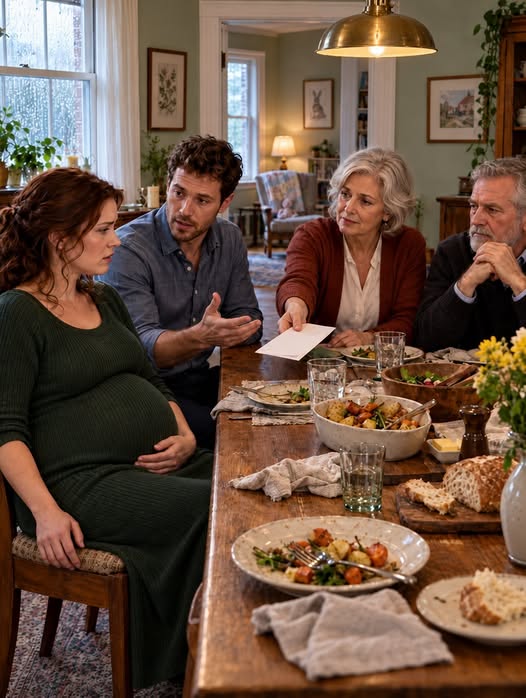
The conversation happened on a Sunday evening.
My husband, Garrett, and I were having dinner with his parents, Evelyn and Richard.
The roast was still steaming in the middle of the table when Garrett put down his fork.
“My parents have picked the name,” he said.
I looked at him.
“What name?”
His mother smiled.
She reached beside her plate and handed me a cream-colored sheet of paper.
At the top were two words written in elegant blue ink.
Gertrude Agnes.
I stared at the page.
Below the name was an entire list of plans.
Announcement cards.
Personalized blankets.
Flowers.
A family gathering.
Seating arrangements.
And a venue.
I looked back at Evelyn.
“You’ve already planned all of this?”
She seemed pleased.
“We wanted to make everything special.”
I glanced at Garrett.
“Did you know about this?”
He nodded.
“Of course.”
I placed the paper on the table.
“We’ve been discussing names for months.”
“I know,” Garrett said.
“But my parents have always wanted to use Gertrude.”
I couldn’t help noticing the difference in the language.
They had wanted it.
They had chosen it.
They had ordered things.
They had informed relatives.
But somehow, I was being told about it as though I were the final person to receive an invitation to my own daughter’s naming ceremony.
The Name Itself Wasn’t the Problem
I want to make something clear.
I didn’t hate the name.
Gertrude Agnes wasn’t an offensive name.
It was a traditional name.
It had family history behind it.
I understood why his parents liked it.
If Garrett and I had discussed it together and decided that it was the right name for our daughter, I wouldn’t have had a problem.
The problem was that I wasn’t included.
That was what hurt.
A baby’s name isn’t a family committee decision.
It’s something the parents should discuss together.
Maybe they choose a family name.
Maybe they choose something completely new.
Maybe they wait until the baby is born.
There are countless ways couples make that decision.
But the common factor should be that both parents have a voice.
At that dinner, I suddenly realized that my voice had been treated as optional.
“They’ve Already Told Everyone”
Garrett leaned back in his chair.
“It’s already been announced to some people.”
I looked at him.
“Announced?”
He shrugged.
“Mom told the family.”
“And that means what?”
He sighed.
“Stella, don’t make this difficult.”
That sentence hurt more than the name.
I placed my hand over my stomach.
Our daughter moved beneath my palm.
I looked around the table.
“So everyone has already made this decision except me?”
No one answered.
Evelyn adjusted her napkin.
Richard looked down at his plate.
Garrett looked uncomfortable.
Then Evelyn said:
“We’re only trying to make this special.”
I believed that she thought she was.
But good intentions don’t automatically make a decision appropriate.
Someone can genuinely believe they are helping while still crossing a boundary.
I Chose Not to Argue
I knew what would happen if I started shouting.
Garrett would tell me I was overreacting.
His mother would say she was only excited.
Someone might blame my emotions on pregnancy.
The conversation would become about my reaction instead of what had actually happened.
So I took a breath.
Then I smiled.
“Okay.”
Evelyn relaxed immediately.
Garrett picked up his fork.
Richard finally looked at me.
The tension disappeared.
They believed the matter was settled.
But it wasn’t.
Not because I had some secret plan to embarrass them.
Not because I wanted revenge.
I simply realized that arguing wasn’t going to solve the underlying problem.
We needed a serious conversation.
The Name Was Only One Example
The truth was that the problem had been building for months.
The nursery was the first place where I noticed it.
I had spent weeks planning it.
Nothing extravagant.
Just a peaceful room.
Soft colors.
A comfortable chair.
A small bookshelf.
A wooden moon decoration I had found at a local store.
Two framed prints.
A simple mobile above the crib.
I wanted the room to feel calm.
One afternoon, I came home and discovered several things had been moved.
I stood in the doorway.
“What happened?”
Garrett was sitting at the kitchen island.
“Mom came over.”
I looked at him.
“Why?”
“She wanted to help with the nursery.”
I walked back upstairs.
The wooden moon was gone.
The framed prints were gone.
The mobile had been replaced.
I turned around.
“Where are my things?”
Garrett shrugged.
“Mom thought the room would look better another way.”
“Did you agree to this?”
He hesitated.
“She’s excited.”
That became his favorite explanation.
She’s excited.
She means well.
She’s trying to help.
She wants to be involved.
And each time, I found myself expected to accept another decision I hadn’t made.
The Small Decisions Add Up
None of those incidents seemed important enough to create a major confrontation.
A blanket.
A decoration.
A stroller recommendation.
A list of guests.
A suggestion about the nursery.
A comment about what the baby should wear.
Individually, each thing seemed small.
Together, they created a pattern.
My pregnancy was slowly becoming something other people were organizing.
And I was becoming an observer.
That’s when I started paying closer attention.
Not because I wanted to build a case against anyone.
But because I needed to understand what was happening.
The Delivery That Changed Everything
A few days before the Sunday dinner, I was sitting at our kitchen table answering work emails.
Garrett was outside.
His tablet was on the counter.
A notification appeared.
I wasn’t looking for anything.
The message simply appeared on the screen.
Deposit Confirmation.
I recognized the venue mentioned in the message.
It was the place his parents had apparently reserved for the family celebration.
I opened the notification.
There was an invoice.
The event date was shortly after my expected due date.
The invoice listed personalized services.
And there, near the top, was the name:
Gertrude Agnes.
I sat completely still.
They hadn’t merely been talking about a name.
They had already spent money based on it.
I closed the document.
I didn’t confront Garrett immediately.
Instead, I printed a copy and placed it in a folder.
I Started Asking Questions
The next morning, I called the hospital where I planned to deliver.
I wasn’t calling to create a conflict.
I simply wanted to understand the normal procedure surrounding birth registration and the decisions parents make after delivery.
The staff member explained the process patiently.
There were forms.
There were requirements.
There were signatures.
There were decisions that belonged to the baby’s parents.
I listened carefully.
Then I wrote down the information.
The conversation gave me something I desperately needed.
Clarity.
I realized that a family celebration, invitations, blankets, or conversations with relatives didn’t make a name official.
The decision still belonged with the parents.
And that meant I didn’t have to fight over a piece of paper someone had already printed.
I simply needed to have the correct conversation with my husband.
The Blanket
The next afternoon, Garrett came into the nursery carrying a package.
“Mom ordered this.”
He opened it.
Inside was a beautiful white blanket.
Gold embroidery covered one corner.
Gertrude.
I touched the fabric.
It was soft.
Expensive.
Carefully made.
I looked at my husband.
“Do you like the name?”
He smiled.
“I’ve always liked it.”
“Have you ever asked me if I like it?”
He paused.
“I thought we were going to use it.”
I shook my head.
“That’s exactly the problem.”
He looked confused.
“What’s the problem?”
“You thought the decision had already been made.”
He didn’t answer.
I continued.
“I don’t want to fight with your parents. I don’t want to embarrass them. I don’t want to ruin anything they’ve prepared.”
I looked directly at him.
“But our daughter’s name is something you and I need to decide together.”
He sat down.
For the first time, I could see that he was beginning to understand.
“Mom Will Be Hurt”
Garrett’s first concern wasn’t the name.
It was his mother.
“She’ll be really upset.”
“I understand.”
“She spent money.”
“I understand that too.”
“She already told everyone.”
“I know.”
He looked at me.
“Then what are we supposed to do?”
I answered quietly.
“Tell them the truth.”
He frowned.
“What truth?”
“That we haven’t chosen the name yet.”
He didn’t respond immediately.
That silence told me something.
He had never considered saying no to his parents.
The Conversation We Needed to Have
That night, Garrett and I sat at the kitchen table.
No parents.
No siblings.
No extended family.
Just us.
I told him everything I had been feeling.
I wasn’t trying to attack him.
I wanted him to understand.
“I feel like everyone has been making decisions about our daughter while I’m expected to approve them afterward.”
He looked down.
“I didn’t realize you felt that way.”
“I’ve tried to tell you.”
“I thought you were upset about small things.”
“That’s because each individual thing was small.”
I paused.
“But together, they aren’t.”
He was quiet.
Then he asked:
“What do you want?”
It was the first time in weeks that someone had asked me that question.
I almost cried.
“I want us to choose our daughter’s name.”
“Just us?”
“Yes.”
He nodded.
“And Mom?”
“We can tell her we appreciate everything she has done.”
“She won’t like it.”
“She doesn’t have to like it.”
That sentence changed something in our marriage.
The Decision
We didn’t choose a name that night.
That surprised Garrett.
I told him I didn’t want to choose simply because we were under pressure.
Instead, we went back to the list we had created months earlier.
We talked about names we both liked.
We talked about family traditions.
We talked about names that had personal meaning.
We even laughed about some of the names we had considered and immediately rejected.
For the first time in months, choosing our daughter’s name felt like something joyful again.
It belonged to us.
Telling His Parents
The next evening, Garrett called his parents.
I sat beside him.
He put the phone on speaker.
His mother answered enthusiastically.
“How is my granddaughter?”
Garrett took a breath.
“We need to talk about the name.”
There was a pause.
Evelyn already sounded nervous.
“What about it?”
“We haven’t chosen it yet.”
Silence.
Then:
“But we’ve already ordered everything.”
Garrett looked at me.
“I know.”
“We told everyone.”
“I know.”
“I don’t understand.”
Garrett continued.
“We should have told you earlier, but the name needs to be something Stella and I decide together.”
His mother became quiet.
Then she said:
“I thought you wanted Gertrude.”
“I like it,” Garrett said.
“But we haven’t agreed on it.”
I finally spoke.
“Evelyn, I appreciate how excited you are. I really do.”
She didn’t answer.
“But I need to be part of this decision.”
Another silence.
Then she said something I didn’t expect.
“I didn’t realize I was making you feel pushed aside.”
That was the beginning of a much better conversation.
Not Every Boundary Needs a Fight
One thing I learned from the experience is that setting a boundary doesn’t always require anger.
Sometimes a boundary can simply be a clear sentence.
“We haven’t decided.”
“Please don’t order anything with a name on it until we choose.”
“We’ll let everyone know when we’re ready.”
“We appreciate your excitement, but this is a decision we’ll make as parents.”
Those statements don’t attack anyone.
They simply establish who is responsible for the decision.
The Venue
The venue reservation created another issue.
The family had already paid a deposit.
Garrett’s parents initially wanted to continue with the celebration anyway.
We explained that we weren’t comfortable having a naming celebration before the baby had even arrived and before we had chosen her name.
Fortunately, the venue allowed the date to be moved.
The deposit wasn’t completely lost.
Instead, Evelyn decided to use the reservation for a family gathering later in the year.
That solution worked surprisingly well.
Nobody had to pretend the previous plan hadn’t happened.
We simply changed it into something everyone could enjoy.
The Personalized Blankets
The blankets were another matter.
Some had already been embroidered.
Instead of throwing them away, Evelyn contacted the company.
They couldn’t change every item, but they were able to modify some of the designs.
For the ones that couldn’t be changed, we decided to keep them as reminders of the excitement surrounding the pregnancy.
Even the blanket with “Gertrude” eventually became part of the story.
It wasn’t our daughter’s name.
But it represented a period when everyone was excited, even if some boundaries had been crossed.
The Birth
Several weeks later, our daughter was born.
The moment I saw her, everything else seemed distant.
She was tiny.
Perfectly imperfect.
Her little fingers curled around mine.
Garrett stood beside me, crying.
Neither of us talked about names immediately.
We simply looked at her.
For the first time, the decision wasn’t theoretical.
She was here.
We spent the next day saying different names aloud.
Some sounded right.
Others didn’t.
Eventually, Garrett looked at me.
“What about this one?”
He said a name from our original list.
I smiled.
It felt right.
Not because his parents had chosen it.
Not because relatives had been told.
Not because invitations had been printed.
Because we had chosen it together.
Telling the Family
We waited until we were ready.
Then Garrett called his parents.
He told them their granddaughter’s name.
There was a brief pause.
Then Evelyn said:
“That’s beautiful.”
I could hear emotion in her voice.
She wasn’t thrilled that her preferred name hadn’t been chosen.
But she was happy to meet her granddaughter.
When she came to the hospital, she brought a small gift.
There was no personalized blanket.
No announcement.
No elaborate decoration.
Just a tiny knitted sweater.
She handed it to me.
“I made this myself.”
I smiled.
“Thank you.”
Then she looked at the baby.
“She’s beautiful.”
She was.
The Real Lesson
The story wasn’t really about the name Gertrude.
It was about something much bigger.
Family traditions can be meaningful.
Grandparents can be excited.
Relatives can have opinions.
But excitement doesn’t create authority.
The people becoming parents are the ones who ultimately need to make parenting decisions together.
That doesn’t mean grandparents should be excluded.
It means their role is different.
They can suggest.
They can share traditions.
They can offer advice.
They can celebrate.
But suggestions become problems when they are treated as decisions before the parents have agreed.
What I Learned About My Marriage
The most important conversation wasn’t the one with Evelyn.
It was the one with Garrett.
I realized that we had developed a habit of avoiding difficult conversations.
He avoided disappointing his parents.
I avoided creating conflict.
So decisions were made by whoever acted first.
That wasn’t healthy.
We needed to learn how to say:
“Let me talk to my spouse first.”
“We’ll decide together.”
“We appreciate the suggestion, but we’re not ready.”
Those sentences became important in the months that followed.
The Nursery Changed Again
After our daughter was born, Garrett and I went back into the nursery.
The room still had some of the decorations his mother had chosen.
We didn’t remove everything.
Instead, we made decisions together.
Some things stayed.
Some things changed.
We put the wooden moon back on the wall.
We hung the framed prints.
We placed the rocking chair near the window.
And on the shelf, we put a small photograph of our daughter.
The room finally felt like ours.
Not mine.
Not Garrett’s parents’.
Ours.
Evelyn Eventually Understood
Several months later, Evelyn and I were sitting together while the baby slept.
She looked around the room.
“You know,” she said, “I got carried away.”
I smiled.
“A little.”
She laughed.
“I was just so excited.”
“I know.”
“I wanted to feel involved.”
“You are involved.”
She looked at me.
“I think I forgot that being involved isn’t the same as making the decisions.”
That sentence meant a lot to me.
I didn’t need her to apologize dramatically.
I didn’t need her to admit she had been wrong about everything.
I simply needed her to understand the boundary.
And she did.
The Name We Chose
Our daughter eventually grew into her name.
We chose it because it had meaning to both of us.
It wasn’t the name his parents had selected.
It wasn’t the name anyone had printed on hundreds of invitations.
It was simply the name we felt belonged to her.
Years later, we told her the story.
She laughed when she heard that her grandparents had once planned to name her something completely different.
“Did you really almost name me Gertrude?”
I smiled.
“Almost.”
She laughed even harder.
Then she asked:
“Why didn’t you?”
I looked at Garrett.
He smiled.
“Because your mom and I decided together.”
Our daughter nodded.
“Good choice.”
We laughed.
Looking Back
Sometimes I still have the original invitation.
The one that was prepared before we had chosen a name.
I kept it in a box with a few other memories from the pregnancy.
The first ultrasound picture.
The hospital bracelet.
A tiny pair of socks.
The original list of baby names.
And one of the personalized blankets.
Not because I regret what happened.
Because it reminds me how easily excitement can turn into assumption.
Everyone involved loved that baby.
That was never the question.
The question was whether love could coexist with boundaries.
Eventually, we learned that it could.
What I Would Do Differently
If I could go back, I wouldn’t wait so long to speak up.
I wouldn’t quietly accept every small decision until they became a larger problem.
I would say something early.
Not angrily.
Not dramatically.
Just clearly.
“Thank you for the suggestion, but Garrett and I will decide.”
That would have saved everyone a lot of confusion.
But I also don’t regret the way everything ultimately turned out.
The experience forced Garrett and me to recognize something important.
Marriage isn’t simply about loving each other.
It’s also about standing together when outside expectations become complicated.
A Quiet Decision Isn’t Always a Secret Plan
When I smiled at that dinner and said “Okay,” I wasn’t planning revenge.
I wasn’t secretly preparing to humiliate anyone.
I wasn’t trying to create a dramatic surprise.
I was simply done arguing.
My quiet decision was to stop treating other people’s assumptions as decisions I had to accept.
I would have the conversation with my husband.
I would make sure the appropriate paperwork was handled correctly.
And I would make sure our daughter’s name was chosen by her parents.
That was enough.
Final Thoughts
Pregnancy can bring enormous excitement to an entire family.
Grandparents start imagining the future.
Aunts and uncles buy gifts.
Relatives offer advice.
Everyone wants to feel involved.
But there is an important difference between being excited and taking control.
A baby’s name, medical decisions, parenting choices, and other major matters belong first to the child’s parents.
Grandparents can have traditions.
They can have suggestions.
They can even have strong preferences.
But those preferences should remain preferences until the parents agree.
In my case, the biggest lesson wasn’t that my husband’s parents chose the wrong name.
It was that my husband and I had allowed other people’s expectations to become part of our decision-making process without stopping to establish our own boundaries.
Once we addressed that, everything became easier.
We didn’t have to fight.
We didn’t have to embarrass anyone.
We didn’t have to throw away every gift.
We simply had to say:
“Thank you. But we’ll decide together.”
And that was the quiet decision I had been making all along.
Not to defeat my husband’s family.
Not to punish them.
But to make sure that when our daughter arrived, her parents were ready to act like a team.