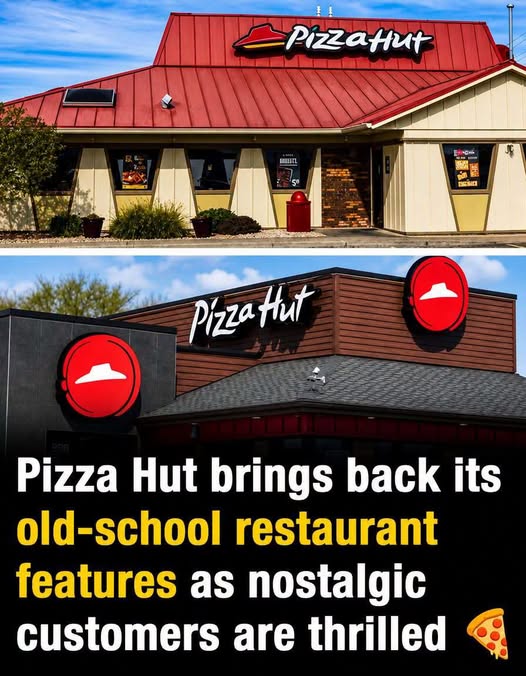
Pizza Hut Brings Back Its Classic Restaurant Style, Reconnecting With a New Generation
For many people, going to a restaurant has never been only about the food.
A familiar restaurant can become part of a person’s memories, connected to birthday celebrations, family dinners, weekend outings, school achievements, first dates, and countless ordinary moments that become meaningful years later.
That is one reason restaurant design can have such a lasting effect.
The colors on the walls, the shape of the tables, the lighting, the menus, the dishes, and even the way food is served can all become part of a person’s memory.
For generations of Americans, Pizza Hut became associated with exactly that kind of experience.
Long before food delivery apps and online ordering became part of everyday life, visiting a Pizza Hut restaurant was often an outing in itself. Families would sit together at a table, children would look through the menu, pizzas would arrive in the middle of the table, and everyone could spend time together before heading home.
Now, elements of that classic Pizza Hut restaurant experience are receiving renewed attention.
The company’s familiar restaurant style has become a nostalgic reference point for people who remember visiting Pizza Hut decades ago, while also introducing younger customers to a design that may feel completely new to them.
More Than a Place to Eat
Restaurant design has changed dramatically over the years.
Today, many restaurants emphasize clean lines, simple colors, open spaces, digital ordering systems, and layouts designed around convenience.
Older restaurant designs often had a different personality.
They were frequently more distinctive.
A customer could walk into a restaurant and immediately know where they were.
For Pizza Hut, that identity was particularly recognizable.
The traditional restaurant environment included features that many longtime customers still remember. The dining rooms had a particular atmosphere, and the experience of sitting down for a meal felt different from simply ordering food for delivery.
That distinction matters because memories are often connected to physical surroundings.
Someone might remember sitting in a Pizza Hut booth with their parents.
Another person might remember celebrating a birthday there.
Someone else might remember meeting friends after school or stopping in for dinner during a family road trip.
The details vary from person to person, but the emotional connection can remain.
A Restaurant Style From Another Era
Pizza Hut became one of the most recognizable names in American pizza culture during the second half of the twentieth century.
As the chain expanded, its restaurants developed a visual identity that became familiar across the country.
The classic locations often had a warm and casual atmosphere designed around sit-down dining.
The restaurant itself was part of the experience.
Customers weren’t simply picking up a pizza and leaving.
They were sitting at a table, sharing food, talking, and spending time together.
For today’s customers, that style can seem almost unusual.
Modern dining increasingly emphasizes speed and convenience. Online ordering allows people to choose their food before they even arrive. Delivery services make it possible to enjoy restaurant meals without leaving home.
Those conveniences have changed consumer habits.
But they have also created renewed interest in experiences that feel more personal and traditional.
The return of classic restaurant elements reflects that interest.
Why Nostalgia Matters
Nostalgia is a powerful part of consumer culture.
People often develop strong emotional connections to brands they encountered when they were younger.
A familiar logo, restaurant design, product package, television commercial, or menu item can instantly bring back memories of another period in life.
For older Pizza Hut customers, classic restaurant details can serve as reminders of childhood or family life.
For younger customers, the same design can represent something they did not personally experience.
That creates an interesting contrast.
One generation sees the style as a memory.
Another generation sees it as something retro and distinctive.
The same restaurant can therefore create two completely different experiences while using the same visual elements.
For longtime customers, a familiar design can feel like a return to something they remember.
For younger visitors, it can feel like discovering a piece of restaurant history.
The Importance of the Dining Room
The dining room has traditionally played an important role in the Pizza Hut experience.
A restaurant dining room gives people a reason to stay.
That may sound simple, but it changes the nature of a meal.
When people sit together around a table, they often spend more time talking and interacting.
Parents can have conversations with their children.
Friends can catch up.
Families can celebrate birthdays.
Coworkers can meet after work.
These moments aren’t necessarily about the restaurant itself, but the restaurant provides the setting.
That is one reason familiar dining spaces can become so meaningful.
A person’s memory may not focus on the pizza.
They may remember who was sitting across the table.
They may remember a birthday celebration.
They may remember laughing with friends.
They may remember a parent ordering for the family.
Years later, the restaurant becomes part of the story.
Bringing Familiar Details Back
The renewed interest in classic Pizza Hut design is part of a larger trend in which established brands revisit elements from their past.
Instead of completely abandoning older visual identities, companies sometimes bring back selected features that customers recognize.
The approach can serve several purposes.
For longtime customers, familiar details can create a sense of connection.
For younger customers, retro design can provide something visually different from the modern restaurants they see every day.
The goal isn’t necessarily to recreate every detail of a restaurant from decades ago.
Instead, recognizable elements can be combined with contemporary expectations.
That allows a brand to acknowledge its history while continuing to operate in a modern marketplace.
A Different Experience for Younger Customers
A younger customer who has never experienced a traditional Pizza Hut dining room may have a very different reaction to classic restaurant design.
Instead of seeing it as a return to childhood, they may simply see it as interesting.
Retro design has become increasingly visible across many parts of popular culture.
Older clothing styles, vintage furniture, classic cars, traditional diners, and old-fashioned signs can all attract attention because they look different from contemporary designs.
Restaurant interiors are no exception.
A younger visitor may appreciate a classic Pizza Hut environment without having any personal memories associated with it.
That is an important part of the appeal.
Nostalgia doesn’t always require personal experience.
Sometimes people become interested in a particular era simply because they enjoy its appearance and atmosphere.
The Difference Between Dining In and Ordering at Home
Pizza has always worked particularly well for sharing.
A large pizza can be placed in the center of a table, allowing everyone to choose different slices and enjoy the meal together.
That naturally creates a social experience.
Delivery and takeout offer convenience, but dining in provides something different.
People leave their homes.
They sit together.
They interact with other people.
They experience the restaurant environment.
That can make a meal feel like an event, even when the food itself is familiar.
As online ordering has become more common, the traditional sit-down restaurant experience can feel increasingly distinctive.
A return to classic restaurant design therefore isn’t only about appearance.
It can also remind customers that restaurants can be places where people spend time together.
Familiarity Can Build Emotional Connections
Brand loyalty is often connected to personal memories.
A customer who remembers visiting Pizza Hut with their parents may later bring their own children.
That creates a connection between generations.
The restaurant becomes part of a family tradition.
Even if the exact menu has changed and the restaurant itself has evolved, familiar visual elements can help maintain that connection.
A classic design can remind someone of an earlier chapter in their life while giving younger family members the opportunity to create their own memories.
That is one reason restaurant traditions can last for decades.
The food may be important, but the surrounding experience can become just as memorable.
Why Restaurant Design Can Be So Recognizable
Think about some of the restaurants you remember from childhood.
You may not remember every meal you ate there.
But you might remember the shape of the tables.
You might remember the lighting.
You might remember the signs.
You might remember where you usually sat.
You might remember the sounds of people talking around you.
These details can become surprisingly powerful memory triggers.
The human brain naturally connects experiences with surroundings.
When several elements appear together repeatedly, they can become part of a person’s mental picture of a particular period in life.
For Pizza Hut customers who grew up visiting the chain, the classic restaurant style can therefore represent much more than interior decoration.
It can represent a period of family life.
A Balance Between Past and Present
Bringing back elements from the past does not mean ignoring the present.
Modern customers still expect convenience, efficient service, digital ordering options, and contemporary restaurant operations.
A successful revival therefore has to balance familiarity with current expectations.
The classic look can provide the emotional and visual connection, while modern systems can continue operating behind the scenes.
That combination allows an established brand to acknowledge its history without attempting to operate exactly as it did decades ago.
In many ways, this reflects how nostalgia works in general.
People rarely want to return completely to the past.
Instead, they often enjoy bringing selected pieces of the past into the present.
The Role of Family Traditions
Family traditions can be surprisingly simple.
For one family, it might be ordering pizza on Friday night.
For another, it might be visiting the same restaurant after a child’s sports game.
For another, it might be having a birthday dinner at a familiar location.
These traditions can continue even when circumstances change.
A restaurant becomes a familiar meeting point.
Parents introduce their children to places they visited when they were young.
Eventually, those children may have memories of the same place.
That creates a connection across generations.
A restaurant doesn’t have to be luxurious or unusual to become part of someone’s personal history.
Sometimes consistency is what makes it special.
Classic Doesn’t Have to Mean Outdated
There is an important distinction between classic and outdated.
Something can have an older appearance while still feeling relevant.
In fact, certain designs become more interesting precisely because they are different from today’s dominant styles.
The classic Pizza Hut restaurant aesthetic is recognizable because it has a strong visual identity.
Instead of blending into a generic restaurant environment, the design can remind customers of a particular period.
That distinctiveness is valuable.
When many modern businesses use similar minimalist design principles, a more recognizable retro style can stand out.
It gives customers something they can immediately associate with the brand.
Creating New Memories
For longtime customers, a familiar Pizza Hut environment may bring back memories.
For younger visitors, it can become the setting for entirely new ones.
A child visiting with their family today won’t necessarily experience the restaurant the way their parents did decades ago.
But they may still remember the visit years later.
They may remember sitting at the table with their family.
They may remember sharing pizza with friends.
They may remember a birthday celebration.
Those experiences can become their own version of the Pizza Hut story.
That is how traditions evolve.
The setting ma