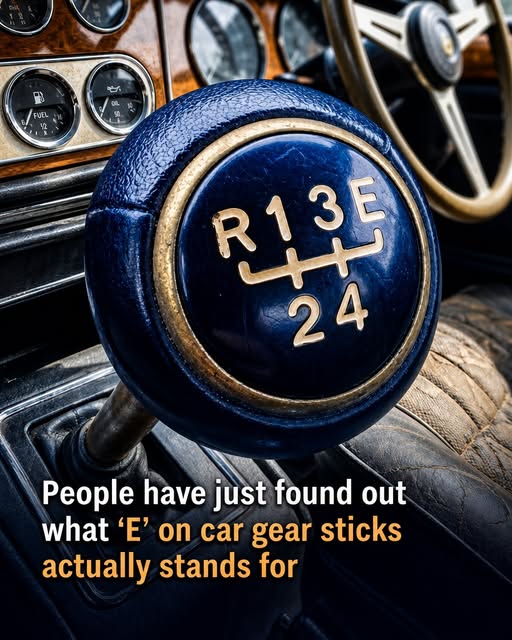
What Did the “E” Mean on Older Car Gear Shifters?
Modern cars often use digital displays, push buttons, rotary selectors, and electronic controls instead of traditional gear levers.
But drivers who remember older automatic vehicles may recall something that looks unusual by today’s standards: a gear selector with a letter “E” among the more familiar markings.
Most drivers recognize P for Park, R for Reverse, N for Neutral, and D for Drive. Depending on the vehicle, there may also be numbers or additional settings for controlling how the transmission behaves.
So what did the mysterious “E” mean?
The answer depends on the vehicle and transmission design. Unlike P, R, N, and D, the letter E was not a universal standard with exactly the same meaning in every car.
In some vehicles, it was associated with an economy-oriented transmission mode, while in others, similar markings could have referred to a particular transmission program or operating setting.
Understanding the history behind these markings offers an interesting glimpse into how automatic transmissions have evolved.
Why Older Gear Selectors Had So Many Markings
Automatic transmissions have changed considerably over the decades.
Early automatic vehicles used relatively simple mechanical systems. As engineers developed more advanced transmissions, manufacturers introduced additional ways for drivers to influence how the transmission operated.
A gear selector could therefore contain more than the basic Park, Reverse, Neutral, and Drive positions.
Depending on the manufacturer, drivers might see numbers such as 1, 2, or 3, along with letters or symbols representing special operating modes.
These settings could affect when the transmission shifted gears, which gears were available, or how the vehicle responded under particular driving conditions.
The markings were often specific to the transmission installed in that particular vehicle.
What Did “E” Usually Refer To?
In some older vehicles, E was used to indicate an Economy mode or transmission program.
The purpose of such a setting was generally to encourage smoother and more economical operation.
An economy-oriented transmission program could change the way automatic gear changes occurred.
Instead of emphasizing quicker acceleration, the transmission could be programmed to favor characteristics associated with fuel-efficient driving.
The exact behavior depended on the vehicle.
For one transmission, an economy setting might influence shift timing.
For another, it could affect throttle response or the way the transmission selected gears.
That is why it is important not to assume that every gear selector marked with an E operated identically.
How an Economy Setting Could Affect Driving
Automatic transmissions continuously make decisions about when to shift between gears.
For example, when a driver accelerates from a stop, the transmission begins in a lower gear and eventually shifts into higher gears as the vehicle gains speed.
The timing of those shifts can influence the driving experience.
A transmission programmed for economy may shift in a way that keeps engine speed relatively moderate during normal driving.
Lower engine speeds can sometimes contribute to reduced fuel consumption, depending on the vehicle and driving conditions.
However, economy does not necessarily mean the vehicle will always use less fuel in every situation.
Driving style, road conditions, vehicle weight, engine design, maintenance, weather, and traffic all influence fuel consumption.
Why the Letter “E” Can Be Confusing
The biggest source of confusion is that manufacturers did not use the letter E in exactly the same way.
A driver might see an E on one vehicle and assume it has the same function on another.
That isn’t necessarily true.
Vehicle manufacturers have used different terminology and transmission designs over the years.
Some vehicles used letters for transmission modes.
Others used numbers.
Some used switches or buttons alongside the gear selector.
Others incorporated the transmission setting into the vehicle’s electronic controls.
As a result, the owner’s manual is the most reliable source for determining exactly what an E position or marking meant on a particular vehicle.
E Was Not Simply Another Gear
Another common misunderstanding is that E represented a separate physical gear.
In many cases, a marking such as E was describing a mode or transmission program, rather than identifying a specific gear ratio.
This distinction matters.
A gear is a mechanical ratio within the transmission.
A transmission mode, on the other hand, can influence how the system selects or uses those gears.
For example, an economy program may allow the transmission to move through its available gears according to a different shift strategy.
The driver isn’t necessarily selecting a new gear called “E.”
Instead, the driver may be selecting a different operating strategy.
Automatic Transmissions Were Becoming More Sophisticated
The appearance of special markings on gear selectors reflects a period when automatic transmissions were becoming increasingly sophisticated.
Early automatic transmissions were largely mechanical and hydraulic.
Over time, manufacturers added electronic controls that could monitor vehicle speed, engine conditions, throttle position, and other information.
Those systems allowed transmissions to make more precise decisions.
Instead of simply responding to mechanical pressure, later systems could use electronic control units to determine when a shift should occur.
This development eventually led to the highly computerized transmissions found in modern vehicles.
From Mechanical Controls to Electronic Systems
Today’s automatic transmissions can be remarkably complex.
A modern transmission may use electronic sensors, solenoids, control modules, and software to determine how and when gears should change.
The driver may barely interact with the transmission at all.
A modern gear selector might simply send an electronic signal to the vehicle’s control system.
Older cars were often more direct.
Moving the gear lever could mechanically operate components connected to the transmission.
This difference helps explain why older gear selectors sometimes contained markings that seem unusual today.
The driver had more visible control over the transmission’s operating modes.
Economy Modes and Fuel Efficiency
Fuel economy has long been an important consideration for vehicle manufacturers and drivers.
When fuel prices rise, drivers naturally become more interested in getting more distance from each gallon or liter of fuel.
Manufacturers have therefore experimented with different transmission strategies designed to improve efficiency.
One important factor is engine speed.
Generally speaking, an engine operating efficiently at an appropriate speed can use less fuel than it would under less efficient conditions.
An automatic transmission can help by selecting an appropriate gear for the vehicle’s speed and load.
An economy-oriented setting can modify that process.
However, the relationship isn’t as simple as “E always saves fuel.”
A transmission may behave differently depending on whether the car is climbing a hill, carrying a heavy load, accelerating quickly, or traveling at a steady speed.
Why Drivers Sometimes Prefer Normal or Performance Settings
An economy setting isn’t always the preferred choice for every situation.
A driver who wants quicker acceleration may find that a different transmission program feels more responsive.
For example, when merging onto a highway or climbing a steep hill, a transmission may need to hold a lower gear for longer.
That can increase engine speed but provide more available power.
A setting designed primarily around economy may prioritize different shift characteristics.
This is one reason manufacturers sometimes provide multiple transmission modes.
The goal is to give the vehicle different operating characteristics depending on driving conditions.
The Meaning of “E” Depends on the Car
If you find an older vehicle with an E marking on its gear selector, it is best not to assume its meaning solely from the letter.
Look at the surrounding markings.
Is E next to D?
Is it positioned where a numbered gear would normally appear?
Is there a separate switch associated with the selector?
Does the dashboard display a corresponding indicator?
These details can help identify what the manufacturer intended.
The owner’s manual is even more useful because it explains the exact transmission system used in that vehicle.
Why Some Older Cars Seem More Complicated
Older dashboards and gear selectors can sometimes look more complicated than modern ones.
This doesn’t necessarily mean the cars were more advanced.
In many cases, the driver simply had more visible mechanical or transmission-related controls.
Modern vehicles often hide those functions behind software.
A driver may select “Drive” and let the car’s computers determine the rest.
The transmission may automatically select gears, adjust shift timing, and respond to changing driving conditions.
The technology has become more complex even though the driver’s controls have become simpler.
The Evolution of the Gear Selector
The history of the gear selector is closely connected to the history of the automatic transmission.
Early systems gradually introduced automatic shifting so drivers didn’t have to operate a clutch or manually select every gear.
As the technology developed, manufacturers introduced additional settings.
Some allowed drivers to limit the highest gear available.
Others changed shift behavior.
Some were designed for towing or difficult terrain.
Others were intended to improve economy.
Eventually, electronic control systems made it possible to manage many of these functions automatically.
Today, some vehicles don’t even use a conventional gear lev