In the Shadow of Iron: Understanding History Through Historical Artifacts
There is something fascinating about holding an object that has survived from another period of history.
A museum visitor might encounter an old iron ball, a fragment of military equipment, an antique tool, or another seemingly ordinary object and suddenly find themselves looking at the past in a completely different way.
Historical artifacts have a unique quality that photographs and written descriptions cannot always provide. They have physical characteristics that allow us to imagine how people from earlier generations lived, worked, traveled, and interacted with the world around them.
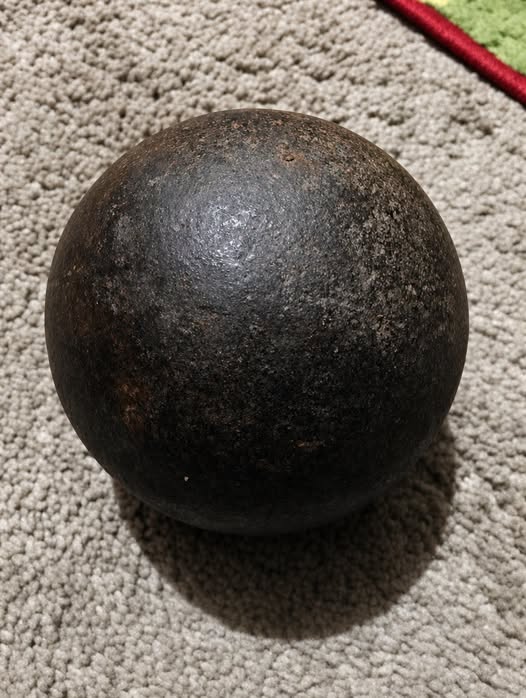
One particularly recognizable example is the old iron cannonball.
Today, a cannonball may look like nothing more than a heavy metal sphere. Yet objects like these can provide valuable information about the development of technology, military history, manufacturing, transportation, and everyday life in earlier centuries.
Rather than viewing such an object only through the events in which it was used, it can also be understood as a piece of material history.
What Was a Historical Cannonball?
Cannonballs were spherical projectiles designed for use with early cannons and other artillery.
They were commonly made from materials such as cast iron, although earlier artillery projectiles could also be made from stone or other materials depending on the period and region.
The basic spherical shape was practical for the technology of the time.
Early cannons were relatively different from modern artillery. Their construction, ammunition, range, accuracy, and firing mechanisms were all influenced by the materials and manufacturing techniques available at the time.
A cannonball therefore represents more than a piece of ammunition. It also reflects the engineering capabilities of the society that produced it.
Why Were Cannonballs Made From Iron?
Iron became an important material for artillery projectiles because it was strong, durable, and suitable for casting.
Manufacturing techniques improved over time, making it possible to produce large numbers of relatively standardized iron projectiles.
The ability to manufacture ammunition consistently was an important part of military logistics.
Armies required large quantities of equipment, and producing objects with predictable dimensions made them easier to transport, store, and use.
The development of ironworking also tells us something about the broader industrial capabilities of historical societies.
The same technological knowledge used to produce weapons and tools could be connected to mining, metalworking, transportation, construction, and other industries.
Why Were Cannonballs Round?
The spherical shape was closely connected to the design of early cannons.
A round projectile could be loaded into a smoothbore barrel without requiring the complicated manufacturing methods associated with many later projectile designs.
The shape also made the object relatively simple to manufacture using casting techniques.
Although modern ammunition may appear highly sophisticated by comparison, early cannon technology represented significant engineering for its time.
Historical artifacts allow us to see how technology develops gradually rather than appearing fully formed.
Cannonballs Varied in Size and Weight
Not every historical cannonball was the same size.
Different cannons were designed to fire projectiles of different dimensions, and military systems varied across countries and historical periods.
Some projectiles were small enough to be handled relatively easily by one person, while larger artillery required substantially heavier ammunition and more extensive equipment.
This is one reason historians and archaeologists pay close attention to measurements.
The diameter and weight of an artifact can sometimes provide clues about the type of cannon associated with it, although identifying an object accurately requires more than simply measuring it.
Historical records, archaeological context, manufacturing characteristics, and comparison with known examples may all be necessary.
What Can an Old Iron Artifact Tell Us?
A historical artifact can reveal surprisingly detailed information.
Its size can provide clues about its original purpose.
Its material can indicate what manufacturing methods were available.
Its surface can sometimes show evidence of casting, corrosion, storage, or later handling.
Its location can provide additional context.
For example, an iron object found near a documented historical site may be interpreted differently from an identical-looking object discovered in a modern garden or construction area.
Archaeology depends heavily on context.
An object separated from its original surroundings can lose much of the information that made it historically useful.
The Importance of Archaeological Context
One of the most important principles in archaeology is understanding where an object was found.
A cannonball discovered at a documented battlefield may potentially be connected with a particular historical event or period.
A similar object found elsewhere might have been moved, collected, reused, or deposited much later.
This is why archaeologists carefully document the location and surroundings of artifacts.
The soil layer, nearby structures, associated objects, and other evidence can all help establish a historical timeline.
In other words, the artifact itself is only part of the story.
The place where it was found can be equally important.
Corrosion Creates Another Layer of History
Iron objects that have spent decades or centuries exposed to moisture and environmental conditions often develop corrosion.
The familiar reddish-brown surface associated with old iron is the result of chemical reactions involving the metal and its surroundings.
Corrosion can sometimes make an artifact appear much older or more mysterious than it actually is.
At the same time, corrosion can provide clues about how an object was stored or buried.
Archaeologists and conservators must therefore balance preservation with investigation.
Cleaning an artifact too aggressively can remove information that may be useful to researchers.
Why Museums Preserve Ordinary Objects
A museum does not need to contain only rare treasures.
Sometimes an ordinary object can be historically valuable because of what it represents.
A cannonball, cooking utensil, farming tool, fragment of pottery, shoe buckle, coin, or piece of household equipment may help researchers understand how people lived during a particular period.
The value of an artifact is not always determined by its appearance.
A simple iron sphere may have little financial value while having considerable educational and historical significance.
Museums preserve such objects because they provide physical connections to the past.
The Human Story Behind Military Artifacts
Military artifacts are often discussed in terms of battles, weapons, and technological development.
But there is also a human story behind them.
Every historical military system depended on people.
Workers mined raw materials. Foundries processed metal. Craftspeople produced equipment. Transport workers moved supplies. Soldiers trained to use the technology. Engineers designed improvements. Communities supported armies through agriculture, manufacturing, and trade.
An iron cannonball therefore represents an entire network of people and resources.
Looking at an artifact this way can make history more understandable.
Instead of seeing a single object in isolation, we can see it as part of a much larger economic and technological system.
Cannon Technology Changed Over Time
Early artillery was not a fixed technology.
Cannons gradually changed as engineers and manufacturers improved their understanding of metallurgy, barrel construction, projectile design, and gunpowder.
Over generations, artillery became more reliable and increasingly standardized.
Eventually, technological developments led to entirely different forms of ammunition and artillery.
The old spherical cannonball belongs to an earlier stage of that technological history.
Its simple appearance can therefore be misleading. Behind it is a long story of experimentation and engineering.
From Battlefield Object to Museum Exhibit
An object originally associated with military use can eventually take on an entirely different role.
Once removed from its historical setting, documented, conserved, and placed in a museum, it becomes an educational artifact.
Visitors may examine its size and weight while learning about the people and technology of an earlier era.
For younger visitors, physically seeing an artifact can make a historical period feel more tangible.
Instead of reading only about artillery in a textbook, they can see the scale of an object that was actually produced and used centuries ago.
That physical connection is one of the strengths of museums.
Why Touching Historical Objects Can Be Memorable
Many people remember museum visits because of interactive experiences.
Being allowed to handle a replica, examine an object closely, or compare historical equipment with modern technology can make an abstract lesson more memorable.
Authentic artifacts, however, are generally handled carefully because their condition can be fragile.
For that reason, museums may use replicas for educational demonstrations while preserving original objects in controlled environments.
A replica can provide the physical experience without exposing a centuries-old artifact to unnecessary handling.
Historical Artifacts Can Challenge Our Assumptions
Objects from the past often look simpler than modern equivalents.
A visitor may see an old iron object and wonder how something so basic could have played an important role in history.
But simplicity does not necessarily mean a lack of sophistication.
Historical technology was developed within the limitations of its time.
Engineers worked with the materials, tools, mathematics, transportation systems, and manufacturing processes available to them.
Within those limitations,