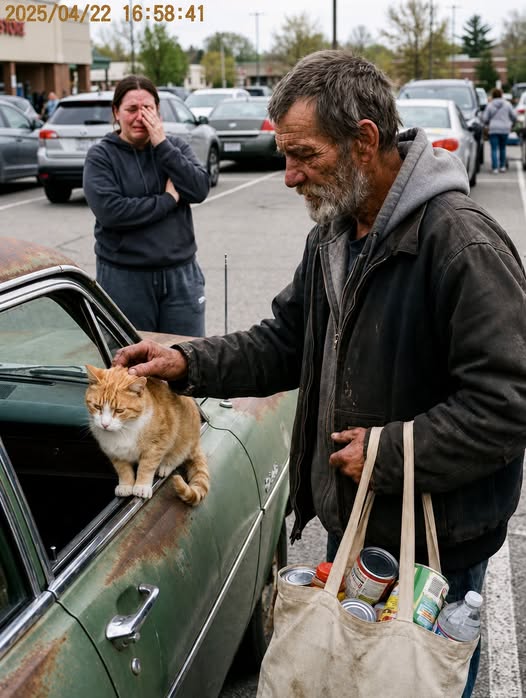
My Former Student Gave Up His Own Food to Buy Cat Food—Then I Discovered Where He Was Living
The man standing in front of me at the grocery store caught my attention for a reason I couldn’t immediately explain.
He had placed a loaf of bread and a jar of peanut butter on the checkout belt. But when the cashier gave him the total, he quietly picked both items up and returned them to the shelf.
Then he came back with only six cans of cat food and two bottles of water.
I watched him pay.
When he turned around, I finally recognized his face.
“Lucas?”
He stopped.
For several seconds, neither of us said anything.
The years seemed to disappear for a moment, taking me back to the classroom where I had first known him.
“Mrs. Miller,” he finally said.
I was his English teacher many years ago.
Back then, Lucas Bennett had been the kind of student everyone seemed to know. He was seventeen, confident, energetic, and almost impossible to overlook.
He had been a talented athlete, and after his team won the state championship, I remembered seeing him beneath the bright stadium lights, holding the trophy above his head while his teammates and family celebrated around him.
Teachers liked him.
Younger students admired him.
He seemed to have a future filled with possibilities.
Now, at thirty-eight, he looked completely different.
His face was thinner. A short, untidy beard covered his jaw, and the jacket he wore appeared several sizes too large. There was something tired about his expression that I hadn’t expected to see.
Still, when he smiled, I recognized the familiar crooked grin.
It was the same expression he used to make whenever I asked why his homework wasn’t finished.
But this time, the smile disappeared almost immediately.
I looked down at the groceries he had purchased.
Six cans of senior cat food.
Two bottles of water.
Nothing for himself.
“Didn’t you have bread?” I asked.
Lucas glanced toward the cashier before answering.
“I decided I didn’t need it.”
His voice was casual, but something about the answer didn’t feel right.
I knew him well enough to recognize when he was avoiding a question.
I didn’t press him in the store.
Instead, I watched him walk through the parking lot.
He headed toward an old pickup truck parked several spaces away.
I stood there for a moment, wondering whether I should simply let him go.
After all, people change. Circumstances change. Sometimes former students become strangers again.
But something kept bothering me.
So I followed him outside.
That’s when I noticed the cat.
An orange-and-white tomcat was curled up on a folded blanket in the passenger seat.
He was clearly an elderly animal.
His fur looked thin, one ear appeared damaged, and his green eyes had a cloudy appearance that suggested he had been dealing with health problems for some time.
When Lucas opened the passenger door, the cat tried to stand.
His back legs trembled.
Lucas immediately leaned into the truck.
“Easy, Barnaby,” he said quietly. “You don’t have to get up.”
The cat stopped struggling and gently pressed his forehead against Lucas’s hand.
The change in Lucas’s expression was remarkable.
The tiredness was still there, but it was joined by a kind of tenderness I hadn’t seen on his face in the store.
“How old is he?” I asked.
“Sixteen.”
Lucas carefully rubbed the fur behind Barnaby’s ear.
“He’s got arthritis,” he explained. “And kidney problems.”
I looked at the grocery bag.
“That food is for him?”
Lucas nodded.
“The veterinarian said wet food would be easier for him.”
I looked back at Barnaby.
Suddenly, the six cans of cat food made sense.
So did the bread Lucas had returned to the shelf.
He hadn’t forgotten to buy it.
He had chosen not to.
He had made a decision about what he could afford, and his elderly cat had come first.
I looked farther into the truck.
That’s when I noticed the other things.
There was a pillow behind the passenger seat.
Two folded blankets.
A plastic storage container filled with what appeared to be personal belongings.
And behind the driver’s seat was a small litter box.
I stood silently for a moment.
Then I looked at Lucas.
“Are you living in your truck?”
His shoulders dropped.
He didn’t answer immediately.
Finally, he nodded.
“Yes.”
The simple word stayed with me.
I had known Lucas as a teenager who seemed to have everything going for him.
Now he was living in an old pickup truck with an aging cat, trying to make sure Barnaby had food and somewhere comfortable to sleep.
I wanted to ask what had happened.
But I also realized that there was probably a long story behind the answer.
Instead, I asked the question more gently.
“How long?”
Lucas looked toward the parking lot.
“A while.”
He didn’t give me an exact number.
Perhaps he didn’t want to.
Perhaps he wasn’t ready to talk about it.
I didn’t push.
We stood beside the truck while Barnaby settled back onto his blanket.
Lucas reached through the open door and adjusted the blanket beneath him.
That small gesture told me more than any explanation could have.
Whatever had happened in Lucas’s life, he was still trying to take care of someone who depended on him.
The Student I Remembered
On the drive home that afternoon, I kept thinking about Lucas.
When he had been seventeen, his life seemed so different.
He was surrounded by classmates, coaches, teachers, and family members.
People expected good things from him.
I remembered his energy in the classroom. He wasn’t always the most organized student, but he had a quick sense of humor and an ability to make other students laugh.
His confidence had sometimes gotten him into trouble.
But underneath it, there had always been kindness.
Seeing him years later made me realize how little we sometimes know about what happens to people after they leave school.
A successful teenager doesn’t necessarily have an easy adulthood.
A person who appears to have a promising future can still encounter financial problems, family difficulties, job loss, housing instability, or circumstances that are impossible to predict.
And people who are struggling often become very good at hiding it.
Lucas had done exactly that.
He had walked into the grocery store, made his purchase, and tried to leave without drawing attention to himself.
But his priorities were obvious.
He had limited money.
He needed food.
And he had an elderly animal depending on him.
Barnaby Was More Than a Pet
The more I learned about Barnaby, the more I understood why Lucas was so protective of him.
Barnaby had been with him for many years.
Lucas told me that he had adopted him when Barnaby was still young.
Over the years, the cat had become part of his life through changes that I could never have known about from a classroom.
Barnaby had been there through ordinary days and difficult ones.
Now, at sixteen, the cat needed extra care.
His arthritis made movement difficult.
His kidney problems required attention to his diet.
And because of his age, even small changes in his condition could matter.
For Lucas, caring for Barnaby wasn’t simply about owning a pet.
It was a responsibility he had chosen to continue carrying.
That explained the grocery store.
The food wasn’t an impulse purchase.
It was part of a routine.
A routine t