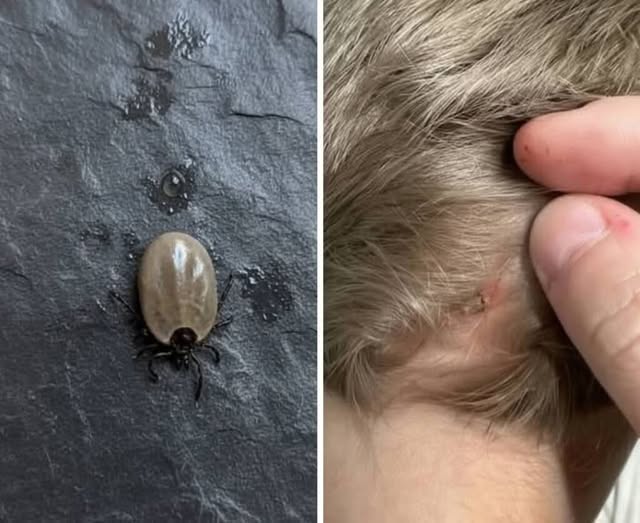
Finding something unfamiliar on your child’s scalp can be an unsettling experience.
One moment, you’re helping your child get ready for bed, brushing their hair, or giving them a bath. The next, you notice a tiny object attached to the hair or sitting close to the scalp.
Naturally, the first question is:
“What is that?”
Parents may immediately wonder whether it is a bug, an insect, a piece of dirt, or something that requires attention. However, identifying a small object on the scalp from a quick glance can be difficult. Several different things can look surprisingly similar, especially when they are very small.
The good news is that noticing something unusual does not automatically mean there is a serious problem.
Instead of guessing, it is better to take a closer look, consider the circumstances, and pay attention to any symptoms your child may have.
Small Objects on the Scalp Can Have Several Possible Causes
There are several possibilities when a parent discovers a tiny bug-like object in a child’s hair.
One possibility is an ordinary piece of debris.
Children play outdoors, spend time on playgrounds, sit on carpets, lie on grass, and participate in activities that can leave small particles in their hair. A tiny seed, piece of plant material, lint, or dirt can sometimes look surprisingly similar to a small insect.
Another possibility is a living insect.
Small insects can occasionally become trapped in hair, particularly after outdoor activities. Depending on the insect, it may move around, remain still, or become caught among individual hairs.
There are also conditions involving the scalp and hair that can produce objects that resemble insects.
For example, dried skin, product residue, or other material can sometimes become attached to individual hairs.
This is why it is difficult to identify an unknown object accurately without seeing it clearly.
Head Lice Are One Possibility Parents Often Consider
When something unusual is discovered in a child’s hair, many parents immediately think about head lice.
Head lice are small parasitic insects that live on the human scalp and feed on blood. They can occur in children and are commonly associated with close head-to-head contact.
However, seeing one unfamiliar object does not automatically mean a child has head lice.
One of the important things to distinguish is a live louse from a nit.
Nits are lice eggs or egg cases attached to individual hairs. They can appear as tiny pale or whitish objects and may be confused with dandruff or other material.
Nits tend to remain firmly attached to the hair shaft, while ordinary flakes of dandruff or loose debris are generally easier to move or remove.
If you suspect lice, carefully examining the hair near the scalp can provide more useful information than simply looking at one isolated object.
What Should Parents Look For?
If you notice something unusual, try to remain calm and examine the area under good lighting.
A bright room or a flashlight can make small objects easier to see.
If possible, use a fine-toothed comb to separate the hair into small sections. This can make it easier to determine whether the object is attached to the hair, resting on the scalp, or simply caught in the hair.
Look for additional signs rather than focusing entirely on one object.
For example, you might notice:
-
Persistent scalp itching.
-
Frequent scratching.
-
Small irritated areas caused by scratching.
-
Multiple tiny objects attached to individual hairs.
-
Insects that appear to move.
-
Redness or irritation around the scalp.
-
Other household members experiencing similar itching.
None of these signs alone provides a definitive diagnosis, but they can help determine whether further evaluation is appropriate.
Don’t Immediately Assume It Is a Dangerous Insect
It is easy to become frightened when you see something unfamiliar on a child’s body.
Online photographs and social-media posts can make this even more stressful because dramatic descriptions are often attached to ordinary discoveries.
A tiny object can look alarming when viewed through a camera or enlarged on a screen.
Before assuming that the object is dangerous, consider where your child has been recently.
Have they been playing outside?
Have they recently visited a park?
Have they spent time around animals?
Have they been camping?
Have they been playing in grass or wooded areas?
The answers may provide useful context.
At the same time, location alone cannot identify an unknown insect.
What If the Object Is Attached to the Skin?
There is an important difference between something sitting in the hair and something that appears firmly attached to the skin.
If an object appears attached to the scalp or skin and you suspect it could be a tick, it is sensible to seek reliable medical or public-health guidance about appropriate removal.
Ticks can attach to people after outdoor exposure, and their appearance can vary depending on their species and stage of development.
If you’re unsure what you are looking at, avoid trying to identify it solely from a social-media comment.
A clear photograph can sometimes help a qualified professional or reputable identification service provide more useful guidance.
Avoid Using Household Chemicals on a Child’s Scalp
One important precaution is to avoid experimenting with household chemicals or unapproved substances in an attempt to remove an unknown insect.
Parents sometimes encounter online suggestions involving strong cleaning products, pesticides, essential oils, or other substances.
These approaches can irritate or injure the scalp and may create a bigger problem than the original discovery.
If treatment is needed, use a product specifically intended for the condition being treated and follow its directions carefully.
When there is uncertainty, a pharmacist, pediatrician, or other qualified healthcare professional can provide appropriate guidance.
What If Your Child Is Not Itching?
The absence of itching does not necessarily identify what the object is.
Some children with certain scalp conditions may experience noticeable itching, while others may not.
Likewise, an insect temporarily caught in the hair may not cause any symptoms at all.
Therefore, the fact that your child says, “It doesn’t itch,” doesn’t completely rule out every possibility.
Instead, treat it as one piece of information.
Examine the area and monitor your child for any changes.
What If There Are Several Objects?
Finding several similar objects may be more significant than finding one isolated particle.
For example, if you notice numerous small items attached close to the scalp, especially around areas such as behind the ears or near the back of the neck, you may want to investigate further.
Again, this does not automatically establish what the cause is.
However, a pattern is generally more informative than a single unexplained object.
If you are uncertain, a healthcare professional can help determine whether further examination or treatment is necessary.
Take a Clear Photograph If You Need Help Identifying It
If you want to ask someone knowledgeable about an unfamiliar object, a clear photograph can be useful.
Try taking the picture in natural light or under a bright lamp.
Use the camera’s focus carefully.
Include one wider photograph showing where the object was found and another close-up photograph showing its shape and texture.
If possible, avoid moving or destroying the object before photographing it.
However, remember that photographs are not always sufficient for a reliable identification. A professional may still need additional information or an in-person examination.
Keep an Eye on the Rest of the Family
If you eventually determine that the object is related to a contagious condition such as head lice, other household members may also need to be checked.
Close contact can make transmission possible, particularly among children who play together or share close physical space.
That doesn’t mean everyone in the household automatically has the same problem.
It simply means that checking close contacts can be a sensible precaution when a contagious condition has actually been identified.
Cleanliness Is Not the Same as Prevention
It’s also important to avoid blaming a child for discovering something unusual in their hair.
Some scalp conditions are not a reflection of poor hygiene.
For example, head lice can affect people regardless of how frequently they wash their hair.
Children can also pick up ordinary outdoor debris simply by playing outside.
Instead of making the child feel embarrassed, approach the situation calmly.
You can turn the discovery into a simple health check rather than something frightening.
When Should You Contact a Healthcare Professional?
Consider seeking professional advice if your child’s scalp becomes significantly irritated, painful, swollen, or infected-looking.
You should also seek guidance if your child develops persistent symptoms or if you cannot determine what the object is and are concerned about it.
If you suspect a tick or another potentially biting insect, professional advice can be particularly useful when the object appears attached to the skin.
Urgent medical attention may be appropriate if your child develops severe or rapidly worsening symptoms after an insect bite or sting.
The exact response depends on the circumstances and symptoms.
Don’t Let a Scary Caption Make the Decision for You
If you discover an unusual object on your child’s scalp and decide to post a photograph online, remember that internet commenters may offer many different explanations.
Some may be correct.
Others may simply be guessing.
A dramatic comment can attract attention, but it isn’t necessarily reliable.
Instead of asking only, “What is this scary thing?”, a better question is:
“What evidence would help identify it accurately?”
That might include a clear photograph, information about where your child has been, whether the object moves, whether it is attached to the hair or skin, and whether your child has any symptoms.
The Most Important Thing Is to Stay Calm
Seeing an unfamiliar object in your child’s hair can certainly be surprising.
But there is no need to assume the worst immediately.
Many things can look like insects when they are actually harmless bits of debris, plant material, dried skin, or other material.
If it is a living insect or a condition requiring treatment, identifying the issue accurately is the first step toward dealing with it appropriately.
Take a careful look.
Avoid applying random substances to your child’s scalp.
Pay attention to symptoms.
And when you’re uncertain, seek advice from a qualified healthcare professional rather than relying solely on an internet comment.
Final Thoughts
Parents naturally want to protect their children, so noticing something unusual on a child’s scalp can lead to immediate concern.
The important thing is to separate observation from assumption.
You may have found an insect.
You may have found a piece of debris.
You may have noticed a material attached to a hair.
Or there may be another explanation entirely.
Without a clear examination, it isn’t possible to identify an unknown object with certainty.
So if you ever find something unusual in your child’s hair, take a breath, examine it carefully, and gather the relevant information before jumping to conclusions.
Sometimes the most useful response to a mystery isn’t panic—it’s a closer look, a little patience, and the right information.