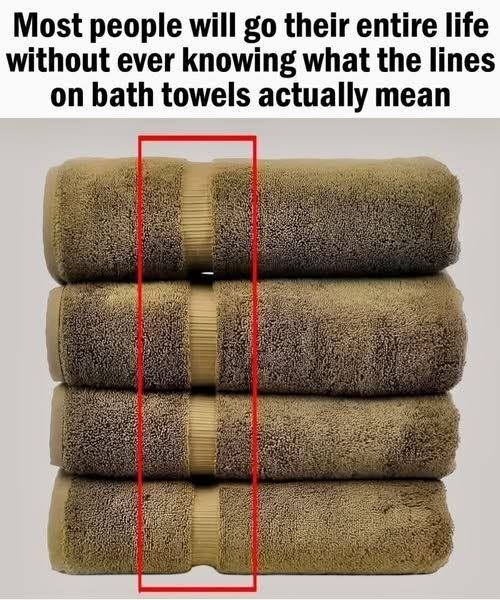
Have you ever looked closely at a bath towel and wondered why it has a strip of lines, patterns, or raised fabric near one or both ends?
It is a small detail that many people notice but rarely stop to think about. Most bath towels have some type of decorative band woven into the fabric, and while it can look like nothing more than a design choice, there are practical reasons manufacturers include it.
The exact appearance of this band can vary depending on the towel’s material, quality, manufacturer, and intended use. Some towels have simple horizontal lines, while others feature more complicated patterns, borders, or textured sections.
So, what is the purpose of these lines?
The Lines Are Often Part of the Towel’s Construction
One of the main reasons towels have a different-looking section near the ends is related to how the towel is manufactured.
The main body of a bath towel is usually designed to provide a soft, absorbent surface. This part commonly uses loops of fabric that can hold water effectively. The woven band at the end is constructed differently and tends to have a flatter texture.
This difference helps create a clear transition between the absorbent central portion of the towel and its finished edge.
The decorative band is sometimes referred to as a dobby border or dobby stripe, depending on its specific construction and design. Manufacturers can use different weaving techniques to create these patterns.
Why Is the Fabric Different in This Area?
A towel needs to be both absorbent and durable.
The fluffy loops in the main portion of a towel are excellent for absorbing moisture, but they can also be more vulnerable to pulling, snagging, or becoming distorted with repeated use and washing.
The flatter woven area near the edge provides a more structured finish. It can help define the towel’s shape and give the manufacturer a practical area in which to finish the fabric.
This is one reason the bands are usually positioned near the ends rather than directly in the middle of the towel.
It Also Gives the Towel a Finished Appearance
There is also a visual reason for the design.
A plain towel made entirely from the same textured material can look somewhat unfinished. Adding a woven border creates a clear edge and gives the towel a more intentional appearance.
Manufacturers can use this area to introduce stripes, geometric shapes, patterns, or other decorative elements.
In other words, the lines can serve both a functional and an aesthetic purpose.
That does not necessarily mean every towel border performs exactly the same function. Different manufacturers may use similar-looking designs for different production or decorative reasons.
Are the Lines Designed to Help You Fold the Towel?
You may have heard the idea that the lines on a towel are intended to show you exactly where to fold it.
This explanation is popular because the borders can make folding easier. If you place the towel’s decorative band in a consistent position, you can create a neat and uniform fold.
However, it is better to think of this as a possible practical use rather than assuming that every towel manufacturer specifically designed the lines as folding instructions.
There is no universal rule saying that a towel must be folded according to its decorative stripes.
The bands are primarily part of the towel’s woven construction and appearance, while using them as a folding guide is simply a convenient habit.
Why Do Some Towels Have More Than One Line?
If you look at different towels, you may notice that their borders are not identical.
Some have a single narrow stripe. Others have several parallel lines. Some feature wide geometric patterns, while premium or decorative towels may have elaborate woven borders.
These differences are largely determined by the towel’s design and manufacturing process.
The number and width of the lines do not necessarily indicate a specific towel size or quality level. A more complicated pattern does not automatically mean that the towel is more absorbent or durable.
In many cases, the border is simply part of the manufacturer’s chosen design.
Do the Lines Make the Towel Less Absorbent?
The woven border generally has a flatter structure than the looped fabric in the main body of the towel. Because of this, it may not absorb water in exactly the same way as the fluffy portion.
That is normal.
The primary absorbent area of a bath towel is usually the larger looped section. The border occupies only a relatively small portion of the towel, so its different texture is unlikely to prevent the towel from performing its main purpose.
In fact, the contrast between the two textures is one of the easiest ways to identify the decorative or structural border.
Why Are These Borders Usually Near the Ends?
The ends of a towel are areas where the fabric needs to be securely finished.
A towel consists of many woven threads and loops, and without an appropriate finishing method, the fabric could begin to unravel.
A structured woven section provides a transition between the main towel fabric and the finished edge. The exact construction varies from one towel to another, but placing a different weave near the ends is a common approach.
This also creates a visually clean boundary.
Instead of having the fluffy looped texture continue right up to the edge, the towel transitions into a flatter, more tightly woven area before reaching the final edge.
Does Every Bath Towel Have These Lines?
No.
You can find plenty of towels without the traditional decorative bands. Some modern towels are designed with a uniform texture across almost the entire surface.
Others may have a different type of border that is difficult to notice.
Towels made from different materials can also have different construction methods. Cotton, microfiber, bamboo blends, and other textile materials may be manufactured using different techniques.
Therefore, there is no single explanation that applies identically to every towel on the market.
What Happens If the Border Becomes Damaged?
Because the border is part of the towel’s construction, damage to this area can sometimes affect the overall appearance or integrity of the fabric.
For example, repeated pulling or snagging may loosen individual threads.
If you notice a loose thread, it is usually better to avoid pulling it. Pulling can make the loose section longer or cause additional threads to become displaced.
Instead, carefully trimming an isolated loose thread may be preferable, provided you do so without cutting into the surrounding fabric.
Proper washing and drying can also help extend the life of a towel.
Does the Border Tell You Anything About Towel Quality?
Not necessarily.
A towel with an elaborate border is not automatically better than a towel with a simple design.
When choosing a towel, factors such as fiber type, fabric density, construction, absorbency, softness, durability, and personal preference are generally more meaningful than the appearance of the decorative lines.
A simple-looking towel can perform extremely well, while a heavily patterned towel may have been designed primarily for appearance.
The border alone should therefore not be treated as a reliable measure of quality.
Why This Small Detail Is Easy to Miss
One reason the lines seem mysterious is that they are so familiar.
We see towels every day, but because the border is a normal part of the design, most people rarely question why it is there.
The same thing happens with many everyday household objects. Small manufacturing details become so common that we stop noticing them.
Once you understand that the different-looking section is connected to the towel’s weaving, finishing, durability, and appearance, the design becomes much less mysterious.
A Simple Way to Look at Your Own Towels
The next time you pick up a bath towel, take a moment to examine the border.
Compare its texture with the main body of the towel.
You will probably notice that:
-
The main section is usually made from softer, raised loops.
-
The border is generally flatter and more tightly woven.
-
The pattern may contain stripes, geometric shapes, or other decorative details.
-
The border is normally positioned close to the towel’s ends.
-
The edges may have additional stitching or finishing to prevent the fabric from coming apart.
These differences provide clues about how the towel was constructed.
The Takeaway
Those lines on your bath towel are not simply random marks.
They are usually part of a woven border that can serve several purposes, including helping finish the towel’s construction, providing a transition between different sections of fabric, adding structure near the edges, and giving the towel a decorative appearance.
The exact purpose can vary between manufacturers and towel designs, so it is best not to assume that every stripe has one specific function.
What seems like an insignificant detail is actually a small example of textile design and manufacturing.
So the next time you grab a towel after a shower, take a closer look at those familiar lines. They are a reminder that even ordinary household items often contain thoughtful design features that we rarely notice.