At seventy-four, I never imagined that one ordinary afternoon would completely change the way I saw my own family.
I had always considered myself independent.
I still drove myself to the grocery store. I cooked my own meals, kept up with the house, paid my bills on time, and handled most things without asking anyone for help.
Most importantly, I still loved being a grandmother.
My eight-year-old grandson, Larry, spent several afternoons each week at my house.
After school, he would sit at my kitchen table while I helped him with his homework.
He had his own blue mug in the cupboard, a drawer filled with colored pencils, and a favorite chair beside the window.
Those little things made my house feel alive.
Then, one afternoon, everything changed.
It happened on the back steps.
I was carrying a basket of laundry when my foot slipped.
I fell hard enough to frighten myself, but thankfully, nothing was broken.
My daughter, Melissa, insisted on taking me to the hospital.
The doctors examined me and told me I had badly bruised my hip. They recommended that I rest, take things slowly for a while, and ask for help if I needed it.
That seemed reasonable.
What didn’t seem reasonable was what happened next.
While I was still in the hospital, Melissa began talking about how dangerous it was for me to live alone.
“You can’t keep doing everything yourself, Mom.”
“I’ve been doing everything myself for years,” I reminded her.
“You fell.”
“I slipped.”
“That’s exactly what I’m talking about.”
I knew my daughter was worried.
I also knew she had become frightened by the idea that something might happen to me.
But I never imagined she would make a major decision about my life without even discussing it with me.
The morning I was discharged, Melissa arrived early.
She smiled and helped me gather my belongings.
“Where are we going?” I asked.
“I’m taking you somewhere for a little while.”
“Where?”
“You’ll see.”
I assumed she was taking me to her house.
Instead, we drove for more than an hour.
Then another.
The familiar roads disappeared behind us.
Eventually, we pulled into the parking lot of a care facility.
I stared at the building.
“Melissa?”
She didn’t answer immediately.
Then I saw my suitcase.
It was sitting beside the entrance.
Two framed photographs from my bedroom were balanced on top.
My heart sank.
“Why is my suitcase here?”
Melissa finally looked at me.
“Mom, I arranged everything.”
“Arranged what?”
“You’re going to stay here.”
I thought I had misunderstood her.
“For how long?”
“We’ll see.”
I looked around the lobby.
There were comfortable chairs, a reception desk, and several residents sitting together.
It appeared clean and well maintained.
But none of that mattered.
I hadn’t chosen to be there.
“You didn’t even ask me.”
Melissa sighed.
“If I had asked, you would’ve refused.”
“Yes,” I said quietly. “I probably would’ve.”
She looked frustrated.
“I’m doing this because I’m worried about you.”
“You could have talked to me.”
“You don’t listen when people tell you you’re taking risks.”
“I slipped on the stairs, Melissa. I didn’t lose my ability to make decisions.”
She didn’t answer.
Instead, she squeezed my hand.
“It’s for your own good.”
Those words stayed with me.
I had heard them before.
People sometimes say them when they believe they know what’s best for someone else.
But “for your own good” doesn’t make a decision feel less painful when nobody asks what you actually want.
Melissa gave the receptionist some paperwork.
Then she handed me a small bag.
“I’ll come back soon.”
I looked at her.
“Can you stay for a while?”
She hesitated.
“I have to get back.”
“What about Larry?”
“He’ll be fine.”
“Can I speak to him?”
“He’s at school.”
“Tell him Grandma loves him.”
“I will.”
Then she hugged me, kissed my cheek, and walked away.
I watched her car disappear through the entrance.
That evening, I sat on the edge of my new bed and looked at the photographs she’d brought from home.
One showed my late husband, Robert, standing beside me in our backyard.
Another showed Melissa when she was a little girl.
I stared at that photograph for a long time.
That house wasn’t simply a building.
It was where Robert and I had raised Melissa.
It was where we had celebrated birthdays and holidays.
It was where Larry had learned to bake cookies with me.
It was where Robert had marked Melissa’s height on the inside of the pantry door every birthday.
Every corner contained a memory.
And now I was eighty miles away from it.
I cried that night.
Not because the facility was terrible.
It wasn’t.
The nurses were kind.
The room was comfortable.
But I hadn’t been given a choice.
And the person who had made that choice was my own daughter.
The next morning, I asked about Larry.
“Has he called?”
The nurse checked the information.
“Not yet.”
I called Melissa.
She answered quickly.
“Mom?”
“How’s Larry?”
“He’s okay.”
“Can I talk to him?”
There was a pause.
“He’s having a difficult time with everything.”
“Please let me talk to him.”
“Maybe later.”
I frowned.
“Why later?”
“He’s adjusting.”
The conversation ended shortly afterward.
I spent the rest of the day wondering what she meant.
By the second day, I still hadn’t heard from Larry.
I became increasingly worried.
That boy and I spoke almost every day.
Even when he was busy, he’d usually send me a quick message or ask his mother to call.
Something didn’t feel right.
On the third afternoon, I was sitting near the window when a nurse knocked on my door.
“There’s someone here to see you.”
“Who?”
She smiled.
“Why don’t you come and see?”
I walked into the hallway.
Then I stopped.
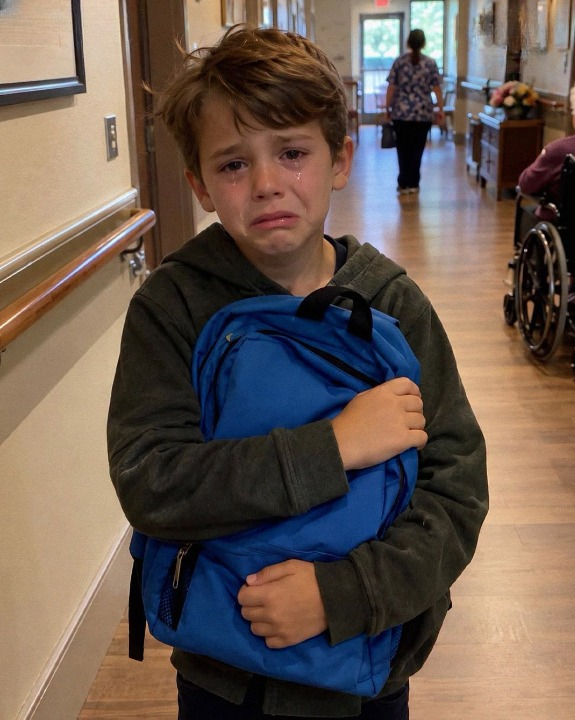
Larry was standing near the entrance.
He still had his school backpack on.
His cheeks were red, and tears were running down his face.
For a moment, I couldn’t move.
Then he saw me.
“Grandma!”
He ran toward me.
I wrapped my arms around him.
“What are you doing here?”
He cried against my shoulder.
“I wanted to see you.”
I held him tightly.
“Where’s your mom?”
He pulled away.
“I don’t know.”
My heart tightened.
“Did she bring you?”
He shook his head.
“I came with someone.”
I looked toward the reception desk.
A staff member explained that an adult had accompanied him and was waiting nearby.
I turned back to Larry.
“Are you okay?”
He nodded, but his expression told me otherwise.
Then he whispered:
“Grandma, I brought something.”
“What?”
He pulled his backpack closer.
“I took it from your house.”
My heart skipped.
“Why?”
“Because I was scared Mom might get rid of it.”
I didn’t understand.
“Get rid of what?”
Larry looked around before answering.
Then he reached for the zipper of his backpack.
His little hands were trembling.
“I didn’t know where else to keep it.”
He opened the bag.
I expected to see a toy, perhaps one of his schoolbooks, or maybe something sentimental.
Instead, he carefully pulled out a small wooden box.
I recognized it immediately.
It had belonged to my husband.
Robert had kept that box in the bottom drawer of his desk.
After he passed away, I had rarely opened it.
I stared at Larry.
“Where did you find this?”
“In the house.”
“Who gave it to you?”
“Nobody.”
He looked down.
“I found it when Mom was moving your things.”
My stomach tightened.
“Moving my things?”
Larry nodded.
“She said the house needed to be cleaned out.”
I felt a chill run through me.
“Why would she be cleaning it out already?”
“I don’t know.”
He held the box against his chest.
“But there was something else.”
“What?”
Larry reached into the backpack again.
This time, he pulled out a folded piece of paper.
“I found this inside Grandpa’s desk.”
I unfolded it.
The handwriting was unmistakable.
It belonged to Robert.
My hands began to shake.
I hadn’t seen that handwriting since before he died.
There were only a few sentences on the page.
But they changed everything.
The note wasn’t addressed to Melissa.
It wasn’t addressed to me.
It was addressed to Larry.
I looked at my grandson.
“Did you read this?”
He shook his head.
“I couldn’t understand all of it.”
I looked back at the paper.
Robert had written that there was something important I needed to know about the house.
Something he had deliberately kept quiet about.
And according to the note, I was supposed to find it only if circumstances ever forced me away from home.
I read the final sentence twice.
“If you’re reading this, something has happened that I hoped would never happen. Trust the person who brings you this message.”
I looked at Larry.
My grandson was the person who had brought it to me.
But why?
What had Robert known?
And what had Melissa been planning?
Suddenly, my daughter’s decision to move me eighty miles away didn’t seem quite as simple as I had believed.
Maybe she really had been worried about my safety.
Maybe she had made a terrible judgment.
Or maybe there was something happening at my old house that I knew nothing about.
I folded the note carefully.
Then I looked at Larry.
“Where did you find the box?”
He pointed toward the backpack.
“In the desk.”
“Was anyone else there?”
He shook his head.
“Mom was downstairs.”
“And you took it?”
He nodded.
“I knew Grandpa wanted you to have it.”
I pulled him close.
“You did the right thing by bringing it to me.”
He began crying again.
“I didn’t want you to think I forgot about you.”
“Oh, sweetheart,” I said, holding him tightly. “I could never think that.”
For the first time since arriving at the care facility, I felt something other than sadness.
I felt determined.
I had spent three days believing that my life had suddenly been taken out of my hands.
But now I realized I still had choices.
I could ask questions.
I could request my own records.
I could speak with the people involved.
And, most importantly, I could find out exactly what Robert had wanted me to know.
That evening, I placed the wooden box beside my bed.
I didn’t open it immediately.
Some part of me was afraid of what I might find.
But another part of me knew I couldn’t ignore it.
The next morning, I called Melissa.
She answered after several rings.
“Mom?”
“Melissa, we need to talk.”
There was silence.
“About what?”
“About my house.”
Another pause.
Then she said quietly:
“What did Larry tell you?”
My heart stopped.
I hadn’t mentioned Larry.
I hadn’t told her about the box.
I hadn’t told her about Robert’s note.
Yet somehow, she already knew there was something I had discovered.
I looked down at the wooden box sitting on my bedside table.
Then I asked the question that had been troubling me since the moment Larry arrived.
“Melissa, what exactly were you planning to do with my house?”
She didn’t answer.
And that silence told me more than words could have.
For the first time, I understood that my fall on the back steps might not have been the only thing I needed to worry about.
There was something happening behind the scenes.
And thanks to my eight-year-old grandson, I finally had a reason to start asking questions.
I didn’t know what was inside the wooden box yet.
I didn’t know what Robert had discovered years earlier.
And I certainly didn’t know why Melissa had moved me so far away without giving me a choice.
But I knew one thing.
I wasn’t going to let anyone make decisions about the rest of my life without listening to me again.