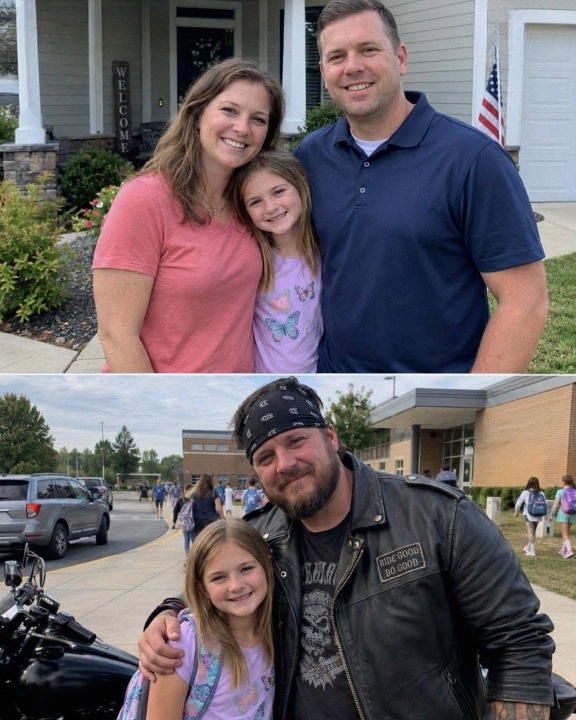
Sometimes, the people who appear the most intimidating to strangers can be the same people who quietly make a difference in the lives of those around them.
I learned that lesson through my neighbor Travis.
For most of my life, Travis had been part of the background of our family story. I had known him since we were children, and although he looked intimidating to people who did not know him, I had always seen a very different side of him.
He was thirty-six years old, tall and heavily tattooed, and usually wore black leather when he was riding his motorcycle. He also played bass in a local band and spent many evenings practicing with his friends.
If you passed him on the street without knowing him, you might have made assumptions based on his appearance.
I never did.
To me, Travis was the person who had helped me when I was younger. He repaired my first car without asking for payment and once helped my mother when our family was going through a difficult period.
He had lived near us for years.
That history meant more to me than appearances.
My husband, Ryan, saw things differently.
Our daughter Emma was seven years old, and when my work schedule changed, collecting her from school became increasingly difficult.
Ryan worked across town and normally didn’t finish until six in the evening. I tried to rearrange my schedule, but there were several afternoons when I simply couldn’t leave work early enough.
I was frustrated one afternoon while talking about the situation.
Travis happened to hear me.
“My rehearsals usually finish near her school around three,” he said. “If you’d like, I can walk Emma home.”
I immediately appreciated the offer.
Still, because Emma was young, we wanted to make sure everything was handled properly.
The school checked Travis’s identification and added him to the approved pickup list. We made sure the arrangement was clear with the school staff, and Travis agreed to bring Emma directly home.
It seemed like a simple solution.
Emma loved it.
She thought Travis was fascinating. She liked hearing about his motorcycle, asking him questions about music, and listening to stories about his band.
To her, he wasn’t frightening at all.
He was simply Travis.
Ryan, however, remained uncomfortable.
“I don’t want Emma getting used to relying on him every afternoon,” he told me one evening.
I understood that he was concerned about our daughter.
But I also felt that he was judging Travis primarily by his appearance.
“He isn’t a stranger,” I reminded him. “I’ve known him for years.”
Ryan shook his head.
“I know, but I still don’t feel comfortable.”
We disagreed about it several times, but eventually decided to continue the arrangement because it was working well.
For approximately three weeks, everything went smoothly.
Every afternoon, Travis collected Emma from school.
He brought her home on time.
Emma would usually come through the front door excited to tell us something about her day.
Sometimes she would talk about a classroom activity. Other times she would tell us about something funny Travis had said.
Nothing seemed unusual.
Then, one Tuesday afternoon, I received a phone call at work.
It was Emma’s teacher.
Her voice sounded serious.
“Mrs. Bennett, could you come to the school as soon as possible?”
My heart immediately began beating faster.
I sat up in my chair.
“Is Emma all right?”
There was a short pause.
“Emma is okay,” her teacher replied. “But there’s something I think you need to see in person.”
I asked what had happened.
Instead of answering directly, she lowered her voice.
“It’s about the man who picks Emma up.”
Those words immediately brought Ryan’s concerns back to my mind.
For three weeks, I had believed everything was fine.
Now, suddenly, I was being asked to come to school because of Travis.
I didn’t know whether I should be worried, confused, or simply cautious.
I grabbed my bag and left work.
During the drive to the school, my thoughts raced through every possibility.
Had Emma been frightened?
Had there been a misunderstanding?
Had someone seen something unusual?
Or had Ryan’s concerns been justified after all?
I tried not to make assumptions before knowing the facts.
When I arrived at the school, Emma’s teacher was waiting near the entrance.
She greeted me but didn’t say much.
“Please come with me,” she said.
Her expression made it clear that this was not a routine conversation.
We walked down the hallway toward the principal’s office.
Every step seemed to make me more anxious.
When we reached the office, she opened the door.
The principal was inside.
So was Emma.
The moment I saw my daughter sitting there, I rushed toward her.
“Are you okay?”
Emma nodded.
“I’m okay, Mommy.”
I looked at the principal.
“What happened?”
The principal gestured toward a chair.
“Please sit down.”
I did.
Emma’s teacher sat nearby.
For a few seconds, nobody spoke.
Then the principal placed something on the desk in front of me.
It was a photograph.
I looked at it without understanding why it was important.
Then I recognized the person in the picture.
It was Travis.
But he wasn’t alone.
The photograph showed him standing outside the school earlier that afternoon.
At first, nothing about the image seemed particularly unusual.
Then I noticed another detail.
Someone else was visible in the background.
The teacher explained that a staff member had noticed something unusual near the school entrance and had taken the photograph as part of their effort to understand what was happening.
The principal then told me something I hadn’t expected.
Travis had not simply been walking Emma home every afternoon.
He had also been doing something else.
Before I could react, Emma spoke.
“Mommy, I tried to tell them.”
I turned toward her.
“Tell me what?”
She looked at her teacher.
Then back at me.
“I thought you already knew.”
My stomach tightened.
The teacher gently explained that Emma had mentioned something during class that had caused them to take a closer look at the situation.
It wasn’t necessarily what I had imagined.
There was no accusation and no conclusion.
The school simply wanted to make sure that everyone understood what was happening.
That distinction mattered.
Too often, people can see a photograph or hear part of a story and immediately create an explanation without knowing the full context.
The school had chosen to speak with me directly instead.
I appreciated that.
The principal then explained the reason for the concern.
Travis had apparently been making an additional stop after collecting Emma.
That stop involved another person connected to the school.
At first, the information sounded alarming.
But as the conversation continued, the situation became more complicated.
Travis had not been hiding Emma from us.
He had not taken her somewhere without permission.
Instead, he had been helping with something that Emma had noticed but did not fully understand.
The person in the photograph was an elderly man who regularly waited near the school.
Travis had been helping him with transportation after discovering that he was struggling to get home safely.
Emma had seen them together several times and had assumed that her parents already knew.
The school had become concerned because they had not been aware of the arrangement.
That was why they contacted me.
The entire situation was very different from the story my imagination had created during the drive to school.
I sat quietly for a moment.
Then I realized something important.
Ryan’s concerns had not necessarily been evidence that Travis was doing anything wrong.
At the same time, my trust in Travis did not mean that we should stop communicating with the school or setting clear boundaries around our daughter.
Both things could be true.
We could appreciate someone’s kindness while still making sure arrangements involving a child were transparent and properly supervised.
I thanked the teacher and principal for contacting me.
Then I hugged Emma.
She had been caught in the middle of an adult misunderstanding without realizing how serious it might appear to other people.
When we left the school, I called Ryan.
I told him everything.
He was quiet for several seconds.
Then he admitted that he might have been too quick to judge Travis based on his appearance.
That evening, we spoke with Travis together.
He apologized for not mentioning the additional stop.
He explained that he hadn’t thought it was important because he believed he was simply helping someone who needed assistance.
Ryan told him that he appreciated the intention but wanted better communication in the future.
Travis agreed.
The experience changed the way all of us looked at the situation.
It reminded me that appearances can be misleading, but it also reminded me that trust works best when it is supported by communication.
Travis’s tattoos, motorcycle, leather clothing, and music career had made him look intimidating to people who didn’t know him.
But none of those things told us what kind of person he was.
At the same time, knowing someone for many years doesn’t mean every decision they make should automatically go unquestioned.
The most important lesson was finding the balance between trust and responsibility.
Emma continued to see Travis as the friendly neighbor who walked her home from school.
Ryan became more comfortable with him.
And I became even more convinced that assumptions are rarely a substitute for a conversation.
What began as an ordinary change to our family’s afternoon routine had unexpectedly taught us something valuable.
We should be careful about judging people based on appearances.
We should communicate clearly when children are involved.
And when something seems concerning, the best response is often to ask questions before reaching conclusions.
Sometimes the person who looks the most intimidating may simply be someone who has spent years helping others quietly.
And sometimes a phone call from a teacher that makes your heart race turns out not to be the beginning of a terrible story, but the beginning of an important conversation.
That Tuesday afternoon certainly frightened me.
But by the time I drove home with Emma, I felt something different.
I felt grateful that her teacher had taken the situation seriously, grateful that the school had communicated with us, and grateful that we had taken the time to understand what had actually happened.
Most of all, I was reminded that there is always more to a person than what we see at first glance.