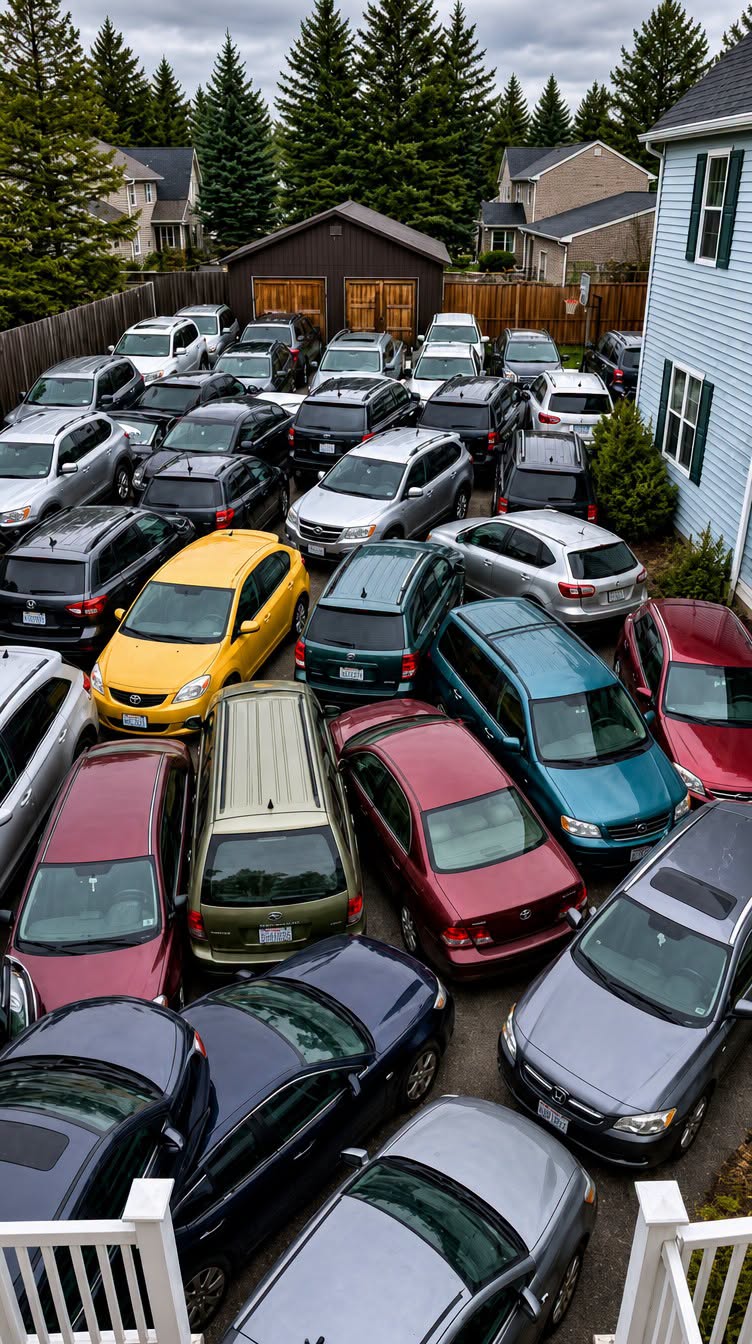
For eight months, my neighbor treated my driveway as though it were an extension of her own property.
At first, I tried not to make an issue of it.
Roberta would pull her SUV into the driveway, leave it there while she visited someone nearby, and return a short time later.
“Just ten minutes,” she would say.
I believed her.
The first few times, it really was about ten minutes.
Then it became an hour.
After that, it became several hours.
Eventually, she started leaving the SUV overnight.
What bothered me wasn’t simply where she parked.
It was the assumption behind it.
She had decided that because part of my driveway was usually empty, she had the right to use it.
And whenever I objected, she acted as though I were being unreasonable.
I didn’t realize that the situation would eventually reveal something about the property that neither of us had fully understood.
The House Across the Street
My husband and I had lived in the house for nearly twenty-five years.
It was an older property with a long driveway that stretched from the road toward the garage.
Behind the house was a narrow private gravel lane.
The lane had been there long before we bought the property.
It connected several homes farther back from the road to a secondary access point.
Over the years, the lane had become less important because most residents used the main road.
Still, it remained private property.
My husband had always taken care of the small section that crossed our land.
After he passed away, I was left with the house, one car, and more maintenance than I sometimes knew how to handle.
I didn’t mind having extra driveway space.
But extra space wasn’t the same as public parking.
That distinction seemed obvious to me.
Apparently, it wasn’t obvious to Roberta.
She lived across the street.
She was friendly enough when we first met.
She smiled when we passed each other.
We occasionally exchanged greetings.
I had no reason to dislike her.
Then she started parking in my driveway.
“I’ll Only Be a Few Minutes”
The first time, I didn’t say anything.
Her SUV was parked near the edge of the driveway while she visited a house down the street.
When she returned, she apologized.
“Sorry. I was only going to be a few minutes.”
“No problem,” I said.
The second time, she did the same thing.
The third time, I mentioned it.
“Roberta, would you mind using your own driveway? Sometimes I need to get my car out.”
She nodded.
“Absolutely.”
I thought that settled it.
Three days later, her SUV was back.
This time, I waited until she returned.
“Roberta, I asked you not to park here.”
She looked at the driveway.
“You weren’t using it.”
“That doesn’t really matter.”
She laughed.
“You have enough room for several cars.”
“That still doesn’t make it yours.”
Her smile disappeared for a moment.
“Fine.”
She moved the SUV.
I thought the problem was over.
It wasn’t.
The Sign
Over the following weeks, I had to ask her several more times to move her vehicle.
Sometimes she was gone for an hour.
Sometimes she was gone for most of the afternoon.
Once, she parked there overnight.
That was when I decided to make the boundary unmistakable.
I purchased a simple sign.
PRIVATE DRIVEWAY
NO PARKING
I placed it near the entrance where anyone approaching the driveway would see it.
The next morning, I looked out the window.
Roberta’s SUV was parked directly beside the sign.
For a moment, I thought I was imagining it.
Then I saw her step out.
She looked directly at the sign.
Then she walked toward her house.
I went outside.
“Roberta.”
She turned around.
“Yes?”
“You saw the sign.”
She shrugged.
“I did.”
“Then why did you park here?”
“You’re making a huge issue out of nothing.”
I stared at her.
“It’s my driveway.”
“You barely use it.”
“That doesn’t change anything.”
She sighed.
“You’re being difficult.”
I didn’t argue.
I simply told her that I expected her to stop parking there.
She walked away.
The Appointment
The situation became serious several months later.
I had a medical appointment scheduled for 8:15 on a Thursday morning.
It had taken weeks to get the appointment.
I needed to leave by 7:45.
At 7:35, I walked outside.
Roberta’s SUV was blocking my car.
I stood there for several seconds.
I couldn’t believe it.
I called her.
No answer.
I sent a message.
No response.
I walked across the street and knocked on her door.
Nothing.
I knocked again.
Still nothing.
I rang the doorbell.
Nothing.
I called again.
Still nothing.
I waited.
Five minutes.
Ten.
Fifteen.
Finally, I became genuinely frustrated.
I needed to leave.
I went back home and tried calling again.
At 7:55, I heard the sound of a door opening.
Roberta stepped outside wearing a robe.
She looked at me.
“Oh. I didn’t hear you.”
“Your car is blocking mine.”
She looked toward the driveway.
“Oh.”
“I have an appointment.”
She walked over to the SUV.
By the time she moved it, I had no realistic way of arriving at my appointment on time.
I had to call the office and reschedule.
The receptionist was polite, but the next available appointment was several weeks away.
I was angry.
When I told Roberta what had happened, she simply shrugged.
“I’m sorry. I was asleep.”
That was when something changed in me.
Not because I wanted revenge.
I didn’t.
I simply realized that asking politely wasn’t working.
I Decided to Stop Arguing
That afternoon, I sat at my kitchen table and thought about the situation.
I could keep knocking on Roberta’s door.
I could continue asking her to move her car.
Or I could handle the problem properly.
I decided to document every incident.
I wrote down dates and times.
I photographed the vehicles when they were parked across the driveway.
I kept copies of my messages.
I also contacted the local property office to confirm the boundaries of my property and the status of the private gravel lane.
That conversation revealed something important.
The lane wasn’t simply an informal shortcut.
There were several property owners whose deeds included access rights connected to it.
There were also maintenance responsibilities that had been poorly documented over the years.
The official records didn’t change the fact that Roberta had no right to use my driveway.
But they did explain why the lane existed.
And they gave me an idea.
The Private Lane
The gravel lane behind my property had always been somewhat mysterious to me.
My husband had known more about it.
He had occasionally mentioned that several neighboring properties had rights to use it.
But because there had been few disputes, I had never looked into the details.
Now I did.
I contacted the county records office.
I requested copies of the relevant property documents.
I learned that decades earlier, the owners of several homes had created a shared access arrangement.
The lane provided access for emergency vehicles, maintenance equipment, and residents whose properties were located farther back.
There was also an old maintenance agreement.
The agreement required the property owners who benefited from the lane to share certain maintenance costs.
Over time, the arrangement had been neglected.
Some homeowners didn’t even know it existed.
Then I found the name of the person who had originally organized the agreement.
It was someone I recognized.
Frank Miller.
An elderly man who lived at the end of the lane.
I had met him once or twice.
He was quiet and rarely came into the neighborhood.
According to the records, he had been involved in maintaining the access road for decades.
The Meeting
I called Frank.
I explained the situation with the driveway.
Then I asked him about the lane.
There was a long pause.
Finally, he said:
“Your husband understood that lane better than most people.”
I was surprised.
“He did?”
Frank laughed softly.
“He was one of the few people who actually read the old agreement.”
Then Frank told me something I hadn’t known.
The lane had originally been designed to provide shared access for multiple properties.
But my driveway was not part of that shared parking area.
It was completely separate.
In fact, several years earlier, there had been a discussion about installing a gate at the entrance to prevent unauthorized vehicles from entering.
The project had never been completed.
Frank offered to come over and look at the documents with me.
We arranged to meet the following Saturday.
Roberta Arrives
Saturday morning came.
I was standing near the driveway when Roberta appeared.
Her SUV turned into my driveway again.
I walked toward her.
“Roberta, please don’t park here.”
She lowered her window.
“I’ll only be ten minutes.”
“No.”
She looked surprised.
“No?”
“No. I’ve asked you repeatedly.”
She sighed.
“Why are you suddenly making such a big deal about this?”
“Because I’ve missed appointments and had to rearrange my schedule because of your car.”
“I said I was sorry.”
“Then please stop doing it.”
She stared at me for a few seconds.
Then she parked.
I didn’t argue.
I stepped away and called Frank.
Twenty minutes later, an older man in a dark jacket arrived carrying a folder.
It was Frank.
The Conversation Roberta Didn’t Expect
Frank walked toward us.
Roberta stepped out of her SUV.
She recognized him.
“Frank?”
He nodded.
“Hello, Roberta.”
“What are you doing here?”
“I was asked to help clarify the access agreement.”
Roberta looked at me.
“What agreement?”
I explained that I had reviewed the property records and discovered that the gravel lane behind my property was governed by an old shared-access arrangement.
Roberta crossed her arms.
“What does that have to do with my parking?”
“Nothing,” Frank said.
She looked at him.
“What?”
“Your parking has nothing to do with the access agreement.”
Frank opened his folder.
“The lane is for access. It isn’t a general parking area.”
Roberta frowned.
“I thought everyone could use it.”
“For driving through, under the terms of the agreement, yes. Parking is a different matter.”
She looked toward the gravel lane.
Then back at us.
“I didn’t know.”
“That is exactly why we’re clarifying it,” Frank said.
The conversation was much calmer than I expected.
There was no shouting.
No humiliation.
No dramatic confrontation.
Just paperwork and facts.
And, for the first time, Roberta seemed to understand that the issue wasn’t personal.
What She Hadn’t Known
Frank showed her the old documents.
The agreement had been created decades earlier.
Several property owners had signed it.
The lane could be used for access to the rear properties.
It could also be used by emergency services and maintenance vehicles.
But nobody had been given permission to treat another homeowner’s driveway as public parking.
Roberta read the documents carefully.
Then she looked at me.
“I honestly didn’t know.”
“I believe you.”
She looked uncomfortable.
“Why didn’t you tell me this earlier?”
“I tried to tell you that the driveway was private.”
“Yes, but I thought you were just being particular.”
I shook my head.
“It wasn’t about being particular.”
She looked down.
For several seconds, nobody spoke.
Then she said something I hadn’t expected.
“I owe you an apology.”
I nodded.
“I appreciate that.”
The Thirty Cars Never Came
There had never been thirty cars waiting behind Roberta’s SUV.
There was no secret event.
No elaborate plan to embarrass her.
No attempt to trap her.
The truth was much more ordinary.
I had initially considered inviting several neighbors to a meeting because many of them were unaware of the access agreement.
But instead of creating another confrontation, I contacted the property office.
We arranged a small meeting for the homeowners affected by the lane.
Frank attended.
A representative explained the records.
Everyone received copies of the relevant documents.
And we discussed how the lane should be maintained going forward.
It turned out that several residents had been operating under different assumptions.
One thought the lane was public.
Another believed only certain houses had access.
Someone else thought the old agreement had expired.
The meeting cleared up years of confusion.
Roberta Changed Her Behavior
After that day, Roberta stopped parking in my driveway.
She began using her own driveway.
If she needed to visit someone, she parked legally on the street when permitted.
A few weeks later, she came to my door.
She was holding a small box.
“I brought you something.”
I opened it.
Inside were homemade cookies.
“You didn’t have to do that.”
“I know.”
She smiled.
“I just wanted to say thank you.”
“For what?”
“For finally making me understand the problem.”
I laughed.
“I think the property documents deserve most of the credit.”
She smiled.
“Maybe.”
Then she became serious.
“I really am sorry about your appointment.”
That mattered more to me than the cookies.
“Thank you.”
She nodded.
Then she left.
What I Learned From the Situation
The experience changed how I handled disagreements.
Before this happened, I believed that being polite meant continuing to ask the same person to respect a boundary.
I eventually learned that politeness and passivity aren’t the same thing.
You can remain calm while being firm.
You can document a problem without trying to punish someone.
You can seek clarification instead of escalating a disagreement.
And sometimes, the most effective solution is simply getting the facts.
Roberta had convinced herself that my driveway was available because I rarely used all of it.
I had convinced myself that she simply didn’t care about my boundaries.
The truth was more complicated.
She had made assumptions.
I had become increasingly frustrated.
Neither of us fully understood the history of the property.
Once we had the actual documents, the disagreement became much easier to resolve.
The Lane Today
The gravel lane is still there.
The homeowners eventually agreed on a maintenance schedule.
Everyone contributes according to the terms of the existing arrangement.
We also installed clearer signs explaining that the lane is private and intended for access.
There are no more arguments about who can drive through it.
And my driveway remains my driveway.
Roberta and I aren’t close friends.
But we are neighbors.
We say hello when we see each other.
Sometimes she asks how I’m doing.
Sometimes I ask about her family.
The tension that once existed between our houses is gone.
Looking back, I’m actually glad the situation happened.
Not because I enjoyed being frustrated.
Not because Roberta was embarrassed.
And certainly not because I wanted to “teach her a lesson.”
I’m glad because it forced me to learn something I should have understood earlier.
Property boundaries aren’t determined by how much space someone appears to have.
A driveway that looks empty still belongs to someone.
A private lane that looks unused can still have legal access rights.
And a disagreement that feels personal can sometimes be solved by simply checking the facts.
The morning Roberta finally stopped parking in my driveway wasn’t dramatic.
There were no crowds.
No confrontation.
No thirty cars surrounding her SUV.
There was an older man with a folder, a set of property records, and a conversation that should probably have happened years earlier.
That was enough.
Sometimes the best resolution isn’t getting even with someone.
It’s making sure everyone understands the same rules.
And after eight months of frustration, that was all I really wanted.