I Married a Widower Who Wanted to Make His Own Choices — After His Funeral, His Lawyer Gave Me a Letter
At seventy-eight, I had stopped expecting life to surprise me.
I thought I understood how the remaining years of my life would look.
Quiet mornings. Simple meals. A few familiar faces. Occasional phone calls from people I had known for years. Long afternoons spent reading or sitting outside when the weather allowed it.
I had made peace with living in a modest room in a state-funded section of a residential care community. It wasn’t luxurious, but it was safe, and after several difficult years following the death of my husband, I had learned to appreciate stability more than comfort.
Then I met Arthur.
He was eighty-two, a widower, and one of the wealthiest residents in the entire facility.
He lived in a private penthouse-style suite on the upper floor, far removed from the shared rooms and dining areas where most residents spent their days. He had his own sitting room, a large bedroom, a balcony overlooking the gardens, and staff members available whenever he needed assistance.
At first, I assumed someone like Arthur would have little reason to notice someone like me.
I was wrong.
Our friendship began over a chessboard beneath an old oak tree.
Neither of us knew that those quiet games would eventually change both of our lives.
The Two Very Different Worlds We Lived In
When I first arrived at the care community, I quickly learned that money could make aging look very different.
Some residents lived in shared rooms and ate meals prepared for the entire facility.
Others had private apartments, personal caregivers, larger dining areas, and additional services.
Arthur belonged to the second group.
He had worked for decades, built a successful business, invested carefully, and accumulated enough wealth that he never had to worry about paying for private care.
But wealth had not protected him from loneliness.
If anything, it sometimes seemed to make it worse.
His wife had died several years earlier, and although he had three adult children, they lived in different parts of the country and rarely visited unless there was something important to discuss.
Arthur never complained about them at first.
He simply spoke about them as though they were distant relatives.
One afternoon, I asked him whether his children lived nearby.
He moved one of his chess pieces and smiled faintly.
“No. They’re all busy.”
I could tell there was more to the answer.
I didn’t push him.
Over time, however, he began talking more openly.
His oldest son was a successful attorney. His daughter managed a business on the West Coast. His youngest son had followed a career in finance.
All three were financially independent.
All three had families of their own.
And all three seemed to have very little time for their father.
Arthur rarely received spontaneous visits.
Most conversations revolved around his finances, medical appointments, property, investments, or decisions about his future care.
That bothered him more than he wanted to admit.
How We Became Friends
Our friendship was not romantic in the beginning.
It was simply companionship.
Arthur played chess almost every afternoon, and I had played casually since I was a teenager.
I wasn’t particularly good, but I enjoyed the game.
One afternoon, I walked past his table in the courtyard and watched him playing alone against a chess app on his tablet.
“You need an opponent?” I asked.
He looked up.
“Are you any good?”
“Good enough to make you work for the win.”
He laughed.
“Sit down.”
I did.
He won the first game.
I won the second.
He accused me of deliberately allowing him to become overconfident.
I told him he was simply making excuses.
After that, we played nearly every day.
Our games became a routine.
Eventually, chess became only the reason we met.
We started talking about books, music, childhood memories, travel, marriage, food, politics, old movies, and the strange changes that come with growing older.
Arthur had traveled around the world.
I had spent most of my life working, raising a family, and managing an ordinary household.
Yet somehow, we found that we had more in common than either of us expected.
Neither of us enjoyed being treated as though getting older meant becoming invisible.
Neither of us wanted people making decisions for us without asking what we actually wanted.
And both of us had learned that money could solve certain problems without solving loneliness.
The Afternoon Everything Changed
One afternoon, Arthur seemed unusually quiet.
We were sitting beneath the oak tree while a light breeze moved through the branches.
He stared at the chessboard for several minutes without making a move.
Finally, he said, “Do you ever feel like people are waiting for you to disappear?”
The question caught me off guard.
I put my hands together on the table.
“Sometimes.”
He nodded.
“I think my children are waiting for me to die.”
I didn’t know what to say.
I didn’t want to encourage bitterness toward his family.
“They may be worried about you,” I said.
Arthur looked at me.
“Worrying about someone and wanting control over their life aren’t always the same thing.”
I remembered that sentence.
At the time, I didn’t realize how important it would become.
When His Children Started Visiting More Often
A few months later, Arthur’s children began appearing more frequently.
At first, I thought it was a positive development.
His daughter visited twice in one month.
His oldest son came to see him and spent nearly three hours in his suite.
His youngest son started calling several times a week.
Arthur initially seemed pleased.
Then he became uncomfortable.
Their conversations were increasingly focused on paperwork.
Medical directives.
Financial accounts.
Property.
Power of attorney.
Long-term care arrangements.
Arthur had always handled his own affairs, but now his children wanted copies of documents and access to information they had never previously requested.
One afternoon, he told me that his oldest son had suggested that someone in the family should become more directly involved in managing his affairs.
Arthur wasn’t opposed to receiving help.
What concerned him was the assumption that help automatically meant control.
“I’m still capable of making my own decisions,” he said.
“I know.”
“I want them to understand that.”
I encouraged him to speak with an independent attorney and make sure his documents reflected his wishes.
That was exactly what he did.
Arthur’s Decision
Several weeks later, Arthur asked me to sit with him on his balcony.
The sun was beginning to set.
He had a cup of tea in his hands.
“I’ve been thinking about something,” he said.
I smiled.
“That’s usually dangerous.”
He laughed.
Then his expression became serious.
“I want to marry you.”
I thought I had misunderstood him.
“What?”
“I want us to get married.”
I stared at him.
Arthur explained that his feelings had grown far beyond friendship.
He loved having me in his life.
He trusted me.
He felt comfortable with me.
Most importantly, he said, he wanted the final chapter of his life to be based on companionship rather than fear.
But there was another reason.
He was worried that his children would continue treating him as though he were incapable of managing his own life.
He believed marriage would give us greater legal clarity as a couple, but I reminded him that marriage alone would not automatically settle every medical, financial, or estate issue.
He agreed.
That conversation led us both to independent legal advice.
We discussed wills, health-care directives, powers of attorney, property ownership, finances, and inheritance.
Nothing was left to assumption.
That mattered to me.
I did not want our marriage to be built around money.
I wanted it to be built around trust.
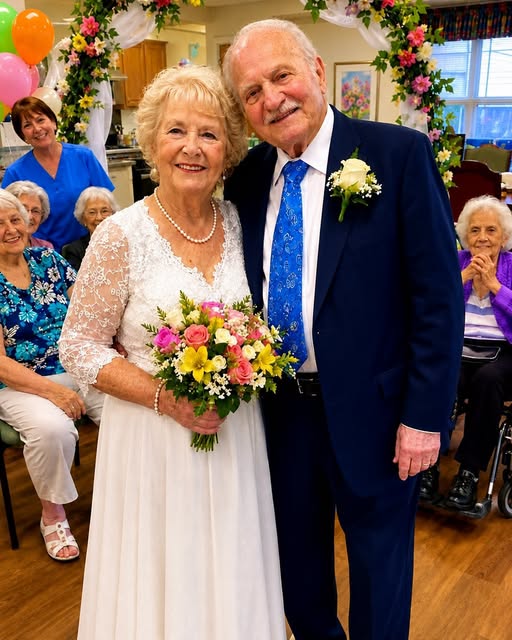
We Got Married Quietly
We didn’t have a large wedding.
There was no elaborate ceremony.
No newspaper announcement.
No expensive celebration.
A few close friends attended.
Arthur wore a dark suit.
I wore a simple blue dress.
When we exchanged rings, he squeezed my hand.
“I never thought I’d get another chance at this,” he whispered.
Neither did I.
Our marriage surprised many people.
Some residents at the facility congratulated us.
Others were skeptical.
A few people assumed I had married Arthur for his money.
That accusation hurt, but I learned not to spend my remaining years trying to convince everyone of my intentions.
Arthur knew why I married him.
I knew why I married him.
That was enough.
Life Together
Arthur eventually asked me to move into his suite.
The space felt enormous compared with the room I had been living in.
At first, I felt uncomfortable.
I was used to a modest life.
I didn’t need a private dining area or a balcony overlooking the gardens.
But Arthur didn’t care about those things.
He cared about having someone beside him.
Our life became surprisingly ordinary.
We had breakfast together.
We read books in the afternoon.
We watched old jazz performances on television.
Sometimes we sat outside without saying much at all.
There was comfort in the silence.
As his health declined, our days became slower.
He needed more assistance.
He tired easily.
Some days he didn’t feel like playing chess.
On those days, I read to him.
He especially enjoyed history books and biographies.
Sometimes he would fall asleep halfway through a chapter.
I would close the book and let him rest.
The Conversations About His Children
Arthur never stopped loving his children.
That was something I admired about him.
Even after difficult conversations, he rarely spoke about them with hatred.
“They’re still my children,” he would say.
“I can be disappointed in them without stopping loving them.”
That distinction became important.
He wanted boundaries, not revenge.
He wanted his children to understand that his money did not give them ownership of his life.
He also wanted them to know that he had not married me to punish them.
He had married me because he loved me.
Arthur made sure his legal documents were updated accordingly.
He also wrote personal letters to each of his children.
In those letters, he explained his decisions in his own words.
He didn’t insult them.
He didn’t accuse them of terrible motives.
He simply told them what he wanted and why.
His Final Months
Arthur’s condition gradually became more serious.
The doctors told us that his health was declining and that we should focus on comfort and quality of life.
We did.
Our world became smaller.
There were fewer trips outside.
More time in the room.
More conversations.
More memories.
One evening, we watched the sunset from the balcony.
Arthur held my hand.
“Do you regret marrying me?” he asked.
I laughed softly.
“Not for one second.”
He smiled.
“Good.”
Then he looked toward the horizon.
“I was afraid I’d spend my final years surrounded by people who wanted something from me.”
“You didn’t.”
“No,” he said. “I didn’t.”
Those were some of the last words we shared that evening.
The Day Arthur Died
Arthur died peacefully several weeks later.
I was beside him.
There was no dramatic scene.
No sudden revelation.
Just a quiet morning and the gradual realization that the man I loved was gone.
I held his hand for a long time afterward.
The room felt impossibly empty.
Despite everything, I knew I had been fortunate.
Arthur had given me two years I never expected to have.
I had given him companionship when he needed it most.
His children attended the funeral.
They were polite but distant.
I couldn’t blame them for grieving differently.
Still, I noticed the tension.
There were conversations that stopped when I entered the room.
There were looks exchanged between the siblings.
I suspected they were worried about their father’s estate.
I tried not to think about it.
The funeral was about Arthur, not his money.
The Visit From His Lawyer
A week after the funeral, Arthur’s longtime attorney asked to meet with me.
He arrived carrying a thin leather folder.
I invited him inside.
He sat across from me.
For several seconds, he didn’t say anything.
Then he placed an envelope on the table.
“I believe you should read this privately,” he said.
I looked at him.
“Is there a problem?”
“No.”
He paused.
“But there are things Arthur wanted you to understand after his death.”
My hands began to tremble.
“Is this about the will?”
“Partly.”
I opened the envelope.
Inside was a handwritten letter.
Arthur’s handwriting was immediately recognizable.
My eyes filled with tears before I had even finished the first paragraph.
He had written the letter months earlier.
He knew his health was declining.
He wanted me to read it only after his death.
What Arthur Had Written
Arthur explained that he knew there might be questions about our marriage.
He knew his children might believe I had influenced him.
He knew some people might assume that his wealth was the reason I stayed beside him.
So he wanted to make one thing clear.
He had made his decisions freely.
He had received independent legal advice.
He had updated his estate plan before and after our marriage.
He had deliberately separated his personal feelings from financial decisions.
Then he wrote something that made me cry.
He said that before meeting me, he had become afraid that the last years of his life would be defined by paperwork, arguments, and people discussing him as though he were already gone.
Meeting me had reminded him that he was still a person.
Not an estate.
Not an account.
Not a business interest.
Not an aging parent whose decisions could automatically be transferred to someone else.
A person.
At the bottom of the letter, he had written:
“I hope you never feel guilty for accepting the life we built together. I didn’t marry you because I was afraid of my children. I married you because I was grateful to have found love again.”
I had to stop reading.
The Part I Didn’t Expect
The lawyer waited patiently.
When I finally looked up, he explained that Arthur had created a carefully structured estate plan.
He had left me the right to remain in the residence for the rest of my life.
He had also provided funds for my continued care and living expenses.
But he had not disinherited his children.
Instead, he had divided the remainder of his estate among them according to a plan he had discussed with his attorney.
There was no secret fortune hidden from them.
There was no dramatic punishment.
There was no attempt to leave his children with nothing.
Arthur had simply wanted to ensure that I would not be left without a home or financial security after his death.
That was all.
The lawyer also told me something else.
Arthur had specifically instructed him to prevent unnecessary conflict.
If disagreements arose, the attorney was to remind everyone that Arthur had made these decisions voluntarily and with professional advice.
I felt relieved.
Not because I was receiving money.
Because Arthur had planned carefully enough that his family would not have to fight over basic questions.
His Children Came to See Me
Several days later, Arthur’s daughter came to visit.
I wasn’t sure what to expect.
She sat across from me with tears in her eyes.
“I owe you an apology,” she said.
I didn’t respond immediately.
She continued.
“I thought Dad had changed because of you.”
I told her he hadn’t.
“He changed because he was getting older,” I said. “And because he wanted to make his own decisions.”
She nodded.
“We were scared.”
I understood.
Losing a parent is frightening.
Realizing that a parent is aging can bring out fear, guilt, and confusion.
Sometimes adult children respond to that fear by trying to take control.
That doesn’t always make them cruel.
Sometimes it simply means they don’t know how to deal with what is happening.
Arthur’s daughter told me that she had been convinced I was going to inherit everything.
When I showed her the letter explaining Arthur’s wishes, she began crying.
“He wrote this?”
“Yes.”
She read it silently.
When she finished, she looked at me.
“He really loved you.”
“Yes.”
She nodded.
“I know that now.”
A Different Kind of Family
Over the following months, things became less tense.
Not perfect.
But better.
Arthur’s children still had questions about the estate.
The lawyer handled those questions.
I stayed out of the legal process as much as possible.
There was no reason for me to fight them.
Arthur had already made his decisions.
Eventually, his daughter and I began speaking occasionally.
His youngest son sent me a letter.
His oldest son called once to apologize for the way he had handled certain conversations while Arthur was alive.
I accepted the apologies.
Not because everything was forgotten.
But because carrying resentment for years would not bring Arthur back.
What the Envelope Really Gave Me
The envelope contained legal documents.
It contained Arthur’s letter.
It contained instructions.
But more importantly, it gave me something I had not expected.
Peace.
For months, I had worried that after Arthur’s death, people would question our marriage.
They might question my intentions.
They might assume I had manipulated him.
They might reduce our relationship to money.
Arthur had anticipated all of that.
He had protected me not only financially, but emotionally.
He had left behind his own explanation.
His voice was still there in those pages.
That meant more to me than anything else.
Looking Back
I sometimes sit beneath the same oak tree where Arthur and I first played chess.
The chessboard is still in my room.
I haven’t played since he died.
Maybe someday I will.
For now, I simply keep it nearby.
Arthur taught me something I wish more people understood about aging.
Growing older does not mean losing the right to make decisions.
Needing help does not mean surrendering independence.
Having money does not eliminate loneliness.
And having adult children does not mean every decision automatically belongs to them.
Families can disagree.
Parents can make choices their children don’t understand.
Adult children can become frightened when they see their parents becoming less independent.
All of those things can be true at the same time.
What matters is how people respond.
Arthur chose to communicate clearly.
He sought professional advice.
He documented his wishes.
He tried to protect the people he loved without turning his final years into a battle.
And he chose companionship.
That was what our marriage really represented.
Not wealth.
Not inheritance.
Not a fight against his children.
It represented two older people finding comfort in one another when neither expected to find it again.
The Final Lesson Arthur Left Me
A few months after his death, I finally returned to the chessboard.
I placed the pieces on the table.
For a moment, I imagined Arthur sitting across from me.
I could almost hear him saying, “You’re going to regret that move.”
I smiled.
Then I made the first move.
Arthur’s children still visit me occasionally.
His daughter sometimes brings photographs.
His youngest son calls around holidays.
We don’t pretend the past never happened.
But we have learned to speak about Arthur without arguing about what he wanted.
His wishes were clear.
He wanted his family to remain a family.
He wanted me to be secure.
And he wanted the people around him to remember that he had been more than his money.
I think that was the real message hidden inside the envelope.
Arthur wasn’t asking anyone to choose sides.
He wasn’t trying to punish his children.
He wasn’t trying to create a final family dispute.
He simply wanted his final decisions to be respected.
And in the end, that is what happened.
I was his wife.
His children were still his children.
And his final chapter belonged to him.
Sometimes, the greatest gift someone can leave behind isn’t money or property.
Sometimes it’s the certainty that, until the very end, you were seen, heard, respected, and loved for who you were.
Arthur gave me that gift.
And I will always be grateful.