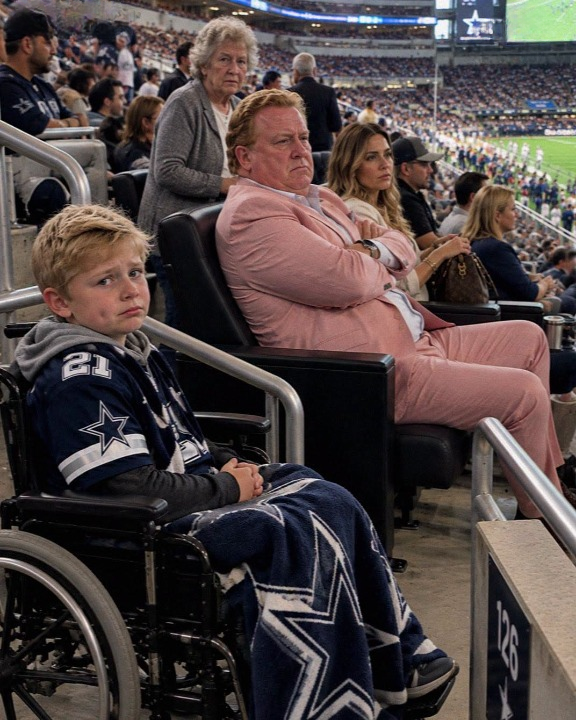
My eleven-year-old son, Caleb, had been counting down to the football game for four months.
Every morning, he would ask how many days were left.
Every evening, he would check the tickets again.
Sometimes he would talk about the players he hoped to see.
Other times, he simply imagined what it would be like to experience a real game from inside the stadium instead of watching from our living room.
For Caleb, the day meant much more than football.
It represented something he had been looking forward to ever since his life changed.
Six months earlier, Caleb had been walking home from school when he noticed a young child chasing a ball toward the street.
A vehicle was approaching.
Without thinking about his own safety, Caleb rushed toward the child and managed to move him out of the way.
The younger boy reached safety.
Caleb did not.
He suffered a serious spinal injury and spent weeks recovering in the hospital.
There were surgeries, rehabilitation appointments, difficult days, and plenty of uncertainty.
The doctors couldn’t tell us exactly what his future would look like.
For a child who had always been active, the change was enormous.
Before the accident, Caleb had played football since he was six.
He loved practicing with his friends.
He loved watching matches.
He loved talking about teams and players.
Suddenly, everyday activities became difficult.
Getting around school required planning.
Going places required accessibility considerations.
Even simple family outings became more complicated.
But Caleb rarely complained.
One afternoon, while we were sitting together at home, he looked at me.
“If I hadn’t helped that little boy, he might have been hurt,” he said.
I told him he had done something incredibly brave.
Then he smiled.
“I’d do it again.”
That was Caleb.
He didn’t want people to feel sorry for him.
He wanted to keep living his life.
And one thing he desperately wanted was to attend a football game in person.
“Mom, do you think we could ever go?”
I promised that I would try.
The problem was the cost.
Tickets weren’t cheap, and accessible seating had to be planned carefully because Caleb needed enough room for his wheelchair.
I began putting money aside whenever I could.
I skipped small purchases.
I brought lunch from home instead of buying food at work.
I sold an old bracelet that I had kept in a drawer for years.
Little by little, the savings grew.
Finally, I had enough.
I purchased two accessible seats close enough to the field that Caleb would have a clear view.
When I showed him the tickets, his face lit up.
He held them carefully as though they were something priceless.
For the next four months, the game became our shared countdown.
Then the day finally arrived.
We arrived at the stadium with plenty of time to spare.
The moment we entered, Caleb looked around in amazement.
He could hear the crowd.
He could see the field.
He could smell the freshly cut grass.
“Mom,” he said, smiling, “I can actually smell the grass from here.”
I laughed.
“I told you it would be special.”
We made our way toward our section.
But when we reached our row, I stopped.
Two people were already sitting in our seats.
One of them had placed a large bag in the space intended to provide additional room for wheelchair access.
I checked the ticket on my phone.
Then I looked at the seat number.
There was no mistake.
These were our seats.
I politely approached the pair.
“Excuse me,” I said. “I believe you’re in our seats.”
The man looked at the tickets in my hand.
Then he looked at the seat numbers.
Instead of immediately moving, he said that he had a better view from there and suggested that we find another place.
I explained that the seats had been specifically purchased for Caleb because of his wheelchair.
He looked toward my son.
Then he shrugged.
“I’m sure you can find somewhere else.”
I tried to remain calm.
“I don’t think you understand. These are designated accessible seats, and my son needs the space.”
The man’s response was dismissive.
He said he had paid for his own ticket and wanted to enjoy the game from that location.
I looked around.
There were plenty of people nearby, but nobody seemed to know what was happening.
Caleb quietly tugged at my sleeve.
“Mom.”
I looked down.
“It’s okay.”
I knew immediately that it wasn’t okay.
Not because of the seats alone.
Because I could see the disappointment on his face.
He had spent months looking forward to this day.
He had worked incredibly hard through rehabilitation.
He had faced changes that no eleven-year-old should have had to navigate.
And now, after all that effort, he was prepared to give up his seat rather than cause a scene.
“We can watch from somewhere else,” he whispered.
My heart sank.
I told him we weren’t leaving.
I called for an usher and showed them our tickets.
While we waited, a voice came from the row behind us.
“Please give them their seats.”
The voice was calm.
I turned around.
An elderly woman was sitting several rows behind us.
She wore a simple gray cardigan and had a small, old-fashioned metal lunchbox resting on her knees.
She didn’t look angry.
She didn’t raise her voice.
She simply looked at the man and repeated herself.
“Those seats belong to them.”
The man turned around.
“I don’t think this concerns you.”
The woman smiled gently.
“Perhaps it does.”
He shook his head.
“We’re here to watch the game.”
“So are they.”
There was something about the woman’s calmness that made the conversation pause.
The usher arrived shortly afterward.
After checking the tickets, the usher confirmed what we already knew.
The seats were ours.
The pair would need to move.
The situation should have ended there.
But the elderly woman remained standing.
She lifted the small lunchbox.
“I have something I’d like you to see.”
The man looked confused.
“What is it?”
“Open it.”
He laughed nervously.
“Why?”
“Because I think you might understand something after you do.”
He looked at the lunchbox.
For a moment, he didn’t move.
Then curiosity got the better of him.
He took it from her and opened the latch.
His expression changed almost immediately.
The amusement disappeared.
He stared into the box.
I couldn’t see what was inside from where I stood.
The woman said nothing.
The man slowly lowered himself into his seat.
Then he looked at Caleb.
His expression was completely different now.
“What is this?” I asked.
The elderly woman looked at me.
“Something I’ve carried with me for many years.”
She opened the lunchbox wider so I could see.
Inside was an old photograph, carefully protected in a plastic sleeve.
There was also a faded hospital wristband and a small handwritten note.
I looked at the photograph.
It showed a young boy sitting in a wheelchair at a football stadium.
The woman explained that the boy had been her grandson.
Years earlier, he had also depended on accessible seating.
He had loved football just as much as Caleb did.
But her family had once faced a similar situation when other spectators didn’t understand why those spaces were necessary.
The boy had eventually told his grandmother something she never forgot.
“He said he didn’t want people to feel sorry for him,” she explained. “He only wanted them to understand that everyone deserves a chance to enjoy the things they love.”
The man holding the photograph became quiet.
The woman continued.
“That photograph reminds me that an accessible seat isn’t simply a good location. For some families, it can determine whether they can participate at all.”
The man looked down.
Then he looked at Caleb.
“I owe you an apology.”
Caleb looked surprised.
The man stood and moved away from the seats.
His companion followed.
There was no argument.
No shouting.
No dramatic confrontation.
Just a quiet acknowledgment that he had made the wrong choice.
The usher helped us settle into our seats.
I positioned Caleb comfortably.
He looked toward the field.
His smile slowly returned.
“Mom,” he whispered.
“What?”
“We’re actually here.”
I smiled.
“Yes, we are.”
The game began a few minutes later.
The stadium erupted with excitement.
Caleb watched every play.
He cheered.
He laughed.
He asked questions.
At one point, he turned toward me and said, “This is even better than I imagined.”
I looked at him and felt tears forming in my eyes.
Not because I was thinking about everything we had lost.
But because I was watching my son experience something he had worked so hard to reach.
During halftime, the elderly woman came over.
She introduced herself and told us a little more about her grandson.
She said she had carried the lunchbox for years because it contained reminders of the values he had taught her.
“Kindness isn’t always about doing something enormous,” she said. “Sometimes it’s simply recognizing when someone else needs a little consideration.”
I thanked her.
Caleb thanked her too.
Then he asked if he could see the photograph again.
She smiled and showed it to him.
He studied the picture carefully.
“Did he like football?”
The woman’s face brightened.
“He loved it.”
Caleb smiled.
“Me too.”
They talked for several minutes.
It was one of the sweetest conversations I had witnessed in a long time.
The man who had taken our seats never returned to cause another problem.
Later, I saw him standing near the entrance.
He approached us once more.
“I’ve been thinking about what she said,” he told me.
Then he looked at Caleb.
“I’m sorry I made your day more difficult.”
Caleb nodded.
“It’s okay.”
The man smiled.
“Enjoy the game.”
And he walked away.
That moment stayed with me.
The elderly woman hadn’t embarrassed him.
She hadn’t insulted him.
She hadn’t tried to make him feel small.
She simply gave him a chance to see the situation from another perspective.
Sometimes, that is enough to change someone’s behavior.
The rest of the game was wonderful.
Caleb talked about it for days afterward.
He remembered the players, the crowd, the atmosphere, and especially the elderly woman with the old lunchbox.
But I think the most important lesson wasn’t about football.
It was about accessibility.
Accessible spaces exist for a reason.
They allow people with disabilities and their families to participate in everyday experiences that many others take for granted.
A wheelchair doesn’t mean someone should have fewer opportunities to enjoy a game, concert, school event, or public space.
And asking for an accessible seat isn’t asking for special treatment.
It’s asking for reasonable access.
That day also reminded me that people don’t always understand circumstances they haven’t personally experienced.
The man who initially took our seats may not have understood what those spaces meant to our family.
But after seeing the photograph and hearing the story, he saw things differently.
And that was enough to change his behavior.
As for Caleb, he came home with a new favorite memory.
He still talks about that football game.
He still remembers the smell of the grass.
He still remembers the crowd cheering.
And he still remembers the little metal lunchbox.
Whenever he talks about it, I smile.