Two years after losing my husband, Mark, to cancer, I had learned to recognize the little things that kept our family connected to him.
For my nine-year-old son, Mason, those memories often came in the form of tools.
His father had been a carpenter. Before his illness became too difficult, Mark had spent countless hours teaching Mason the basics of woodworking. He showed him how to hold a measuring tape, smooth a rough piece of wood, and carefully drive a screw without damaging the board.
Whenever Mason helped me around the house, he repeated one of his father’s favorite lessons.
“Build things people actually need.”
Those words stayed with him.
They also became important in a way none of us expected.
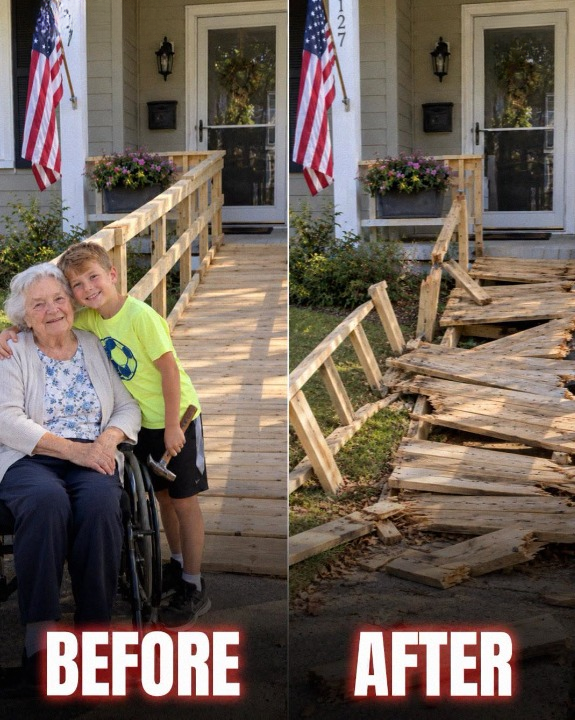
A few houses away lived an elderly woman named Mrs. Bennett. She lived alone and used a wheelchair to get around. Although she was independent in many ways, leaving her home had become increasingly difficult.
Mason noticed.
He always noticed things like that.
Whenever he saw Mrs. Bennett struggling with her groceries, he would offer to carry them. He helped move her trash cans back from the curb and sometimes sat with her outside while she told him stories about her younger years.
She had once worked as an Army nurse during the Vietnam era, and Mason loved listening to her stories.
There was one thing he didn’t understand, though.
Mrs. Bennett almost never left her house.
One afternoon, Mason finally asked her about it.
She looked toward the three steps leading from her front porch to the lawn.
“Those might as well be a mountain,” she told him.
Mason didn’t say much after that.
But I could tell he was thinking.
Mason Gets an Idea
That evening, while we were eating dinner, Mason asked me whether he could use some of his father’s leftover lumber.
I asked what he wanted to build.
“A ramp for Mrs. Bennett.”
I wasn’t sure at first.
Mason was only nine. Building a safe wheelchair ramp isn’t the same as making a small shelf or birdhouse. It requires careful planning and appropriate construction.
So we talked about it.
We agreed that I would supervise him, help with the difficult parts, and make sure the project was safe and appropriate.
Mason was thrilled.
For the next several days, our driveway became a little workshop.
Mason measured boards, sanded rough surfaces, sorted screws, and carefully marked pieces of lumber with his pencil. I helped him with the tasks that required an adult, while he handled as much of the project as he safely could.
Every evening, he looked at the unfinished ramp and imagined Mrs. Bennett using it.
He wasn’t interested in how it looked.
He was interested in whether it would help.
Eventually, the project was finished.
It wasn’t fancy.
It wasn’t professionally decorated.
But it gave Mrs. Bennett a practical way to get from her porch to the yard.
The first time she used it, something happened that I will never forget.
She slowly rolled down the ramp and stopped beneath her maple tree.
She looked around the yard for several seconds.
Then she began to cry.
Mason stood beside her with the biggest smile I had seen on his face.
For the first time in a long time, Mrs. Bennett could sit outside her own home without worrying about the steps.
She thanked Mason repeatedly.
He simply shrugged.
“Dad said we should build things people need,” he replied.
Mrs. Bennett smiled through her tears.
For a moment, everything felt perfect.
Then our neighbor arrived.
The Neighbor’s Objection
The woman who lived next door was named Tiffany. She worked as a realtor and was frequently showing properties in the neighborhood.
When she noticed the new ramp, she stopped near the sidewalk and stared at it.
Her expression wasn’t exactly welcoming.
She complained that the structure affected the appearance of the property.
I calmly explained that the ramp was located on Mrs. Bennett’s property and had been built to help her access her own yard.
Tiffany wasn’t convinced.
She said she was concerned about how the neighborhood looked to prospective buyers.
I understood that everyone has different opinions about property appearance, but this wasn’t simply a decorative structure.
It served a purpose.
Mrs. Bennett needed it.
Mason happened to be nearby and heard the conversation.
I could see that he was upset, but he didn’t argue.
Instead, he quietly walked inside.
That evening, I found him looking at some of the photographs of his father.
He asked whether he had done something wrong.
I told him he hadn’t.
His project had been created out of kindness, and that was something he should never be ashamed of.
I thought the disagreement would end there.
I was wrong.
The Ramp Was Suddenly Gone
The following morning, Mason went outside before breakfast.
Within seconds, I heard him calling my name.
Then he started crying.
I ran outside.
The ramp had been severely damaged.
Several boards were broken, one of the railings had been removed, and pieces of wood were scattered across the ground.
One of the broken boards still had Mason’s pencil measurements on it.
He stared at the pieces in silence.
For him, it wasn’t just lumber.
It represented something his father had taught him.
It represented the time we had spent building something for another person.
And now it was lying in pieces.
Mrs. Bennett remained near her doorway, unable to use the steps safely.
Mason was devastated.
I was angry too, but I knew that the situation needed to be handled responsibly. Instead of making assumptions about who was responsible, I documented the damage and began looking into what had happened.
Tiffany was nearby that morning.
When I asked her about the damaged ramp, she made a dismissive comment about the neighborhood looking better without it.
That response only made the situation more confusing.
Mason didn’t understand why something meant to help someone could become a source of conflict.
I didn’t have a good answer.
An Unexpected Morning
That night was difficult.
Mason kept asking whether Mrs. Bennett would be able to use the yard again.
I promised him we would figure something out.
The next morning, however, something unusual happened.
Just after breakfast, a large black SUV pulled up outside Tiffany’s house.
Then another followed.
A third vehicle arrived moments later.
Several professionally dressed people stepped out.
Nobody in our family knew who they were.
The activity immediately attracted attention from the neighborhood.
Tiffany opened her front door.
At first, she looked pleased to see the visitors.
One of the men spoke with her for a moment.
Then another person handed her a large red document box.
Tiffany opened it.
Her expression changed almost immediately.
The confidence disappeared from her face.
She began reading through the papers inside.
Then she looked up.
“What is this?” she asked.
The man calmly explained something to her.
I couldn’t hear every word from where I stood.
But I could see Tiffany becoming increasingly concerned.
She shook her head.
“This can’t be right.”
The man remained composed.
He pointed toward the documents.
Tiffany continued reading.
Then she looked across the street toward Mrs. Bennett’s house.
Her expression had completely changed.
The Mystery Behind the Documents
At that point, none of us knew what was inside the box.
We could only speculate.
Perhaps it was related to the damaged ramp.
Perhaps it concerned the property.
Perhaps there was some other issue involving the neighborhood that we knew nothing about.
I didn’t want to jump to conclusions.
But one thing was becoming clear.
Whatever those documents contained, Tiffany hadn’t expected them.
Mrs. Bennett watched from her doorway.
Mason stood beside me.
He whispered, “Mom, do you think they know about the ramp?”
I told him I didn’t know.
A few minutes later, the visitors left Tiffany’s property.
The SUVs remained parked outside for a short time before eventually driving away.
Tiffany stayed inside.
For once, there was no argument and no confrontation.
Just silence.
What Happened Next
Later that day, we learned more about the situation.
The people who had visited were representatives handling a property and legal matter connected to the neighborhood.
The documents raised questions about responsibilities and permissions that had not previously been clear to everyone involved.
Most importantly, the incident prompted the damaged ramp to receive proper attention.
Instead of continuing an argument between neighbors, the matter was addressed through the appropriate channels.
A safe solution was arranged for Mrs. Bennett.
Mason watched the process carefully.
He didn’t care about the disagreement anymore.
He cared about one thing.
He wanted Mrs. Bennett to be able to get outside again.
When the work was finally completed, Mrs. Bennett rolled into her yard and stopped beneath the maple tree.
Mason smiled.
She reached for his hand.
“You built the first one,” she told him. “You helped people understand why this mattered.”
Mason looked down at the ground.
Then he smiled.
A Lesson Mason Will Never Forget
The experience taught all of us something.
A community isn’t simply a collection of houses.
It’s made up of people.
Some people care deeply about appearances. Others care more about practical needs. Sometimes those priorities can conflict.
But kindness shouldn’t be dismissed simply because it isn’t fashionable or because it doesn’t fit someone’s idea of perfect curb appeal.
Mason had started his project with leftover lumber, his father’s old lessons, and a simple desire to help someone who needed it.
He didn’t build the ramp to impress anyone.
He built it because Mrs. Bennett had told him that the steps felt like a mountain.
And at nine years old, he understood something that adults sometimes forget.
If you can make someone’s day a little easier, why wouldn’t you?
The Memory of Mark Lives On
For me, the most meaningful part of the entire experience wasn’t the disagreement with Tiffany or the unexpected arrival of the SUVs.
It was seeing my husband’s lesson continue through our son.
Mark had spent years working with his hands.
He believed that building something useful was one of the simplest ways to make a difference.
Mason remembered that.
Even after his father was gone, the lesson remained.
Every time he picks up a tape measure, every time he sands a piece of wood, and every time he asks whether something can be repaired instead of thrown away, I see a little bit of his father in him.
And now, whenever we pass Mrs. Bennett’s house and see her sitting beneath the maple tree, I think about how a small project became a much bigger lesson.
It reminded our family that helping someone doesn’t require fame, money, or recognition.
Sometimes, it starts with a nine-year-old boy, a few pieces of leftover lumber, and a simple belief that the things we build should serve a purpose.
That is a lesson worth carrying forward.