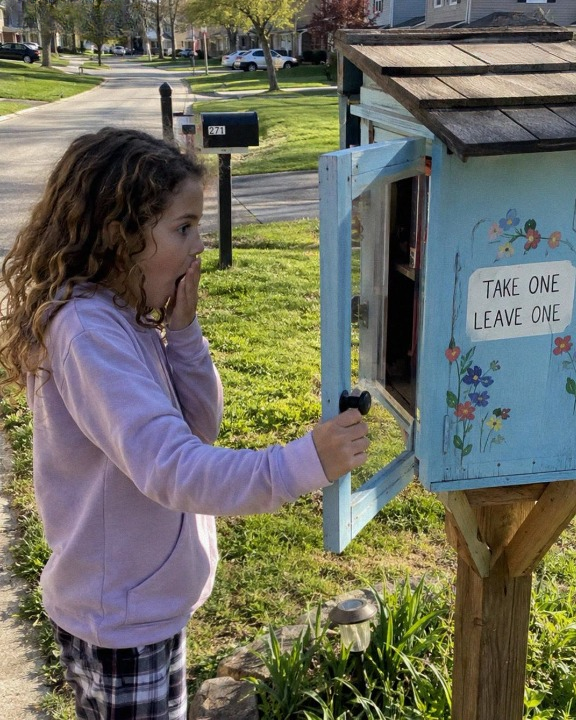
At exactly 6:42 yesterday morning, my eleven-year-old daughter screamed my name from the front yard so loudly that I nearly dropped my coffee.
“Mom! Come here! You have to see this!”
I was halfway through my first sip, still trying to wake up, when I heard her shout again.
“MOM!”
Something about her voice made me put the mug down immediately.
I hurried toward the front door.
Considering Carly had spent the entire previous day treating the little wooden library she had built like the grand opening of a major public institution, my first thought was that somebody had damaged it.
Maybe a storm had knocked it over.
Maybe someone had left the door open.
Or perhaps one of the neighborhood kids had accidentally broken something.
I stepped outside.
Carly was standing beside the little library in her pajama pants and an oversized sweatshirt that belonged to her father.
She wasn’t crying.
She wasn’t injured.
She was simply staring through the tiny glass door.
“What happened?” I asked.
She pointed.
“Look.”
I walked closer.
At first, everything appeared normal.
The little blue library was still standing.
The yellow roof was intact.
The tiny wooden sign above the door was still there.
TAKE A BOOK. LEAVE A BOOK.
Carly had painted those words herself.
Underneath, in smaller letters, she had written:
PLEASE DON’T TAKE THE SHELF.
When I asked her why she had included that message, she had shrugged.
“People are weird.”
Now, however, she wasn’t smiling.
Several books had been pushed toward the sides of the bottom shelf.
There was a strange empty space in the middle.
Something was sitting at the very back.
I couldn’t see what it was.
“Did you put something in there?” Carly asked.
“No.”
“Dad?”
“He is still asleep.”
She looked at me.
Then she reached for the little latch.
“Carly, wait.”
But she had already opened the door.
She crouched down.
Her eyes widened.
Then she gasped.
“What is it?” I asked.
She didn’t answer.
I stepped closer and looked inside.
And my stomach dropped.
There was a small envelope sitting behind the books.
It wasn’t one of Carly’s envelopes.
It wasn’t something I recognized.
And written across the front in neat handwriting were four words:
For the person who finds this.
Carly looked at me.
“Is it a letter?”
“I think so.”
“Should we open it?”
I hesitated.
The obvious answer was no.
It didn’t belong to us.
But the envelope had been deliberately placed inside a community library, where anyone could have found it.
Before I could decide what to do, Carly noticed something else.
There was a second envelope underneath the first.
And a third.
All three were labeled with different messages.
Please read.
For a neighbor.
If you need a little hope.
Carly looked fascinated.
“Mom…”
“I know.”
She carefully picked up the first envelope.
Then she stopped.
“Maybe whoever put these here wants someone to read them.”
I wasn’t convinced.
But before we could discuss it further, the sound of the front door opening made us turn around.
My husband, Dean, stepped onto the porch.
“What’s going on?”
Carly pointed toward the library.
“Someone left letters.”
Dean walked over.
He examined the envelopes without touching them.
“Do you know who?”
“No,” I said.
Carly looked up at us.
“What should we do?”
Dean thought for a moment.
“Maybe read the first one.”
So Carly carefully opened the envelope.
Inside was a handwritten note.
It wasn’t long.
It simply said:
“If you’re reading this, you probably found this little library because you needed something. Maybe you need a book. Maybe you need encouragement. Maybe you just needed a reason to stop and smile for a minute.
Whatever brought you here, I hope today gets a little easier.
Take what you need.
And when you’re able, leave something kind behind for the next person.”
Carly read it twice.
Then she looked at me.
“That’s nice.”
“It is.”
She carefully folded the note.
“Who wrote it?”
“I don’t know.”
We opened the second envelope.
This one contained a different message.
It was written by someone who said they had recently moved into the neighborhood and felt completely alone.
They explained that they had been having trouble adjusting to a new city.
Then, one afternoon, they noticed Carly’s little library.
They hadn’t taken a book.
Instead, they had stood there for several minutes reading the handwritten sign.
They wrote that it reminded them that small things could still bring people together.
Carly’s eyes became wide.
“Someone actually noticed my library.”
“Apparently.”
She smiled.
Then we opened the third envelope.
This one was different.
It contained a child’s drawing.
There was a picture of a blue house, a yellow sun, and a little wooden library beside a mailbox.
Underneath, a child had written:
Thank you for making this.
Carly stared at the picture.
“Who’s this from?”
“I don’t know.”
She immediately wanted to find out.
That was when I realized something.
The library had only been open for one day.
And already, it had become more than a place to exchange books.
It had become a place where people were leaving pieces of themselves.
The story of Carly’s little library had started several weeks earlier.
She had come home from school one afternoon and announced that our neighborhood had a “serious reading problem.”
I had asked what she meant.
She explained that she had seen a free community library in another neighborhood and thought our street needed one.
Carly has always loved books.
She brings novels to family gatherings in case she gets bored.
She once read the instruction manual for our vacuum cleaner because she couldn’t find anything else interesting.
She keeps books beside her bed, on her desk, in the car, and sometimes in the kitchen.
So when she decided she wanted to build a little library, none of us were surprised.
My husband had an old kitchen cabinet sitting in the garage.
Carly immediately claimed it.
For two weekends, she sanded it, painted it, and decorated it.
Dean helped her attach it to a sturdy post beside our mailbox.
She chose pale blue for the walls and bright yellow for the roof.
She added the sign.
She even painted tiny flowers around the door.
At one point, our dog stepped into the yellow paint.
He left a paw print near the bottom.
Carly refused to cover it.
“That’s the logo now,” she announced.
When the library finally opened, she filled it with books she had outgrown.
I added several books from my own shelves.
Dean contributed a few novels.
Then something wonderful happened.
Our neighbors started participating.
One person brought mystery novels.
Another brought children’s books.
Someone else added cookbooks.
A little boy riding a scooter stopped, traded a dinosaur book for a book about planets, and rode away smiling.
Carly watched from the window.
“He used it correctly,” she whispered proudly.
That evening, she checked the library several times.
Before bed, she made me promise that I wouldn’t look inside the following morning until she had inspected it herself.
I promised.
Sometime after midnight, our dog barked once.
Just once.
I heard his collar move downstairs.
Then everything became quiet again.
I didn’t think much of it.
But now, standing beside the library and holding those mysterious notes, I wondered if someone had visited during the night.
Carly wanted to know who.
We decided to ask around without making assumptions.
Later that morning, Carly posted a message in the neighborhood group.
She didn’t mention the letters in detail.
She simply wrote that someone had left some encouraging notes in the library and that she hoped whoever had written them would eventually come forward.
Within an hour, people started responding.
One neighbor said they had seen someone walking near our house late the previous evening.
Another said their teenage son had noticed an older man looking through the library.
But none of those clues gave us a definite answer.
Then, around lunchtime, there was a knock at our door.
Carly ran to answer it.
Standing outside was a woman named Mrs. Bennett, who lived three houses away.
She was holding a small stack of books.
“I heard about the notes,” she said.
Carly immediately invited her inside.
Mrs. Bennett smiled.
“I didn’t write them.”
Carly’s shoulders dropped.
“But I might know who did.”
She explained that her elderly father had recently moved into a nearby care community.
He had always loved reading and writing.
Over the years, he had kept dozens of journals filled with short reflections, poems, and encouraging messages.
According to Mrs. Bennett, he had noticed Carly’s library during one of his walks.
“He told me he loved the idea,” she said.
“He said a neighborhood should have places where people can leave something good behind.”
Carly’s eyes widened.
“Did he write the letters?”
Mrs. Bennett smiled.
“I think so.”
She handed Carly one of the books.
“Would you like to meet him?”
Carly didn’t hesitate.
“Yes.”
That afternoon, we visited Mrs. Bennett’s father.
He was sitting near a window with a book in his lap.
When Carly introduced herself, his face brightened.
“So you’re the librarian.”
Carly laughed.
“It’s not really a library.”
He shook his head.
“It is if people find something they need there.”
Carly told him about the letters.
He admitted that he had written them.
He said he didn’t want attention.
He simply wanted to leave something positive for whoever happened to find them.
“I thought your little library was a beautiful idea,” he told her. “Books have a funny way of connecting people who might otherwise never meet.”
Carly thought about that.
Then she asked him a question.
“Can we keep doing the letters?”
He smiled.
“Of course.”
From that day forward, something changed in our little neighborhood.
People started leaving more than books.
Someone began leaving handwritten recommendations.
Another person added bookmarks.
A child started drawing pictures for whoever found them.
Someone left a note that simply said, “Have a good day.”
Another said, “You’re doing better than you think.”
Nobody knew exactly where the messages would end up.
That was the beauty of it.
They weren’t addressed to specific people.
They were meant for whoever happened to need them.
And Carly began adding her own messages too.
She would occasionally place a little card inside the library.
Sometimes it said:
“Keep reading.”
Sometimes:
“Try something new.”
And once, she wrote:
“Don’t forget that small things can matter.”
Watching her taught me something I hadn’t expected.
We often imagine that making a difference requires something enormous.
A major donation.
A huge project.
A dramatic act of kindness.
But sometimes, making a difference can begin with an old cabinet, a few cans of paint, and a child who thinks her neighborhood needs more books.
Carly’s little library didn’t solve every problem.
It didn’t change the world overnight.
But it gave people a place to stop.
A place to exchange something.
A place to leave a kind word.
And perhaps most importantly, it reminded everyone that small gestures can travel farther than we realize.
That mysterious discovery at 6:42 that morning could have been nothing more than a few envelopes.
Instead, it became the beginning of something our entire neighborhood now looks forward to.
And every time I walk past that little blue library and see someone opening the door, I remember what Carly said on the day we built it.
“This neighborhood just improved.”
She may have been right.
Sometimes all it takes is one small idea to remind people that a community is made stronger when everyone has something to give.