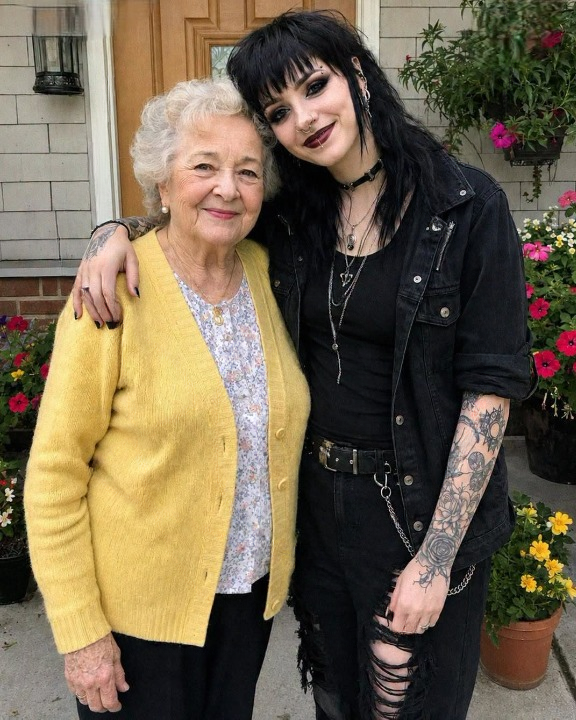
Maeve noticed the striking contrast the moment Raven first appeared on their porch. Clad in heavy black clothing, intricate tattoos, and striking facial piercings, the young goth woman looked entirely out of place in seventy-three-year-old Doris’s quiet suburban home, which was usually dedicated to morning gardening and peaceful book club meetings. Yet, every Saturday, Raven arrived for tea at the kitchen table. They sat together, talking in hushed tones, and occasionally asked Maeve to step out of the room because their conversations were strictly private.
Naturally, Maeve felt displaced and deeply suspicious, a tension amplified whenever she caught sight of a mysterious wooden box that Doris kept covered with a small kitchen towel. But as the weeks passed, Maeve noticed a profound shift: her mother looked lighter, happier, and genuinely revitalized after each Saturday visit. Reluctantly, Maeve decided to stop questioning an unlikely bond that brought her mother such evident joy. Months later, however, tragedy struck when Doris suffered a sudden, fatal stroke, leaving the household paralyzed by grief and plagued by unanswered questions about those weekly private sessions.
Following the funeral, while guests milled about quietly, Raven approached Maeve. With swollen eyes and a solemn expression, she pressed a small, cold brass key into Maeve’s palm. Doris had given strict instructions: this key was to be handed over only after her death. Raven offered no immediate explanations, saying simply that she had known a completely different, hidden side of Doris that Maeve had never seen, and warning her not to hide the key away in some forgotten drawer.
The key fit a small brass lock on the wooden box Maeve had so often seen covered with a towel. Inside lay a trove of handwritten cards, unsent letters, and painful proof of Doris’s decades-long estrangement from her sister, Elaine. Doris had written letter after letter over the years but had never found the courage to mail them. Raven understood this paralysis intimately because she, too, was estranged from her own mother. The two women had bonded over their shared stubbornness, encouraging each other to bridge the gaps in their respective families.
Every Saturday, Raven had gently pushed Doris to finally reach out to Elaine. In return, Raven had found the courage to call her own mother. Their friendship blossomed from mutual vulnerability and the painful realization that waiting for the “perfect” words is often just another clever guise for avoidance. Doris found it infinitely easier to confess her deep-seated fears to a stranger who had not spent years watching her stubbornly refuse reconciliation.
As Maeve sorted through the box, a jarring revelation came to light. Years earlier, Elaine had reached out to ask whether Doris ever mentioned her. Weary of the lingering tension and caught in the middle, Maeve had taken the easiest path, giving a dismissive answer that allowed Elaine to believe Doris no longer cared. When Elaine now learned about the stack of unsent cards, she realized with stinging clarity that Maeve’s old dishonesty had helped preserve the damaging silence. Deeply hurt and angry, Elaine left before they could begin to mend the fracture.
While placing the letters back into the wooden box, Maeve discovered one final, unmailed envelope bearing Elaine’s name. She was tempted to open it, but recognized that prying would only continue the cycle of interference. Instead, she drove to Elaine’s home, confessed without excuses that she had always known Doris missed her, and accepted responsibility for her past interference. Maeve demanded no forgiveness and pressured her aunt in no way; she simply handed over the envelope where it belonged and stepped back.
Three weeks later, Elaine returned to Doris’s kitchen table. The letter inside revealed a raw confession: Doris had spent years waiting until she knew precisely what to say, only to realize that waiting itself was the poison that kept them apart. She had missed her sister every single day of the separation. While the message could not resurrect the decades they had lost, it shattered the false belief that love had ever disappeared.
Slowly, Maeve and Elaine began the delicate work of rebuilding their relationship. Raven remained a vital part of their story—not as a mysterious interloper who tried to replace a daughter, but as a compassionate catalyst who gave Doris a safe space to confront her fears. What had initially seemed like an jarring mismatch of styles had hidden profound patience, loyalty, and empathy.
The brass key ultimately opened far more than a decorative wooden box. It exposed the heavy toll of convenient lies and demonstrated how lingering silence can calcify into an unintended family tragedy. Doris passed away before she could speak the words aloud to Elaine, but her final message forced Maeve to stop managing other people’s lives and start facing the truth. True healing finally began when each woman took accountability for her own choices. For Maeve, the hardest pill to swallow was learning that protective silence and selfish avoidance look identical from the inside—and that true love requires letting go of control and letting others make their own decisions.