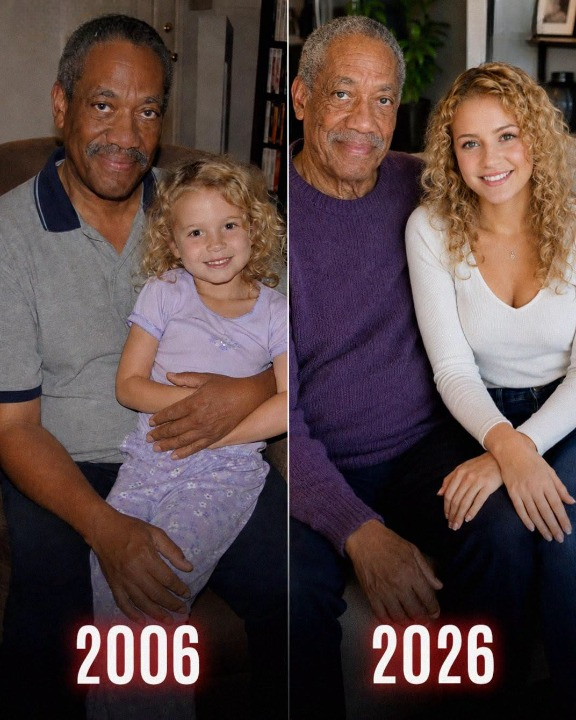
At seventy years old, my life is mostly measured in quiet afternoons, the steady ticking of the grandfather clock in the hallway, and the fading photographs that line my mantle. But twenty years ago, my world didn’t just change—it was utterly obliterated in the span of a single icy heartbeat.
It was the week before Christmas. My son, his loving wife, and their two wonderful children—Emily, who was just five years old, and her older brother—had spent the evening at my home. We had exchanged gifts early because a massive winter storm was forecasted to slam into the region by morning. They packed up their sedan around nine o’clock, laughing as they strapped the kids into the backseat, waving goodbye through the falling snow.
They never made it home.
Less than two miles down our isolated country road, their car skidded on a patch of black ice hidden beneath fresh powder, drifted off the shoulder, and slammed head-on into a dense row of ancient oak trees.
When the local sheriff knocked on my door at 3:00 AM, the cold air rushing into my hallway felt like physical blows. By dawn, I learned the devastating truth: my son, his wife, and my grandson had all perished instantly upon impact.
The only survivor was five-year-old Emily.
Doctors called her survival a medical miracle. The responding police officers called it a freak stroke of luck. Our local pastor repeated the word “miracle” from the pulpit as he stood before three closed caskets during a funeral service that felt infinitely too long and entirely too cruel.
Emily had suffered a severe concussion, multiple broken ribs, and deep, purple contusions across her chest from the frantic pull of her seatbelt. When she finally woke up in the hospital room, doctors gently questioned her about the moments leading up to the crash. She remembered almost nothing. They explained to me that psychological trauma and head injuries often shroud terrifying events in fog. They urged me to protect her mind, advising me never to interrogate her or force her to piece together memories she wasn’t ready to handle.
So, I buried my family, packed up my son’s house, brought five-year-old Emily home to my modest house, and learned how to become a full-time father all over again as I was rapidly approaching my fiftieth birthday.
Raising Emily in the Shadow of Grief
We rarely talked about the crash. How could we? The grief was a heavy, suffocating blanket that draped over every birthday, every holiday, and every quiet Sunday morning.
When little Emily occasionally asked why her parents and brother weren’t coming home, I swallowed the sharp lump in my throat and gave her the gentlest, safest truth I could manage.
“It was a terrible accident, sweetheart,” I would tell her, stroking her hair as she buried her face in my sweater. “A bad winter storm. The roads were too slick. Nobody was to blame.”
She always accepted it quietly, her big eyes reflecting a maturity no child should ever possess.
The years marched on relentlessly. Emily blossomed into a remarkably kind, resilient young woman. She never gave me a moment of teenage trouble, pouring her energy into her studies, earning scholarships, and eventually graduating from university with honors. After college, she made the decision to move back home for a couple of years to save money while working as a legal research analyst at a prominent firm downtown.
At twenty-five, she was brilliantly intelligent, fiercely independent, and yet, to me, she was still that fragile little girl who used to curl up and fall asleep against my shoulder during winter thunderstorms.
Then, right as the twentieth anniversary of the tragedy approached, the atmosphere in our home shifted subtly.
Emily grew distant and withdrawn. She spent hours locked in her bedroom or hunched over her laptop, sorting through old newspaper clippings and digital archives. At dinner, she started dropping conversational questions that felt entirely too calculated.
“Grandpa, do you remember what time they left your house that night?” she asked one evening, her eyes fixed intently on mine over her bowl of soup.
A few days later: “Did the police ever question you more than once after the accident?”
I brushed the anxiety aside, convincing myself that it was just a natural byproduct of approaching the twenty-year milestone of the crash. I figured grief was simply manifesting as morbid curiosity.
The Sunday Afternoon That Changed Everything
Then came a freezing Sunday afternoon in mid-December.
I was sitting in my usual armchair by the fireplace when the front door swung open. Emily walked in, but unlike her usual routine, she didn’t take off her heavy winter coat. She stood frozen in the entryway, her face completely drained of color.
In her hand, she held a single, neatly folded sheet of legal paper.
“Grandpa,” she said. Her voice sounded eerily calm, but the hand holding the paper was shaking violently. “Can we sit down at the kitchen table? Please.”
A cold sweat broke out across the back of my neck. I slowly pushed myself out of the armchair and followed her into the kitchen. We sat across from each other under the harsh glow of the overhead light.
She pushed the folded paper across the Formica table toward me.
“I need you to read this,” she whispered, her eyes boring into mine with a haunting intensity. “And before you do… I have to confess something to you. For a long time, the doctors thought I didn’t remember anything. But memory doesn’t always stay buried.”
She leaned forward, her voice cracking as she delivered the sentence that stopped my heart:
“It wasn’t an accident.”
My hands trembled as I reached out and unfolded the paper. As my eyes scanned the printed text and handwritten notes compiled from old police logs, public vehicle inspection reports, and confidential forensic summaries, the room began to spin.
My breath caught in my throat, and the world went entirely black around the edges.