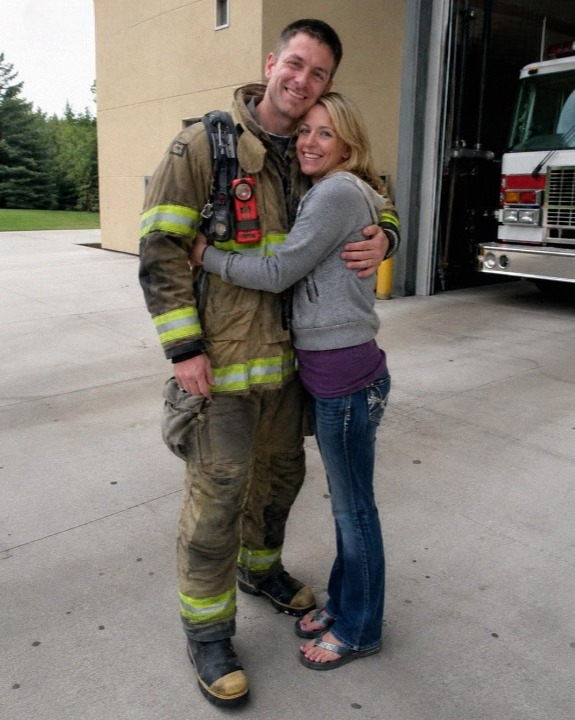
Marriage to a first responder comes with a very specific kind of lifestyle—one built around missed dinners, interrupted holidays, and a perpetual calendar of shifted expectations. My name is Amanda, and my husband, Tyler, has been a professional firefighter for nine grueling years. I have spent nearly a decade learning how to celebrate anniversaries on Tuesdays, holding birthday cake until midnight, and mastering the quiet art of sleeping alone while the wind howls outside and a pager hums on the nightstand.
Tyler loved his job with a fierce, quiet dedication. He was the kind of man who would check his gear three times, volunteer for the worst weekend details without complaint, and always keep an extra pair of dry socks in his locker. But the schedule was relentless—stretching into grueling 24-hour rotations that frequently swallowed up birthdays, holidays, and family milestones.
This year, however, I decided I was completely done with delayed celebrations.
Tyler’s birthday happened to fall right in the middle of a brutal, mid-week 24-hour shift at Station 4. Instead of resigning myself to another quiet evening eating leftovers by myself while texting him emojis across the table, I hatched a secret plan to make things special.
I arranged for a local bakery to make his absolute favorite—a triple-chocolate fudge cake with custom blue icing. I spent my morning running errands, picked up a buoyant bunch of helium balloons that read Happy Birthday, and loaded everything carefully into the backseat of my sedan. I mapped my timing so I would arrive right during their mid-afternoon downtime, knowing the firehouse protocol well enough to avoid their mandatory training blocks and meal preparations.
I had pulled this exact surprise stunt once before, back when we were newly married. On that day, the entire station had practically thrown a welcoming parade. The guys had hooted, hollered, and teased Tyler mercilessly while devouring half the cake in under sixty seconds. Tyler had turned bright red, embarrassed out of his mind, but his eyes had shone with a deep, undeniable happiness that stayed with me for years.
I expected a repeat of that warm, chaotic camaraderie.
I parked my car in the gravel lot right out front of the station, the bright balloons bobbing and rustling against the ceiling of my car. Stepping out into the crisp afternoon air, I adjusted my grip, balanced the white bakery box carefully in both hands, and walked up toward the massive, open bay doors.
The Weight in the Air
The first thing that registered wasn’t a greeting. It was the absolute, suffocating silence.
Usually, Station 4 was a living organism of noise and activity. Even during downtime, you could hear the faint murmur of a television broadcast from the dayroom, the clatter of silverware, the booming laughter of firefighters swapping stories, or the distant screech of a power drill in the maintenance bay.
Today, the garage was dead quiet.
Three of Tyler’s fellow crew members were standing near the heavy red apparatus bay, leaning against a workbench. When my shadow fell across the concrete threshold, all three heads snapped up in unison.
My welcoming smile froze mid-air.
Nobody smiled back. Not a single corner of a mouth twitched upward. Instead, a heavy, suffocating tension dropped over the room like a lead blanket. A few of the guys exchanged swift, highly uncomfortable glances, instantly breaking eye contact with me as though they were silently voting on who had to deal with the civilian standing in their doorway. They looked away, staring determinedly at the tires of the engine or the tools on the wall.
My stomach gave a sickening lurch, the kind of visceral drop you feel when an elevator plummets too fast.
“Is… is Tyler around?” I asked, my voice instantly shrinking, sounding much smaller, thinner, and more vulnerable than I had intended. I clutched the white cardboard box a little tighter against my chest, the colorful ribbons of the balloons trailing awkwardly behind me in the breeze.
For a second, nobody moved. The silence stretched out, heavy and unbearable, humming with a dread I couldn’t yet identify.
Then, heavy footsteps echoed from the back office corridor.
Captain Reyes, a seasoned 25-year veteran with silver temples and eyes that had seen every imaginable tragedy, walked out into the open bay. He was moving slowly, deliberately, with an expression on his face that I had literally never seen in all the years I had visited the station. It wasn’t his usual warm, grandfatherly grin or his sharp professional demeanor. It was a look of profound, crushing hesitation.
He stopped a few feet away from me. He looked down at the bright, cheerful birthday balloons dancing in the air. Then, very slowly, he raised his eyes to meet mine.
His face was completely devoid of color.
“Amanda,” Captain Reyes said, his voice dropping into a somber, gravelly register that made the hairs on the back of my arms stand up.
He didn’t ask what I was doing there. He didn’t wish me a good afternoon. He just looked at me with an agonizing mixture of pity and sorrow.
“You don’t know yet?” he asked softly.