We had trusted our babysitter since the previous fall.
Her name was Megan, and from the beginning, she seemed almost too good to be true. She always arrived a few minutes early, regularly sent me photographs of my son eating lunch or playing with his toys, and somehow managed to leave our house cleaner than she found it.
Most importantly, my ten-month-old son, Oliver, adored her.
Every time Megan walked through the door, Oliver’s face lit up. He would smile, wave his little hands, and crawl toward her as quickly as he could.
I used to tell everyone that my husband, David, and I had been incredibly fortunate to find her.
Megan watched Oliver three afternoons a week while I worked from my home office upstairs. I liked the arrangement because I was nearby in case she needed me, but I could still focus on work without constantly stepping away.
For months, there was only one strange thing I occasionally noticed.
The same delivery driver came to our house almost every week. He was a tall, middle-aged man who usually wore a blue cap. Most of the time, he placed our packages beside the front door, photographed them, and walked away.
Sometimes, however, he would stop in front of our Ring camera.
He appeared to say something directly into it before leaving.
Unfortunately, the microphone on our doorbell camera had been broken for months. We could see recorded video, but we couldn’t hear anything.
David and I kept saying we would replace it.
We never did.
I assumed the driver was simply announcing where he had left a package. Perhaps he was talking through an earpiece or recording a note for his company.
It didn’t seem important.
Then last Thursday happened.
That afternoon, I was upstairs participating in a virtual meeting while Megan watched Oliver downstairs. He had been unusually tired that week, but I assumed he was going through another growth phase.
At approximately two o’clock, my phone displayed a motion notification from the front porch.
I glanced at the screen and recognized the delivery driver. He placed two boxes beside the door, took the required photograph, and started walking away.
Then he suddenly stopped.
Halfway down the porch steps, he turned his head toward the side of our house.
For several seconds, he didn’t move.
A figure briefly appeared near the edge of the recording. It was Megan. She was carrying something wrapped in a dish towel as she walked toward the outdoor trash cans beside our garage.
The driver watched her lift one of the lids and throw the object inside.
Megan returned to the house without noticing him.
The driver took several steps toward his vehicle, stopped again, and looked back at our home.
His expression made my stomach tighten.
He didn’t look frightened.
He looked deeply uncomfortable, as though he had witnessed something he wasn’t supposed to see and was trying to decide whether he should become involved.
Finally, he returned to the porch.
He looked directly into the Ring camera and said something. When he received no response, he waved at the lens.
Of course, the broken microphone prevented me from hearing him.
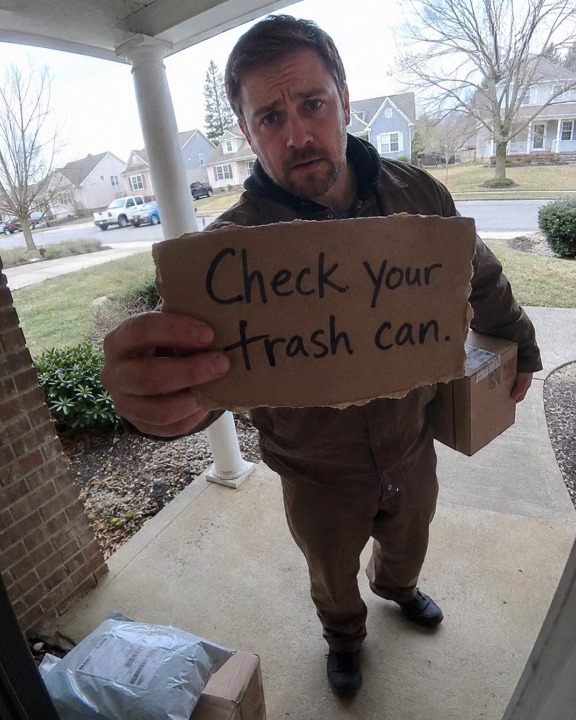
The driver glanced over his shoulder, picked up one of the packages, and tore a small piece of cardboard from its damaged corner.
He searched his pockets until he found a marker.
His hands were visibly shaking.
Then he wrote four words in large capital letters and held them directly in front of the camera:
“CHECK YOUR TRASH CAN.”
I stared at my phone.
For one second, I couldn’t move.
Then I left the meeting without offering an explanation and ran downstairs.
Megan was sitting on the living-room sofa looking at her phone. Oliver was asleep in his playpen.
“Is everything okay?” she asked.
“I need to check something outside.”
I hurried through the kitchen, opened the back door, and ran toward the trash cans.
One lid wasn’t completely closed.
I lifted it.
Near the top of the trash was the dish towel I had seen in the recording. I pulled it aside and discovered a small white plastic device.
It was one of our carbon monoxide alarms.
The batteries had been removed, but a red warning light continued flashing faintly.
I recognized the alarm immediately. It had been mounted in the hallway near Oliver’s nursery.
Underneath it was another detector from our basement.
I couldn’t understand what I was seeing.
Why were two safety alarms in the trash?
Then I remembered Oliver’s unusual tiredness. I also thought about the mild headache I had experienced that morning. Neither detail had seemed important by itself.
I knew carbon monoxide couldn’t be seen or smelled. I also knew this wasn’t something I could safely investigate on my own.
I moved away from the house and called Megan.
“Bring Oliver outside immediately,” I told her. “Do not stop to collect anything.”
“What’s wrong?”
“Just bring him out now.”
Something in my voice must have frightened her because she didn’t argue.
Less than a minute later, she came through the back door carrying Oliver. I took him from her and moved toward the far end of the yard.
Then I called emergency services.
Megan looked confused.
“Why are you calling them?”
“I found our carbon monoxide alarms in the trash.”
Her expression changed.
“Oh,” she said. “Those.”
I stared at her.
“You knew they were there?”
“They kept making noise. I thought the batteries were running out.”
“Why didn’t you tell me?”
“I was going to. They were bothering Oliver, so I removed them.”
“Both of them?”
“The basement one started making noise on Tuesday. The hallway one went off today.”
“You threw away two alarms without telling us?”
“I thought they were defective,” she said defensively. “There wasn’t any smoke.”
“Carbon monoxide alarms don’t detect smoke.”
Megan fell silent.
The fire department arrived within minutes. The delivery driver was still parked on the street, watching from inside his vehicle.
The firefighters instructed everyone to remain outside while they entered the house with monitoring equipment.
A few minutes later, one of them returned wearing a serious expression.
He confirmed that the carbon monoxide level inside the house was elevated. The readings were particularly concerning near the basement utility area.
A problem with the furnace ventilation system had allowed gas to build up inside the house. The firefighters shut down the system, opened the house for ventilation, and contacted the appropriate utility service.
They also recommended that Oliver and I receive medical evaluation because we had been inside for several hours.
David met us at the hospital.
By then, I was shaking so badly that I could barely explain what had happened.
Fortunately, Oliver was alert by the time we arrived. The medical team evaluated him and monitored us. After several hours, we were allowed to leave with instructions to remain away from the house until professionals confirmed it was safe.
Megan’s mother picked her up from outside our home.
Before leaving, Megan apologized.
“I honestly thought the detectors were broken,” she said.
“You should have called me the moment the first one sounded.”
“I didn’t want to interrupt your work.”
“You interrupted me whenever Oliver refused his lunch. You could have interrupted me about a safety alarm.”
She looked down.
“I’m sorry.”
I told her she would no longer be caring for our son.
Firing her wasn’t an act of revenge. I understood that she hadn’t intended to place Oliver in danger.
But caring for a child requires judgment. Removing two warning devices, throwing them away, and saying nothing was a decision I couldn’t overlook.
I also learned that the hallway alarm hadn’t merely produced an occasional low-battery chirp. It had activated a full spoken warning that included the words “carbon monoxide.”
Megan later admitted she had wrapped it in the towel to quiet the sound.
That detail confirmed our decision.
The following morning, after the house was declared safe, I reviewed the Ring recording again.
I watched the driver observe Megan carrying the alarm to the trash. I saw his uncertainty and the moment he chose to turn around.
His name was Marcus.
I contacted the delivery company and asked if they could pass along my telephone number. I wanted to thank him personally.
Marcus called that afternoon.
“I hope I didn’t cause trouble,” he said.
“You may have saved my son.”
He became quiet.
Then he explained what he had seen.
As he was approaching our porch, Megan came out through the side door carrying an alarm wrapped in a towel. Even from several feet away, Marcus heard the device announce its warning.
He watched her remove the batteries and place everything in the trash.
“At first, I thought maybe she was replacing it,” he said. “Then she went back inside without bringing out another alarm or opening any windows.”
He tried speaking through our doorbell camera, assuming I would answer.
When no one responded, he remembered seeing a second discarded detector in the can during an earlier delivery. He decided a written message was the only way to make certain someone saw the warning.
“Why didn’t you simply knock on the door?” I asked.
“I was about to,” he said. “But I didn’t know whether the woman lived there or how she would react. I thought sending a message through the camera would reach the homeowner directly.”
He had made the right decision.
David and I invited Marcus and his wife to dinner once our furnace was repaired. He initially declined because he insisted he had only done what anyone else would have done.
But that wasn’t true.
Many people would have told themselves it was none of their business. Marcus could have returned to his vehicle, completed the next delivery, and forgotten what he had seen.
Instead, he stopped.
He noticed something unusual, trusted his instincts, and found a way to warn us.
His employer later recognized him for his actions, although Marcus seemed embarrassed by the attention.
“I didn’t do anything special,” he said during dinner. “I just didn’t want to drive away and spend the rest of the day wondering.”
The incident changed several things in our home.
We replaced every safety detector and arranged for regular professional inspections of our heating system. We also repaired the Ring microphone immediately.
For months, David and I had ignored that broken microphone because it seemed like a minor inconvenience. We never imagined that one day someone might need it to send us an urgent warning.
Most importantly, we became more careful about who we trusted with Oliver.
Megan had appeared perfect because she arrived early, cleaned the house, and sent cheerful photographs. Those qualities were helpful, but they weren’t a substitute for good judgment and honest communication.
Looking back, there had been small warning signs.
On two occasions, I had noticed that a detector was missing from the basement ceiling. Megan claimed it had fallen and that David must have moved it. Another time, she complained that the hallway alarm was too sensitive.
I accepted those explanations because I trusted her.
I don’t blame myself for failing to predict what happened, but I no longer dismiss changes involving safety equipment.
Oliver is healthy and energetic today.
He was too young to understand why we suddenly rushed out of the house or why firefighters arrived in our driveway. One day, however, I’ll tell him about the delivery driver who noticed something strange and refused to ignore it.
Four words appeared on my phone that afternoon:
“Check your trash can.”
They seemed mysterious and frightening at first.
In the end, they led me to a discarded alarm, a hidden danger, and a reminder that speaking up can make an extraordinary difference.
Marcus delivered two ordinary packages to our home that day.
But the most valuable thing he gave our family was a warning.