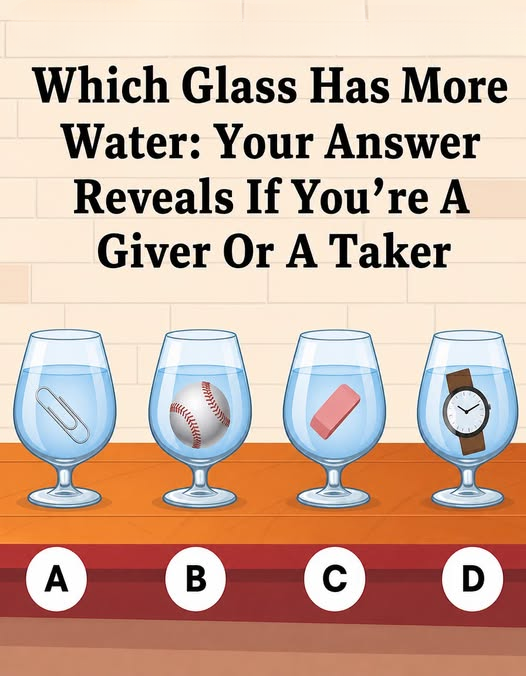
The Glass Puzzle: What Your Choice Might Say About How You See Giving, Sharing, and Receiving
People have always been fascinated by personality quizzes, visual puzzles, and simple challenges that seem to reveal something deeper about the way we think.
Sometimes the puzzle involves choosing a door.
Sometimes it asks which animal you notice first.
Other times, it presents a group of everyday objects and asks you to make a quick decision without overthinking it.
One popular example is the so-called glass puzzle.
The idea is simple: you are shown several glasses arranged differently—some fuller, some emptier, some placed closer to a source, and others farther away. You are then asked which glass you would choose first.
According to the playful interpretation often attached to the puzzle, your answer may reflect whether you naturally see yourself as more of a giver, a receiver, a planner, or someone who prefers balance.
It is important to say one thing clearly before going further:
This is not a scientific personality test.
A single visual puzzle cannot reliably determine your character, generosity, or emotional nature.
Still, these puzzles can be entertaining because they encourage us to pause and think about how we make decisions.
And sometimes, the explanation we give for our choice is more interesting than the choice itself.
Why Visual Personality Puzzles Are So Popular
Human beings naturally enjoy discovering patterns.
We look for meaning in:
- Shapes
- Colors
- Images
- Choices
- Reactions
This is one reason personality quizzes spread so quickly online.
They offer something irresistible:
A simple question with a personal answer.
Even when we know the result is mostly entertainment, we still want to see whether it feels accurate.
The Basic Idea Behind the Glass Puzzle
Different versions of the glass puzzle exist.
In a common version, several glasses contain different amounts of liquid.
You may be asked:
Which glass would you choose?
Or:
Which glass would you fill first?
Some versions ask which glass should be given to another person.
Others focus on which container appears most useful.
The interpretation usually depends on how someone thinks about:
- Fairness
- Resources
- Sharing
- Opportunity
- Personal needs
If You Choose the Fullest Glass
People who immediately choose the fullest glass may simply be practical.
Why choose less when more is available?
A playful interpretation might describe this choice as representing confidence, efficiency, or a desire to make the most of available opportunities.
It does not necessarily mean someone is selfish.
In everyday life, choosing the best available option can be perfectly sensible.
If You Choose the Emptiest Glass
Someone who selects the emptiest glass might interpret the puzzle differently.
Perhaps they imagine filling it.
Perhaps they see potential rather than what is already there.
A lighthearted personality interpretation might connect this choice with:
- Optimism
- Creativity
- Patience
- Interest in building something gradually
Again, the explanation matters more than the answer.
If You Choose a Glass for Someone Else
Some versions ask which glass you would offer another person.
People who immediately choose the fullest or best option for someone else may identify strongly with generosity.
They may enjoy making others comfortable.
They may think about another person’s needs before their own.
But even here, real generosity cannot be measured by a single puzzle.
People behave differently depending on circumstances.
The “Giver” Label
The word “giver” is often used to describe someone who enjoys helping others.
In daily life, a giver might:
- Offer support without being asked
- Share resources
- Listen carefully
- Volunteer time
- Help friends solve problems
These qualities can be wonderful.
However, healthy giving also requires boundaries.
Constantly putting everyone else first can eventually lead to exhaustion.
The “Taker” Label Can Be Misleading
Online puzzles sometimes use the word “taker” negatively.
That oversimplifies human behavior.
Receiving help is not selfish.
Accepting opportunities is not automatically greedy.
Every healthy relationship involves both giving and receiving.
Sometimes we help.
Sometimes we need help ourselves.
Balance is important.
Why Balance Matters
Imagine someone who gives constantly but refuses assistance.
They may eventually become overwhelmed.
Now imagine someone who only receives and never contributes.
Relationships may become one-sided.
Healthy communities usually depend on mutual support.
People give when they can.
They receive when they need to.
That exchange creates connection.
Your Reasoning Is More Interesting Than Your Choice
Suppose two people choose the exact same glass.
One chooses it because it contains the most.
Another chooses it because they intend to share it.
Same answer.
Completely different reasoning.
This demonstrates why simple personality puzzles should be treated as conversation starters rather than serious assessments.
The story behind the choice matters.
How Real Personality Is Studied
Psychologists use much more comprehensive methods when studying personality.
Scientific assessments typically involve:
- Multiple questions
- Consistent scoring methods
- Large research samples
- Reliability testing
- Statistical validation
Researchers may examine broad personality dimensions rather than judging someone from one spontaneous choice.
That is very different from a social-media puzzle.
Why We Still Enjoy These Games
If these tests aren’t scientifically definitive, why are they so appealing?
Because they encourage self-reflection.
They give us an excuse to ask questions such as:
- Do I usually think about others first?
- Am I comfortable accepting help?
- Do I take risks?
- Do I prefer security?
- How do I make decisions?
Those questions can be meaningful even if the original puzzle is just entertainment.
A Simple Exercise
Try this without looking for the “correct” answer.
Imagine three glasses.
One is nearly full.
One is half full.
One is almost empty.
You may keep one and give another to someone you care about.
Which do you choose?
Now ask yourself why.
Did you keep the fullest?
Give away the fullest?
Choose the middle option because it felt fair?
Prefer the nearly empty glass because you imagined filling it later?
There is no wrong answer.
The interesting part is noticing your reasoning.
Context Changes Decisions
Your choice might also change depending on the situation.
If you were extremely thirsty, you’d probably choose differently than if you had just finished drinking water.
If the other person were a child, your answer might change.
If resources were limited, you might think differently again.
This is exactly why human behavior cannot be reduced to one image.
Context matters.
Personality Changes Too
People are not permanently fixed into categories.
Experiences influence us.
Relationships influence us.
Age changes priorities.
Someone who was highly cautious at twenty may become more adventurous at forty.
A person who struggled to accept help may eventually learn that receiving support is healthy.
Personality has consistency, but people also grow.
Use Puzzles for Fun, Not Judgment
One of the biggest mistakes with viral personality quizzes is treating results as absolute truths.
A puzzle should never be used to decide that someone is:
- Selfish
- Generous
- Untrustworthy
- Kind
- Manipulative
Those judgments require understanding someone’s actual behavior over time.
A playful quiz simply doesn’t provide enough information.
What Real Generosity Looks Like
If you’re interested in whether you are genuinely giving, consider your everyday behavior instead.
Ask:
Do I listen when friends need support?
Do I help when I’m able?
Do I respect other people’s boundaries?
Can I accept help without guilt?
Do I give because I want to, or because I feel pressured?
Those questions reveal much more than a glass puzzle ever could.
Giving Without Losing Yourself
Generosity is healthiest when it doesn’t require ignoring your own needs.
Helping others and caring for yourself are not opposites.
You can be generous while still saying no.
You can be compassionate without taking responsibility for everyone’s problems.
You can receive support and still be independent.
Balance makes kindness sustainable.
Final Thoughts
The glass puzzle is a fun example of why people enjoy visual personality games.
Choosing one glass over another might encourage you to think about sharing, opportunity, fairness, or personal needs.
But no single answer can determine whether you are truly a giver or a taker.
Human personality is far too complex for that.
The real value of the puzzle lies in the conversation it creates.
Why did you choose what you chose?
What assumptions did you make?
Would your answer change under different circumstances?
Those questions are far more revealing than any label.
So the next time a visual puzzle promises to reveal your “true personality,” enjoy it.
Think about your answer.
Compare it with friends.
Have fun with the interpretation.
Just remember that who you truly are is reflected not in which glass you choose—but in the decisions you make, the way you treat people, and how you balance giving with receiving throughout everyday life.