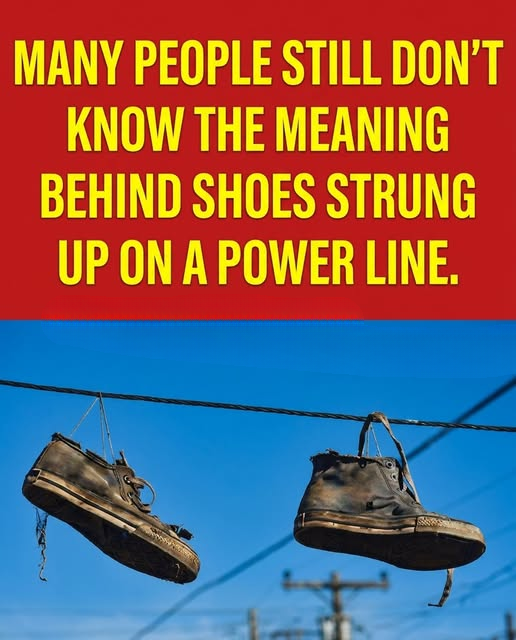
Sneakers dangling high above the street from overhead power lines are becoming a progressively less common sight in modern, rapidly modernizing neighborhoods, yet they continue to spark immense curiosity, speculation, and endless urban folklore. Whenever someone looks up and spots a pair of battered trainers swaying in the gentle breeze against the backdrop of an open sky, it triggers a cascade of questions. Who put them up there? How did they manage such an impossible-looking throw? And, most importantly, what do they actually mean?
Across the globe, this peculiar phenomenon—frequently referred to as “shoefiti”—has occupied a strange space in our collective cultural imagination. While some view it as a harmless prank or a form of spontaneous street art, others load the imagery with dark underworld connotations, linking the suspended footwear to territorial markers, illicit trade, or neighborhood memorials.
To fully understand why shoes end up on power lines, we have to peel back decades of urban legends, evaluate the actual physical realities of cities, and examine the very real safety hazards that accompany the practice.
The Origins of “Shoefiti”: A Global Canvas
The term “shoefiti”—a portmanteau of “shoe” and “graffiti”—was popularized to describe the art form or practice of tossing shoes over elevated wires, cables, and tree branches. But long before the term was coined, the practice itself had already planted deep roots across diverse communities worldwide.
Anthropologists and sociologists note that human beings have a long history of marking public spaces to signal presence, transition, or play. Throwing objects into trees or onto wires requires a surprising amount of coordination, luck, and persistence. Because it takes effort, the act itself became a medium of expression.
In some neighborhoods, shoe-tossing evolved as an informal rite of passage. Young people stepping into new phases of life—such as graduating from school, finishing sports seasons, or moving away from home—would sometimes toss their worn-out footwear as a physical manifestation of leaving a piece of their youth behind. In this context, the shoes represent closure, a visual timestamp of a life chapter concluding in the very streets where those memories were forged.
Unpacking the Urban Legends: What Do the Shoes Really Signify?
Because the origins of shoe-tossing are decentralized and vary wildly from region to region, dozens of competing theories have emerged over the decades. Some of these theories are rooted in genuine community concerns, while others lean heavily into cinematic exaggeration and urban myth.
1. Gang Territories and Criminal Signaling
One of the most pervasive theories is that dangling shoes serve as geographic markers for gang activity or turf boundaries. According to this narrative, rival groups use footwear to signal who controls a specific block or intersection.
While law enforcement agencies in certain cities have historically investigated these claims, comprehensive urban studies and sociological research have largely downplayed the connection as a widespread rule. While isolated incidents involving local street crews using markers cannot be entirely ruled out historically, criminologists note that relying on weather-worn sneakers to manage territory is entirely inefficient. In many cases, the “gang sign” narrative persists more through Hollywood movies and television crime dramas than verified police intelligence.
2. Advertising Open-Air Drug Markets
Another dark rumor frequently attached to shoefiti is that pairs of shoes hung near street corners act as an open advertisement for illicit drug sales—essentially signaling to buyers that substances can be purchased nearby.
Municipal leaders and neighborhood associations have occasionally echoed these fears, prompting city utility crews to dispatch removal teams. However, municipal studies tracking shoe-tossing data have repeatedly failed to establish a direct, reliable correlation between dangling sneakers and active drug distribution. Often, these rumors gain traction because human beings naturally look for patterns and explanations when confronted with unusual public sights.
3. Community Memorials and Tributes
A far more poignant and community-centered explanation is that shoes are sometimes tossed as spontaneous memorials. When a neighborhood youth or a beloved community member passes away tragically—whether through violence, accidents, or illness—friends and neighbors occasionally string their old shoes over nearby wires.
In this framework, the height of the shoes represents elevation, symbolizing that the individual is “walking in the clouds” or watching over the neighborhood. These makeshift memorials allow peers to pay their respects visibly and collectively, creating a shared landmark of grief and remembrance.
4. Pranks, Boredom, and Peer Pressure
Sometimes, the simplest explanation is the most accurate: kids being kids. Tying the laces of a pair of worn-out sneakers together and launching them upward is an age-old test of athletic skill, coordination, and bravado.
Children and teenagers frequently throw shoes to settle bets, show off physical strength, or pull lighthearted pranks on friends. Unfortunately, this dynamic also intersects with darker social issues like bullying. In unfortunate instances, peer pressure or harassment results in a victim’s shoes being stripped away and tossed out of reach as an act of intimidation. Furthermore, many people simply discard old, unwearable shoes by tossing them outdoors when garbage disposal isn’t top of mind, resulting in accidental catches on overhead wires.
The Physical Reality: Modern Infrastructure and Declining Sightings
If you feel like you see fewer pairs of shoes hanging from power lines today than you did ten or twenty years ago, your observation is likely correct. The practice is noticeably on the decline in many metropolitan areas.
Several modern shifts account for this disappearance:
-
Underground Utilities: Modern urban planning and neighborhood development increasingly favor burying electrical, telephone, and internet cables underground. Without overhead lines crisscrossing the streetscape, the physical canvas for shoefiti simply ceases to exist.
-
Aggressive Municipal Removal: Because dangling shoes can make a neighborhood look neglected or trigger unfounded fears about crime, many city councils and utility providers now actively remove shoes as part of standard maintenance routines.
-
Shifting Youth Culture: As recreational habits shift toward digital landscapes, outdoor street culture evolves. The traditional pastime of tossing footwear has lost steam among younger generations.
The Hidden Dangers: Why Shoe-Tossing is a Serious Safety Hazard
While urban folklore treats shoe-tossing as a quirky mystery, utility companies, electrical engineers, and local governments view the practice through a lens of strict public safety. Throwing anything toward overhead infrastructure carries severe, potentially life-threatening risks.
1. Electrical Shock and Electrocution
Overhead power lines carry immense voltages designed to power entire neighborhoods. While insulated wires exist, many distribution lines are exposed to the elements. If a person uses a wet rope, a metallic cord, or a damp shoe to throw over a line, or if the thrown object bridges a gap between lines, it can create a direct path for electricity to travel down to the ground. This introduces a severe risk of catastrophic electric shock, severe burns, or instant fatality.
2. Power Outages and Equipment Damage
When foreign objects wrap around electrical cables, they introduce weight and friction. Heavy shoes, especially when waterlogged after a rainstorm, can cause lines to sag, sway, and touch neighboring wires. This creates electrical shorts, sparks, transformer blowouts, and sudden neighborhood power outages that impact hundreds or thousands of homes and businesses.
3. Interference with Emergency and Utility Crews
Utility workers require clear, unobstructed access to power grids to perform routine maintenance and rapid emergency repairs during storms. Tangled debris complicates their work, introducing unnecessary hazards into an already dangerous profession. Furthermore, attempting to retrieve shoes independently by climbing utility poles or tossing hooks into lines trespassing on utility property creates extreme physical danger from falls and electrocution.
Conclusion: Balancing Curiosity with Common Sense
The tradition of tossing shoes onto power lines remains a complex tapestry of folklore, personal expression, community grief, and adolescent mischief. While it invites endless speculation about what happens beneath the surface of our neighborhoods, it is ultimately a fading urban tradition.
Next time you spot a pair of weathered sneakers swaying against the clouds, you can appreciate the rich history of urban lore behind them. However, it is equally important to recognize the real-world dangers they represent. Respecting municipal infrastructure, prioritizing community safety, and keeping public utility lines clear ensures that our neighborhoods remain safe, functional, and brightly powered for everyone.