My name is Sarah Parker. I am thirty-seven years old, and for the past twelve years, I have taught second grade at a small, underfunded public elementary school in our town.
Every August, as summer vacation draws to a close, a familiar pattern repeats itself in my classroom. While many children arrive on the first day of school wearing brand-new clothes and carrying bright, character-themed backpacks filled with colorful supplies, there are always a few students who walk through my door carrying their single notebook in a crinkled plastic grocery bag. Their families face tough financial choices, and basic items like watercolor sets, highlighters, or sturdy lunch boxes simply fall outside their monthly budgets.
I could never bring myself to pretend not to notice.
So, every single year, before the first bell rang, I would quietly take a significant portion of my own modest paycheck and head to the local department store. I would pack my shopping cart with durable backpacks, packs of wooden pencils, crayons, safety scissors, folders, and insulated lunch boxes.
On the first morning of class, those supplies would mysteriously appear in the empty cubbies of the children who needed them most, complete with anonymous handwritten name tags. I never told the administration or the parents where the items came from. Whenever our school principal gently pressed me about the sudden appearance of the supplies, I would just offer a warm smile and say:
“Maybe Santa starts his shopping a little early in our school district.”
The children never asked uncomfortable questions either. They simply hugged their new backpacks tightly to their chests, smiled from ear to ear, and ran off into the hallway to show their classmates. Seeing their confidence restored on the very first day of school was worth far more to me than any money spent.
However, stretching a public school teacher’s salary to cover classroom supplies meant making personal sacrifices. Over the years, I put off upgrading my own wardrobe, postponed repairs on my old car, and repeatedly mended my own belongings instead of replacing them.
By late spring of this past school year, my favorite pair of teaching sneakers had seen better days. The rubber soles were visibly peeling away at the toe, the fabric along the sides was thin and faded, and I had already taken a needle and heavy thread to stitch the left shoe back together twice. But they were comfortable, and I preferred spending my extra money on books for our classroom library rather than buying new footwear for myself.
Last Friday afternoon, with summer break only a week away, my second-graders packed up their desks and headed out to the buses.
One of my students, a quiet seven-year-old girl named Lily, stayed behind. She stood near my desk, holding her artwork, her eyes slowly drifting down toward my feet. She stared at my worn-out, hand-stitched sneakers for a long, quiet moment.
She looked up at me with her big, serious brown eyes and asked softly:
“Mrs. Parker… if you always buy new backpacks, crayons, and lunch boxes for everyone in our class… why don’t you ever buy new shoes for yourself?”
I let out a gentle laugh, tapping the toe of my shoe against the floor.
“Oh, these old things?” I replied cheerfully. “They still work just fine, Lily. They get me from the chalkboard to the playground every single day, and that’s all I really need.”
Lily didn’t laugh or smile back. She simply nodded thoughtfully, gave me a quick hug, and walked out the door to catch her bus. I smiled to myself, touched by her sweet observation, but quickly put the conversation out of my mind as I turned back to grading spelling tests.
The following Monday morning, shortly after I arrived at school, our principal stopped by my room and asked me to pop into the main gymnasium before my second-graders arrived for their morning reading block. I assumed it was a quick, last-minute briefing regarding end-of-year inventory or staff scheduling.
I smoothed down my sweater, walked down the quiet hallway, and pushed open the double doors of the gym.
I froze in complete surprise.
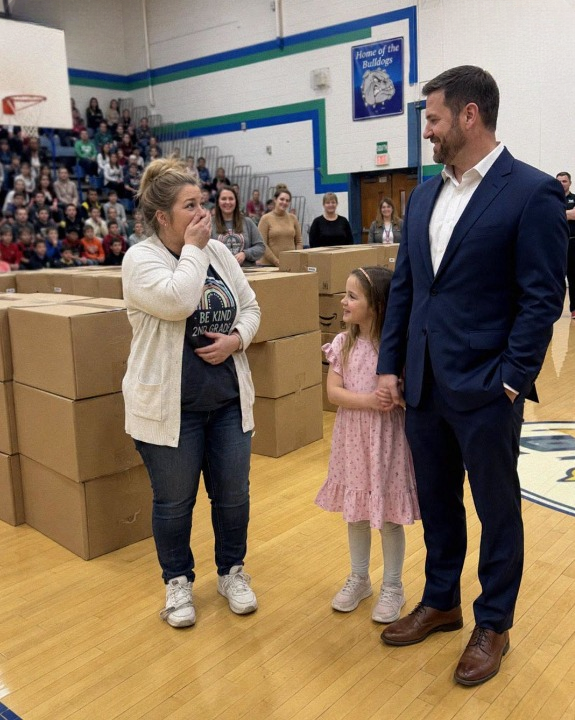
Instead of an empty room or a small group of teachers, the entire gym was filled with energy. My entire second-grade class was sitting on the lower bleachers, clapping their hands and whispering excitedly. Standing right near the center court line alongside our principal was Lily, holding the hand of a tall man dressed in a tailored navy blue suit that looked completely out of place in an elementary school gym.
Lily’s face lit up with pure joy the moment she spotted me in the doorway. She took her father’s hand and pulled him forward to meet me.
“Mrs. Parker!” Lily beamed. “This is my dad!”
Her father stepped forward with a warm, respectful smile, extending his hand. “Hello, Mrs. Parker. My name is David. It is an absolute honor to finally meet you in person.”
He paused, glancing down at my worn sneakers for a fleeting second, before looking back up at me with deep sincerity in his eyes.
“Lily came home on Friday afternoon and cried through dinner,” David explained gently. “She kept asking me why the kindest, most generous teacher she has ever known is the one person who always goes without basic things for herself. When she told me how you spend your own salary every single August to make sure no child in your class ever feels left out, I decided to look into it.”
It turned out that David was the founder of a regional charitable foundation that specialized in educational funding.
“After speaking with your principal over the weekend,” David continued, “we realized that your quiet generosity has supported dozens of families over the past decade. It was time for this community to take care of you.”
Before I could process his words or offer a response, the heavy double doors at the far end of the gymnasium slowly swung open.
One after another, members of the parent-teacher association, local business owners, and school volunteers began walking onto the basketball court. They were carrying large, heavy cardboard boxes wrapped in bright ribbons.
I watched in wide-eyed amazement as they stacked three boxes, then six, then ten, until a massive pyramid of more than twenty large storage crates stood right in the center of the gym.
Every single box had a large white label printed across the front bearing my name: FOR MRS. PARKER’S SECOND-GRADE CLASSROOM.
David gestured toward the massive stack with a smile. “Inside these boxes are full sets of educational tablets, complete school supply kits for every single student entering your grade for the next five years, a fully funded grant for your classroom library, and a dedicated fund so you will never have to spend a single penny of your own paycheck on school supplies ever again.”
Lily stepped forward, reaching into a small gift bag her father was holding, and pulled out a beautifully wrapped box tied with a yellow bow. She held it out to me with both hands.
“And this one is just for you, Mrs. Parker,” Lily whispered proudly.
With trembling hands, I untied the ribbon and opened the box. Inside was a brand-new pair of top-quality, supportive walking sneakers, alongside a gift card to a local shoe boutique.
Tears spilled over my eyelashes as I looked up at the sea of smiling faces—my students cheering from the bleachers, the parents waving from the court, and the little girl whose observant heart had brought an entire community together.
I knelt down on the gym floor, pulled Lily into a tight hug, and knew that every quiet sacrifice I had made over the years had found its way back to me a hundred times over.