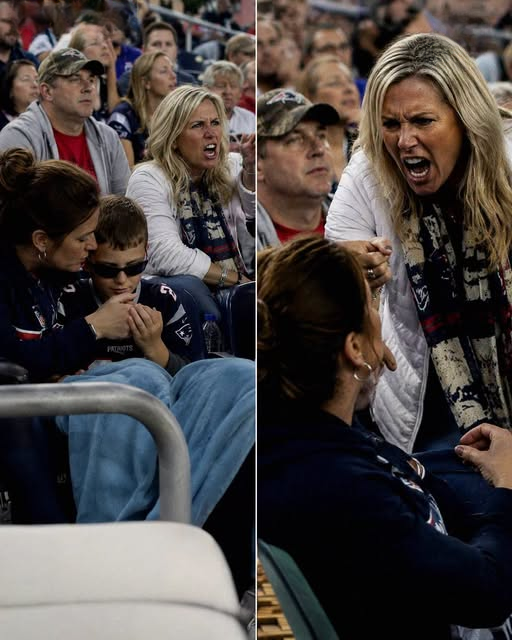
My husband, Mark, and I take our two young boys to our local university football games whenever we manage to secure tickets.
It has become a beloved family tradition that we look forward to all season long. The roaring crowd, the smell of roasted peanuts, the energetic marching band, and the crisp autumn air create an incredible atmosphere that our kids talk about for weeks afterward.
Last Saturday evening, we settled into our mid-field seats, excited for a great game. A few rows directly in front of us, I noticed a mother sitting alongside her young son, who appeared to be around eight or nine years old.
At first, I barely paid attention to them as we cheered during the opening kickoff. But as the first quarter progressed, I found myself repeatedly drawn to watching their interactions.
The little boy sat remarkably still the entire time. Despite the sun setting and the giant stadium floodlights turning on, he kept a pair of dark sunglasses firmly over his eyes. What caught my attention most was his behavior during big plays—he never once looked up at the giant video scoreboard, never reacted when the home team scored a touchdown, and never joined the surrounding crowd in cheering or clapping. He simply sat in his seat with his head slightly tilted downward, as though the noisy stadium around him existed in a completely different world.
What truly fascinated me, however, was his mother’s complete dedication to him.
She didn’t watch the football field for more than a second or two at a time. Throughout the entire first half, she remained constantly leaned over toward her son, her lips almost touching his ear, quietly whispering a steady stream of words. At the same time, her fingers gently traced soft, repetitive circular patterns over and over on the palm of his small hand.
I’ll admit that in my initial ignorance, before I understood what was truly taking place, I briefly wondered to myself why she wouldn’t just let the boy focus on the action taking place on the field.
As it turned out, I wasn’t the only spectator observing them.
A man sitting four seats down in their row—wearing an expensive team jersey and holding a large beverage—had clearly grown increasingly frustrated with her continuous hushed chatter. Throughout the second quarter, he kept huffing loudly, turning to his friends, rolling his eyes, and complaining about the constant distraction right in his line of sight.
During a critical third-down play in the third quarter, the tension finally boiled over.
The man suddenly stood up, threw his arms into the air, and shouted angrily across the aisle:
“Hey, lady! Would you shut up already?! Some of us paid good money to actually watch the game, not listen to you talk non-stop into your kid’s ear!”
A sudden, uncomfortable hush fell over our immediate seating section. Several fans turned around in shock, while others shifted uncomfortably in their seats, stunned by the man’s harsh, public outburst.
Remarkably, the mother didn’t even turn her head to look at him. She didn’t flinch, raise her voice, or engage in an argument. She simply held her son’s small hand a little tighter, continued tracing gentle circles on his palm, and kept quietly whispering into his ear in the same soothing, rhythmic tone.
Her calm refusal to acknowledge him only seemed to infuriate the impatient spectator even further.
He stepped out of his seat, stomped down the concrete aisle, and towered directly over her row, his face red with anger. “I’m talking to you!” he yelled, attracting the attention of several nearby ushers. “If you can’t keep quiet and let people enjoy the game, take your kid and leave!”
Seeing that the situation was escalating rapidly and threatening to turn into an aggressive confrontation, my husband immediately stood up from his seat, intending to step in and diffuse the argument before things got worse.
But before Mark or the approaching stadium security officers could reach the row, the woman slowly stood up from her folding stadium seat.
She deliberately stepped directly in front of her young son, positioning her body as a protective shield between him and the aggressive fan. She held her chin high, looked the angry man dead in the eye with tears welling in her eyes, and spoke in a clear, carrying voice that rang out across the quieted section.
“My son was born completely blind and deaf,” she said, her voice trembling with raw, emotional dignity. “I am using tactile sign language on his hand and describing the energy, colors, and movement of his very first live football game so he can experience the world just like you do.”
The impact of her single sentence hit the entire section like an absolute thunderbolt.
The angry man froze in his tracks. The aggressive, arrogant posture he had maintained for the last five minutes vanished in an instant. His face drained of all color, and his hands dropped slowly to his sides as the profound weight of his ignorance hit him.
The surrounding fans stood in stunned, breathless silence. The stadium ushers who had rushed down the aisle stopped dead in their tracks, their eyes wide with emotional realization.
“I… I had no idea…” the man stammered, his voice barely an audible whisper as sheer embarrassment and shame overtook him. “Ma’am… I’m so sorry… I didn’t realize…”
“He loves football,” the mother added softly, her voice breaking slightly as she wiped a tear from her cheek. “He can’t see the scoreboard, and he can’t hear the stadium speakers, but he can feel the vibrations of the crowd in his chest. I am his eyes and his ears tonight.”
Without another word, the humbled man bowed his head, turned around, and quietly walked out of the stadium section entirely, unable to face the crowd he had just disrupted.
A moment later, an elderly gentleman sitting directly behind the mother stood up and began clapping softly. Within seconds, the entire section joined in—cheering, clapping, and offering supportive nods to the extraordinary mother who had dedicated every second of her evening to making sure her son felt included in a world he couldn’t see or hear.
My husband and I sat back down, wiping away our own tears. For the remainder of the game, the atmosphere in our section transformed completely. Neighboring fans brought over popcorn, official team pennants, and souvenir foam fingers for the young boy, making sure he felt like the most celebrated guest in the entire stadium.
What began as an appalling display of impatience turned into a unforgettable lesson in empathy—reminding everyone present that we rarely know the quiet battles or unique triumphs taking place in the lives of the people around us, and that a little patience and understanding can transform a moment of hostility into a profound celebration of human love.