After my daughter and her husband died in a sudden car accident, I became the only constant support left in little Maya’s life.
She was just three years old at the time. I was sixty-one. Without a second thought, I rearranged every single aspect of my life—my retirement plans, my quiet house, and my daily schedule—to raise my granddaughter.
My son, Daniel, was twenty when the accident happened. Despite his young age, he stepped up in ways I hadn’t expected. He visited us every single weekend, taught Maya how to ride her first bicycle without training wheels, and sat in the front row of every school play, holding large poster boards with her name written in glitter marker.
She called him Danny. She adored him completely.
“He’s like my big brother,” Maya once told her elementary school teacher with a bright smile. “Except he’s old.”
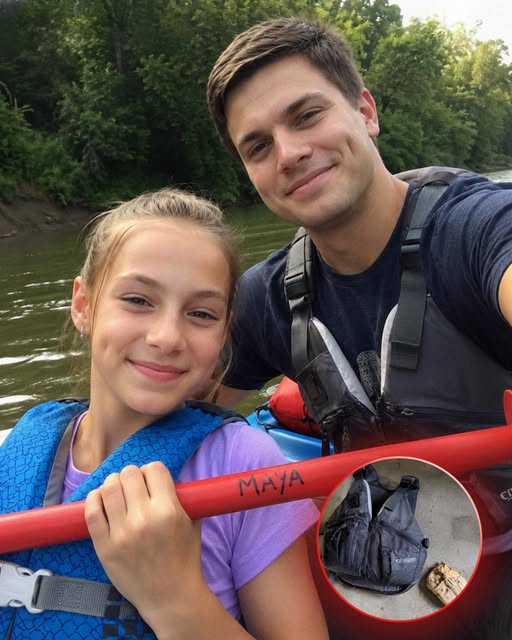
Maya was eleven years old the summer they planned a weekend kayaking trip. It was meant to be a simple day trip along a calm river forty minutes outside town—a route Daniel had navigated a dozen times. Two summers earlier, he had even bought Maya her very own child-sized kayak paddle, painted bright red with her name written along the handle.
They loaded the gear into Daniel’s truck and left at eight o’clock on a sunny Saturday morning.
Daniel returned alone at four o’clock that afternoon.
He was dripping wet, trembling so violently he could barely stand on his own two feet. He stumbled into my living room, his orange life vest still securely buckled across his chest.
“She went under,” Daniel wept, clutching his head in panic. “The current surged near the bend. I tried to reach her, Mom… I dove in again and again. I couldn’t find her.”
The local search and rescue teams scoured the river for two straight weeks. Professional divers, rescue boats, and hundreds of local volunteers walked both banks mile by mile. But despite their exhaustive efforts, they never found Maya.
The police eventual classified the event as a tragic accidental drowning. Investigators interviewed Daniel three separate times, and his account of the event never wavered.
I believed my son completely. In the months following the tragedy, Daniel looked like a man who had spiritually drowned alongside his niece and simply forgotten to stop breathing. He became quiet, withdrawn, and carried a permanent shadow of grief everywhere he went.
For seven long years, Daniel kept that old orange life vest hanging on a wooden peg in his garage. Whenever I visited his house, seeing that vest served as a painful reminder of the darkest day of our lives.
Last Saturday, I drove over to Daniel’s house to drop off fresh vegetables from my garden while he was out at work.
Finding his front door locked, I decided to leave the basket inside his side garage, where it was cool and shaded. As I walked past his workbench in the dim light, my shoulder accidentally brushed against the hanging life vest, knocking it off its wooden peg.
The heavy vest hit the concrete floor with a thud. As it landed, a thick package wrapped in faded canvas and bound with electrical tape slipped out from a hidden slit torn into the internal foam lining of the vest.
Surprised by the heavy object, I knelt down on the cold floor. My hands began to shake as I pulled a pair of shop scissors from his workbench and cut through the tape, slowly unwrapping the canvas layer by layer.
What I found inside made my heart stop. I fell to my knees right there on the concrete, tears pouring down my face as a scream escaped my throat.
Inside the wrapping was not evidence of a crime, but a waterproof container holding Maya’s small red kayak paddle handle, her birth certificate, a stash of emergency cash, and a recent, undated photograph of Maya as an older teenager, sitting smiling on a porch outside a suburban home in another state. Alongside the photo was a handwritten notebook detailing a hidden, unauthorized custody arrangement.
The realization hit me like a physical blow: I had spent seven years living a lie. Maya hadn’t drowned that day. Overwhelmed by deep-seated anxieties after the loss of his sister, and fearing that family court battles or distant relatives might take Maya away from our small family unit, Daniel had staged the accident to quietly hide her away with a trusted former family friend in a remote town, paying for her care under an assumed identity.
My mind raced with a terrifying conflict of emotions—grief, shock, fury, and an overwhelming surge of love knowing my granddaughter was alive.
With trembling fingers, I pulled out my phone, dialed 911, and reported the truth to the authorities.
Within two hours, police cruisers pulled into the driveway. When Daniel returned home from work and saw the open canvas package sitting on his hood, he didn’t run or argue. He simply lowered his head, dropped his keys, and wept in quiet relief that the secret he had carried for seven years was finally out in the open.
The legal fallout was swift and complex, but three days later, social services and local law enforcement facilitated our long-awaited reunion.
When eighteen-year-old Maya walked into the meeting room, tears streaming down her face, she looked so much like her mother that my breath caught. I rushed across the room and pulled her into my arms, holding her tightly for the first time in seven years.
While our family faced a long road of legal accountability and emotional healing, the heavy cloud of tragic loss was finally replaced by the truth—and the chance to rebuild our lives together.